My brain has been shocked by this problem dealing with charges and Coulombs law

Click For Summary

Homework Help Overview

The discussion revolves around a problem involving Coulomb's law and the calculation of forces between charged particles. The original poster expresses confusion regarding their calculations and results related to the forces exerted by two charges.

Discussion Character

  • Exploratory, Assumption checking, Mathematical reasoning

Approaches and Questions Raised

  • Participants discuss the calculations of forces using Coulomb's law, questioning the values used for distance and the correctness of the results. There are attempts to clarify the setup and the implications of the calculations.

Discussion Status

Some participants have provided feedback on specific calculations, suggesting that the original poster re-evaluate certain values and consider the implications of significant figures. There is ongoing exploration of the direction of the resultant force and its representation in the context of the problem.

Contextual Notes

There are mentions of class policies regarding homework help, and the original poster clarifies that this is an online homework assignment rather than a quiz. The discussion includes concerns about potential roundoff errors and the interpretation of angles in relation to force vectors.

riseofphoenix
Messages
294
Reaction score
2
My brain has been shocked by this problem dealing with charges and Coulombs law :(
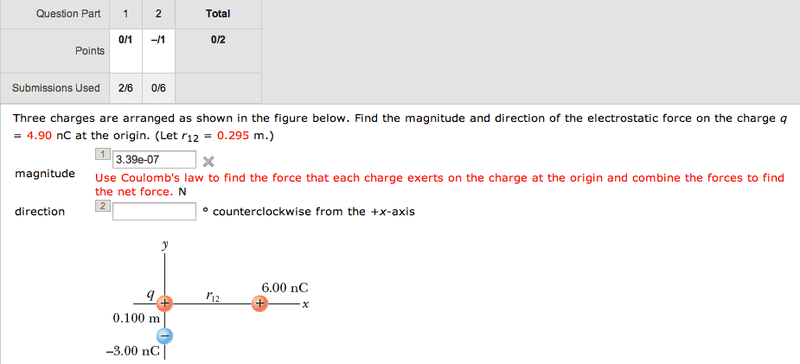
Physics_zps5a4fa021.png


This is what I did...

F = k*q1*q2/r^2
F = [ (8.99 * 10^9)(4.9 * 10-9)(6.0 * 10^-9) ] / (0.295)^2
F = 0.000000264 / 0.087025
F = 0.0000003034
F = 3.034 * 10^-7 N

F = k*q1*q3/r^2
F = [ (8.99 * 10^9)(4.9 * 10-9)(3.0 * 10^-9) ] / (0.295)^2
F = 0.000000132 / 0.087025
F = 0.0000001519
F = 1.519 * 10^-7 N

Resultant: √ (3.034 * 10^-7)^2 + (1.519 * 10^-7)^2 =√ ( 1.1488262 * 10^-13) = 3.39 * 10^-7

I got it wrong though :(

Please help
 
Physics news on Phys.org


This looks like an online quiz. What is the class policy on seeking help vs. working independently for unsupervised quizzes?


Check your value for r in the second calculation.


LastOneStanding said:
This looks like an online quiz. What is the class policy on seeking help vs. working independently for unsupervised quizzes?

This isn't an online quiz. It's an online homework assignment that's been given to my class through Webassign.


ap123 said:
Check your value for r in the second calculation.

Oh!
Ok give me a sec. Imma try to change r in the second equation to 0.100...


F = k*q1*q2/r^2
F = [ (8.99 * 10^9)(4.9 * 10-9)(6.0 * 10^-9) ] / (0.295)^2
F = 0.000000264 / 0.087025
F = 0.0000003034
F = 3.034 * 10^-7 N

F = k*q1*q3/r^2
F = [ (8.99 * 10^9)(4.9 * 10-9)(3.0 * 10^-9) ] / (0.100)^2
F = 0.000000132 / 0.01
F = 0.0000132
F = 1.32 * 10^-5 N

Resultant: √ (3.034 * 10^-7)^2 + (1.32 * 10^-5)^2 =√ ( 1.743 * 10^-10) = 1.32 * 10^-5 (?)"INCORRECT. Your incorrect answer may have resulted from roundoff error. Make sure you keep extra significant figures in intermediate steps of your calculation."

WHAT?


EDIT

F = k*q1*q2/r^2
F = [ (8.99 * 10^9)(4.9 * 10-9)(6.0 * 10^-9) ] / (0.295)^2
F = 0.000000264 / 0.087025
F = 0.000003037 (there was one extra 0 that i took off here)
F = 3.037 * 10^-6 N

F = k*q1*q3/r^2
F = [ (8.99 * 10^9)(4.9 * 10-9)(3.0 * 10^-9) ] / (0.100)^2
F = 0.000000132 / 0.01
F = 0.0000132
F = 1.32 * 10^-5 N

Resultant: √ (3.037 * 10^-6)^2 + (1.32 * 10^-5)^2 =√ ( 1.834 * 10^-10) = 1.35 * 10^-5

Is that the answer?


What about direction?

This is what I did...

arctan(0.0000132/0.000003037) = 77.04

I submitted that answer and I got this -.-

"INCORRECT. Examine the diagram and determine which quadrant contains the angle of the net force."

The answer isn't -77 either. :(


Your force value for the first charge is off by a power of ten. You'd probably be better off sticking with exponential notation than going through fixed point notation; it's too easy to miscount decimal places.

The problem statement says it wants the direction angle measured counterclockwise from the positive x-axis. So a negative value is NOT okay. Sketch the force vectors and the resultant vector and calculate accordingly.
 
  • #10


gneill said:
Your force value for the first charge is off by a power of ten. You'd probably be better off sticking with exponential notation than going through fixed point notation; it's too easy to miscount decimal places.

The problem statement says it wants the direction angle measured counterclockwise from the positive x-axis. So a negative value is NOT okay. Sketch the force vectors and the resultant vector and calculate accordingly.

Oh wait...the answer is -101 according to webassign o.O
Idk how they got that
 
  • #11


Rise...
you can look at the charges and figure out which quadrant the resultant is in,right??
 

Similar threads

Replies
3
Views
2K
Replies
6
Views
9K
  • · Replies 1 ·
Replies
1
Views
3K
  • · Replies 3 ·
Replies
3
Views
2K
Replies
1
Views
2K
  • · Replies 8 ·
Replies
8
Views
4K
  • · Replies 3 ·
Replies
3
Views
7K
  • · Replies 5 ·
Replies
5
Views
8K
Replies
4
Views
2K
  • · Replies 1 ·
Replies
1
Views
6K