Need help manufacturing something with threads. THREAD FAILURE problem.

Click For Summary

Discussion Overview

The discussion revolves around the manufacturing of a threaded rod mechanism intended to deform metal samples until failure occurs. Participants explore the necessary engagement length of the threaded rod to ensure that the failure of the samples can be achieved without compromising the integrity of the mechanism. The scope includes technical reasoning related to material properties, shear stress calculations, and design considerations.

Discussion Character

  • Technical explanation
  • Mathematical reasoning
  • Debate/contested

Main Points Raised

  • One participant notes that the length of engagement is influenced by both the material properties and the shear area of the thread form, suggesting the use of stripping area tables for calculations.
  • Another participant provides a formula for shear stress in relation to force and diameter, indicating a need for precise measurements and calculations.
  • Concerns are raised about the factor of safety being lower than 2, with one participant expressing uncertainty about the average shear strain of steel.
  • A rule of thumb is shared regarding the relationship between ultimate shear stress and ultimate tensile stress for ductile metals, referencing Mohr's Circle for context.
  • There is a request for assistance, indicating that the original poster feels stuck with their research problem.

Areas of Agreement / Disagreement

Participants have not reached a consensus on the specific calculations or methods to use, and multiple viewpoints regarding the factors affecting shear stress and engagement length are present.

Contextual Notes

Participants have not fully identified all forces acting on the threaded mechanism, and there are unresolved questions regarding the average shear strain of steel and the implications of the factor of safety.

Who May Find This Useful

Individuals interested in mechanical engineering, materials science, or those working on research involving threaded mechanisms and material failure may find this discussion relevant.

SlimJ87D
Messages
6
Reaction score
0
hello everyone, this is my first post.

Right now I am trying to figure out which equations to use to solve the following.

I will have a block that will a threaded rod through it. This block will be next to another larger block. In between these blocks are going to be metal samples.

Now here is the cool part, when I turn the thread via gears and such, the block that is engaged with the threaded rod will move and help deform the separate metal samples till failure occurs.

I need to know how much engagement (Le) the block has to have with the threaded rod so failure will not occur.

Some helpful givens:
-I am using steel
-The amount of force needed to break these samples is approximately 300lbs, that is 150 in the opposite directions of the sample.
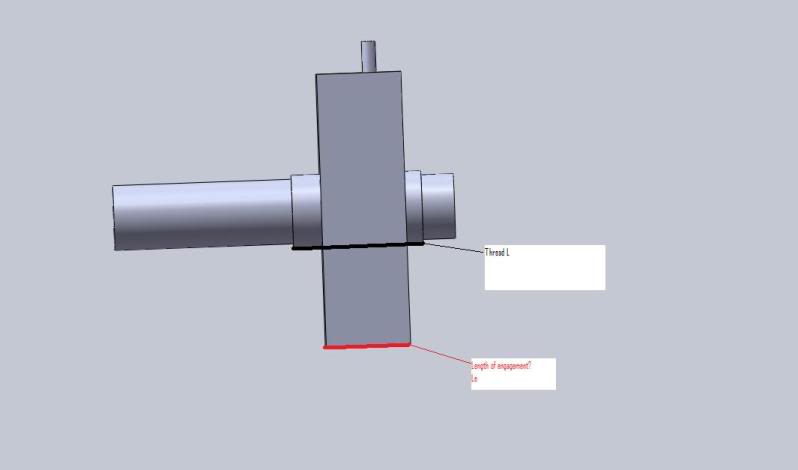
assem2.jpg
 
Engineering news on Phys.org
Length of engagement is based on material (obviously) as well as shear are of the thread form. Most tables list shear stripping area per 1 diameter of length. You can use the 1D stripping area as a starting point to calculate the stripping load over the stripping area and compare to the material allowables for the stresses.

The tough part is really properly identifying ALL of the forces on your thread, i.e. not just the forces due to the load (preload, etc...).
 
Yeah, this is why I decided to use steel.

It is going to be 4o to 80 threads per an inch. The guy asking me to produce this wants it to be very very very precise...

Well the equation I have found from McGraw-Hill's series of ME is

Tao(Shear stress) = [2 * F(force)] / [pi * d(diameter) * Le]

I'm a little rusty at finding the shear stress of steel, I have all I need using poisson's ratio except the shear strain.

Does anyone know the average shear strain of steel?

I can already predict a factor of safety will probably be lower than 2 sadly. But the guy wants it, and it does something pretty simple.

I can even change the diameter if I want to to decrease Le because I am basically controlling every variable via manufacturing.
 
Last edited:
Can anyone help please? I'm stuck with this problem for my research.
 
A rule of thumb for most ductile metals is that ultimate shear stress allowable is 50% of ultimate tensile stress (think of a Mohr's Circle).
 
FredGarvin said:
A rule of thumb for most ductile metals is that ultimate shear stress allowable is 50% of ultimate tensile stress (think of a Mohr's Circle).

Thanks Fred. Right when you said Mohr's circle, I remembered right away.

Seeing that I can't send you a PM Fred, I just wanted to ask you on what you think of going straight to work and then possibly getting a MS, or just going straight for the MS?
 

Similar threads

Replies
2
Views
2K
  • · Replies 7 ·
Replies
7
Views
3K
Replies
3
Views
2K
  • · Replies 9 ·
Replies
9
Views
2K
  • · Replies 7 ·
Replies
7
Views
8K
  • · Replies 9 ·
Replies
9
Views
4K
  • · Replies 4 ·
Replies
4
Views
7K
  • · Replies 169 ·
6
Replies
169
Views
10K
Replies
12
Views
6K
  • · Replies 14 ·
Replies
14
Views
2K