Neutron scattering probability distribution

Click For Summary
SUMMARY

The forum discussion centers on the scattering probability distribution of neutrons in hydrogen gas at finite temperature, as described in Chapter 2-II of Duderstadt & Hamilton's "Nuclear Reactor Analysis." The participants analyze the probability function for elastic scattering collisions, specifically when incident neutron energy equals thermal energy (Ei = kT). They identify discrepancies in the normalization of the probability distribution, with values calculated around 0.84, contrasting with expected results near 0.5. The discussion highlights the potential inaccuracies in the original plots and equations presented in the referenced texts, suggesting a need for further investigation into normalization factors.

PREREQUISITES
  • Understanding of differential scattering cross sections
  • Familiarity with Maxwell-Boltzmann velocity distribution
  • Knowledge of probability distribution functions
  • Basic concepts of neutron physics and thermal equilibrium
NEXT STEPS
  • Investigate the normalization of probability distribution functions in neutron scattering
  • Learn about the derivation of differential scattering cross sections in nuclear physics
  • Review the equations and plots in John Lamarsh's "Nuclear Reactor Theory" for comparison
  • Explore numerical integration techniques for validating theoretical models in neutron physics
USEFUL FOR

Students and professionals in nuclear physics, particularly those focusing on neutron interactions, reactor analysis, and statistical mechanics. This discussion is beneficial for anyone seeking to understand the complexities of neutron scattering and the associated mathematical models.

evceteri
Messages
1
Reaction score
0
Hi, I'm reading Chapter 2-II of of Duderstadt & Hamilton's "Nuclear Reactor analysis". In the section "Differential scattering cross sections with upscattering" it is discussed the situation in which neutrons suffers elastic scattering collisions in a hydrogen gas at finite temperature T and the nuclei are in motion with a Maxwell - Boltzmann velocity distribution.

For this case they cite the scattering probability as given by
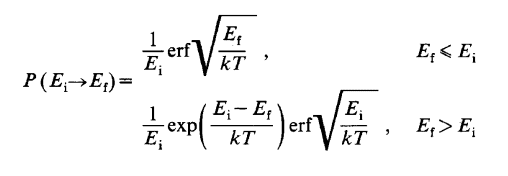
probability.png

where
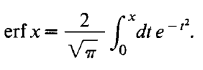
erf.png

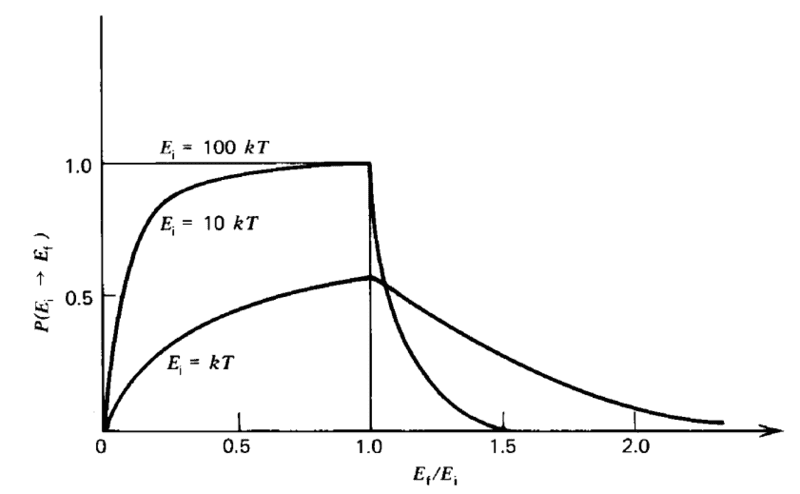
Then they plot the probability distribution for some incident neutron energies:
probabilit2.png


I've been trying to reproduce this plot but I just don't seem to understand how.

So, for example, if ##E_i = kT## and ##E_f/E_i = 1.0 ## then ##E_f = kT## and $$P(E_i \rightarrow E_f) = \frac {1} { kT} erf \sqrt { \frac {kT} {kT}} = \frac {0.84} {kT}$$.

I'm not sure what I'm supposed to do next, as the expected result in the plot is about 0.5. I know ##P(E_i \rightarrow E_f)## is a probability distribution so in order to get rid of the ##kT## I need to integrate but from where to where?

Can you help me figure it out?
 
Engineering news on Phys.org
I don't think it is exact, in that to the best I can tell, the probability function isn't precisely normalized to unity. Perhaps someone else can weigh in and confirm my preliminary assessment here.
## \int\limits_{x_o}^{+\infty} e^{-t^2} \, dt \neq e^{-x_o^2} ##, and it looks like they might have thought that it is. There is also a factor of ##2/\sqrt{\pi} ##, but it still won't normalize properly.
## \int\limits_{x_o}^{+\infty} e^{-t^2} \, dt=\int\limits_{0}^{+\infty} e^{-(t+x_o)^2} \, dt=e^{-x_o^2} \int\limits_{0}^{+\infty} e^{-(t^2+2 x_o t)} \, dt ##. Perhaps they overlooked the ## 2 x_o t ##. If the ## 2 x_o t ## weren't there, I think it might normalize how they wanted it to.
 
Last edited:
Charles Link said:
I don't think it is exact, in that to the best I can tell, the probability function isn't precisely normalized to unity. Perhaps someone else can weigh in and confirm my preliminary assessment here.
I had a similar thought. I was wondering if the equations are correct in DH. They are also found in John Lamarsh's Nuclear Reactor Theory. We had to derive the equations. As far as I remember, the plots are correct. When Ei >> kT, i.e., the neutrons have much greater energy than the hydrogenous material, there is no upscatter. Upscattering occurs as the neutron energy approaches thermal equilibrium with the hydrogen.

The value 0.84 is about a factor of 1/ln2 * 0.58, which is about the value where Ei = kT.

I'd have to find my copies of Lamarsh and DH to compare the developments of the equations.
 
  • Like
Likes   Reactions: Charles Link
@PeroK Might you take a look at the above formulas and see if you concur with my assessment. Thanks. :)
 
Similar equations and a figure with a little more resolution are given in Lamarsh, "Nuclear Reactor Theory", on page 243. In the Lamarsh figure, the intercept looks to be about 0.51.

If you look at the graph for 100*kT, you can see that it makes a box about 1x1, which is the correct normalization for a probability distribution function. Therefore, I am assuming that both the x-axis and y-axis are divided by Ei. The x-axis is marked correctly, but the y-axis is not.

A plot of the results I get is shown below. I added an additional line at 0.5*kT. I can't explain why the intercept in the books is about 0.51 and the intercept we are getting is 0.84 (corresponding to erf(1)).

I looked at the references given by Duderstadt and Hamilton, but they do not have a graph in this form.
scat_lamarsh_243.png
 
After a little more investigation, the equations and a similar plot are in Bell and Glasstone, "Nuclear Reactor Theory", 1970. The plot is Figure 7.5 on page 336 and the equations are (7.31) and (7.32) on page 337. The plot in Bell and Glasstone indicates a value close to 0.84 when Ei=Ef=kT.

Bell and Glasstone reference Beckurts and Wirtz "Neutron Physics", 1964. This book has similar equations and a the plot shown below. This plot indicates a value of 0.84 when Ei=Ef=kT.

energy-transfer-beckurts-wirtz.png


In conclusion, I believe the figure in Duderstadt and Hamilton is not very precise and the correct intercept should be erf(1). (You have to remember that plots generated in the 60's and early 70's were usually drawn by hand, and may not be as precise as we expect today.)
 
  • Like
Likes   Reactions: Charles Link and Astronuc
I still have no success at showing the probability function is normalized to unity. I can't show or prove it to be incorrect, but I also haven't been able to show or prove that it is normalized to unity.
 
I agree. I tried to integrate it numerically, but it doesn't appear to be normalized to unity.
Here are the approximate sums I calculate with different values of Ei
10kT 1.05
2kT 1.247
1kT 1.471

Now I'm wondering if the equations are missing a normalization factor, and the Duderstadt plot includes a "fixed" normalization factor?
 
  • Like
Likes   Reactions: Astronuc and Charles Link
Very interesting @rpp . Perhaps I was spending a lot of time trying to prove two things equal that simply aren't. Kind of pathetic if multiple textbook authors have propagated the same error, so it would be good to have a definitive answer on this. I had no success proving them to be not equal algebraically,(i.e. the two areas/integrals in question ), but if a numerical integration shows they are far from equal, that is sufficient.
 
Last edited:

Similar threads

Replies
1
Views
671
  • · Replies 4 ·
Replies
4
Views
3K
  • · Replies 4 ·
Replies
4
Views
3K
  • · Replies 15 ·
Replies
15
Views
4K
  • · Replies 4 ·
Replies
4
Views
2K
  • · Replies 4 ·
Replies
4
Views
5K
  • · Replies 1 ·
Replies
1
Views
1K
  • · Replies 5 ·
Replies
5
Views
712
  • · Replies 1 ·
Replies
1
Views
2K
  • · Replies 24 ·
Replies
24
Views
2K