No Limits of Integration for Electric Field Integral?

Join the discussion
Registration is free. Ask a follow-up in this thread, or start your own.
5 replies · 2K views
member 731016
Homework Statement
This is a more concise version of my 'Electric Field of a Uniform Ring of Charge' thread that I posted yesterday and made a typo.
Relevant Equations
Continuous charge distribution formula
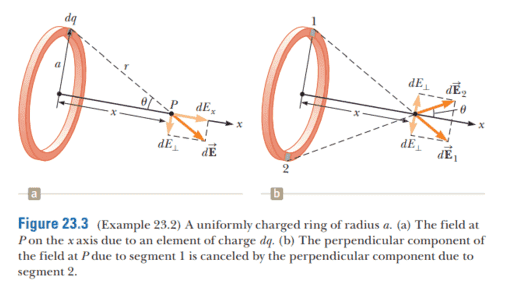
For this problem,

s7y2w.png
uCKQS.png


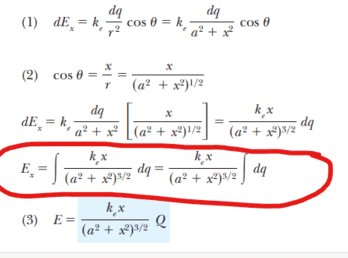
The solution is,

ok160.png


However, why have they not included limits of integration? I think this is because all the small charge elements dq across the ring add up to Q.

However, how would you solve this problem with limits of integration?

Many thanks!
 
Physics news on Phys.org
You can assume a uniform linear charge density on the ring, ##\lambda=\dfrac{Q}{2\pi a}.## Then an arc element ##ds## at polar angle ##\phi## in the plane of the ring subtends angle ##d\phi## so that ##ds=a d\phi##. The charge on that element is ##dq=\lambda ds=\lambda a d\phi## so that when you integrate going around the ring once, you have $$\int dq=\int_0^{2\pi}\lambda a d\phi=2\pi a\lambda=2\pi a\frac{Q}{2\pi a}=Q$$Does this answer your question?
 
Reply
  • Like
Likes   Reactions: member 731016
kuruman said:
You can assume a uniform linear charge density on the ring, ##\lambda=\dfrac{Q}{2\pi a}.## Then an arc element ##ds## at polar angle ##\phi## in the plane of the ring subtends angle ##d\phi## so that ##ds=a d\phi##. The charge on that element is ##dq=\lambda ds=\lambda a d\phi## so that when you integrate going around the ring once, you have $$\int dq=\int_0^{2\pi}\lambda a d\phi=2\pi a\lambda=2\pi a\frac{Q}{2\pi a}=Q$$Does this answer your question?
Thanks for your answer @kuruman, I think that answers my question for now!
 
kuruman said:
You can assume a uniform linear charge density on the ring, ##\lambda=\dfrac{Q}{2\pi a}.## Then an arc element ##ds## at polar angle ##\phi## in the plane of the ring subtends angle ##d\phi## so that ##ds=a d\phi##. The charge on that element is ##dq=\lambda ds=\lambda a d\phi## so that when you integrate going around the ring once, you have $$\int dq=\int_0^{2\pi}\lambda a d\phi=2\pi a\lambda=2\pi a\frac{Q}{2\pi a}=Q$$Does this answer your question?
Sorry @kuruman, why are you allowed to use the linear charge density, because doesn't the ring have a width too?

Are you assuming that x >> width, so the width is negligible?

Many thanks!
 
Callumnc1 said:
Sorry @kuruman, why are you allowed to use the linear charge density, because doesn't the ring have a width too?
No, it does not have a width because the calculation assumes that it is a "thin" ring which means zero width. If it has a width, say it is a washer of inner radius ##a## and outer radius ##b##, then you have to do a different calculation and also integrate over ##r## from ##a## to ##b##. That's a different homework problem.
 
Last edited:
Reply
  • Like
Likes   Reactions: cwill53 and member 731016