Node analysis problem: 2 Current Sources and 3 Resistors

6 replies · 2K views · last reply
Gunther_Guss
Messages
4
Reaction score
0
Homework Statement
Please, help me to find the value of V1, V2, I1 and I2.
Relevant Equations
i have my own answers but i need to confirm wether my answers are correct or not. Thanks.
-
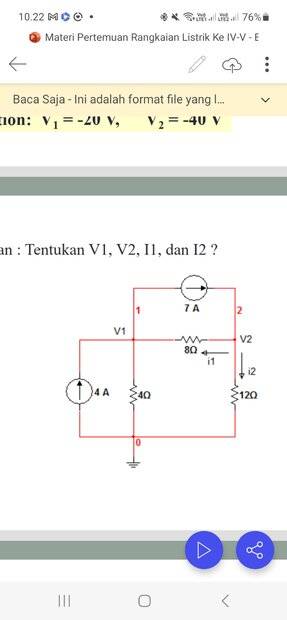
Circuit schematic with nodes 0, 1 and 2 and node voltages V1 and V2: a 7 A current source between nodes 1 and 2, a 4 A current source on the left, resistors of 4 Ω, 8 Ω and 12 Ω, with currents I1 and I2 marked.
 
Last edited by a moderator:
Gunther_Guss said:
i have my own answers but i need to confirm wether my answers are correct or not. Thanks.
On the homework forum, before we can help, you need to show your work and the answers you got.
 
renormalize said:
On the homework forum, before we can help, you need to show your work and the answers you got.
Alright, how about this ? is this correct ?
Handwritten node analysis solution: two nodal equations solved by elimination giving V1 = 4 V and V2 = 36 V, then currents I1 = 4 A and I2 = 3 A, with the final results listed below.
 
Last edited by a moderator:
Welcome to PF.

Gunther_Guss said:
Alright, how about this ? is this correct ?
In future posts, please type your work into the forum so that it is easier to read. I'll try to check your work later today unless somebody else beats me to it.

I will also send you a private message (PM) with some tips on how to use LaTeX to type math into PF. That is the best way to show your work. :smile:
 
Gunther_Guss said:
Alright, how about this ? is this correct ?View attachment 332471
Haven't checked the detailed working but the initial equations look correct and your final values satisfy the equations. So it looks good.

If you haven't already done so, remember you can (should!) check your working by seeing if the final values satisfy the original equations.
 
  • Like
Likes   Reactions: DeBangis21, renormalize, FactChecker and 1 other person
Your answers are correct, but I didn't review your method.

If you continue to study EE, you will learn about the Norton and Thevenin source transformations which make this kind of problem really pretty simple. Below is a picture of my solution notes which don't require any equations beyond simple arithmetic. They aren't meant to be understandable, just an example of how practicing analog EEs would solve this (realtime unedited notes).

Handwritten circuit analysis notes showing a source transformation: a current source and resistors are converted to a voltage source in series with resistors, leading to node voltages V2 = 36 V, I2 = 3 A, I1 = 4 A, and V1 = 4(4 - 7 + 4) = 4 V.
 
BTW, you'll need to get used to routinely verifying your own solutions at the end of each engineering problem you solve. That is part of the job. Out in the real world you will get fired if you constantly ask your boss to check your calculations, that's why he hired you, he has his own work to do. You will also get fired if your products don't work because you made mistakes you didn't correct. All of us make mistakes, it's not realistic to expect not to. But when you do make a mistake, you need to be the one that spots it and fixes it.