Non Inverting Amplifier Currents

  • Thread starter Thread starter dsdsuster
  • Start date Start date
  • Tags Tags
    Amplifier Currents
Click For Summary
SUMMARY

The discussion centers on the behavior of currents in a non-inverting amplifier configuration. It is established that the input current is ideally 0 A due to the high input impedance of the amplifier. The current flowing into ground is calculated as Vin/R1, where R1 is the resistor connected to ground. The current does not originate from the battery supplying Vin, nor does it return to the battery, as the amplifier draws power from a separate DC power supply, preventing any charge buildup in the battery.

PREREQUISITES
  • Understanding of non-inverting amplifier configurations
  • Familiarity with Ohm's Law and current calculations
  • Knowledge of high impedance input characteristics
  • Basic concepts of DC power supply in electronic circuits
NEXT STEPS
  • Study the principles of operational amplifier configurations
  • Learn about high impedance input and its implications in circuit design
  • Explore the role of DC power supplies in amplifier circuits
  • Investigate current flow in various amplifier types, including inverting and non-inverting amplifiers
USEFUL FOR

Electronics students, circuit designers, and engineers interested in understanding operational amplifier behavior and current flow in amplifier circuits.

dsdsuster
Messages
30
Reaction score
0
I'm confused by the fact that for the typical non-inverting amplifier,
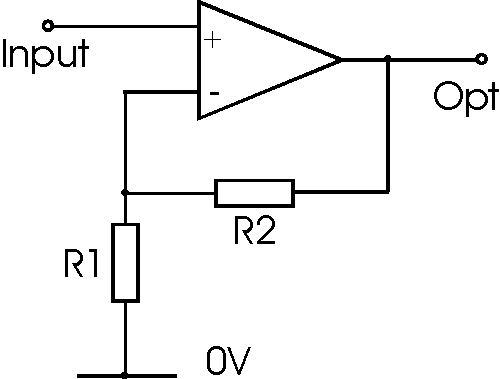
op-amp_basic_non_inv.gif


(1) The input current is ideally 0 A.
but
(2) The current going into ground is given by Vin/R1 where R1 is the resistor above ground.

If Vin were provided by a battery for example, which has Voltage=0V on one side and Vin on the other doesn't this imply that the current isn't steady and charge is building up inside the battery?

Thanks!
 
Physics news on Phys.org
The amplifier will draw the corresponding current from its power supply, which is not part of that sketch. No relevant charges are built up.
 
The current through R1 has not come from the battery, and is not going to the battery. The amplifier input is high impedance, so practically no current is drawn from the battery, as you stated.

As mfb indicated, current through the circuit components comes from/goes to the DC power supply powering the circuit (not marked in your schematic because everyone knows it's there anyway). :smile:
 

Similar threads

Replies
2
Views
3K
  • · Replies 6 ·
Replies
6
Views
3K
Replies
15
Views
3K
  • · Replies 16 ·
Replies
16
Views
4K
  • · Replies 5 ·
Replies
5
Views
5K
  • · Replies 4 ·
Replies
4
Views
3K
  • · Replies 13 ·
Replies
13
Views
3K
  • · Replies 3 ·
Replies
3
Views
2K
  • · Replies 6 ·
Replies
6
Views
3K
  • · Replies 21 ·
Replies
21
Views
3K