Impedance seen by input of inverting amplifier

Click For Summary

Discussion Overview

The discussion centers around the impedance seen by the inverting input of an inverting amplifier, particularly in the context of understanding how this impedance relates to the feedback resistors R1 and R2. Participants explore the implications of this impedance in relation to input bias currents and offset voltages, as well as the application of Thevenin equivalents in circuit analysis.

Discussion Character

  • Technical explanation
  • Conceptual clarification
  • Debate/contested
  • Mathematical reasoning

Main Points Raised

  • Some participants assert that the impedance seen by the inverting input is the parallel combination of the feedback resistors R1 and R2, while others express confusion about this interpretation.
  • One participant mentions the concept of 'virtual ground' at the inverting input due to the non-inverting input being grounded, suggesting that this condition influences the impedance seen.
  • Another participant challenges the characterization of R1 as a feedback resistor, indicating a potential misunderstanding in terminology.
  • Concerns are raised about the validity of using a voltage divider approach to analyze the circuit, with some participants questioning whether it is appropriate to assume Vout is zero when determining equivalent resistance.
  • Discussion includes the role of input bias currents and how adding a resistor from the non-inverting input to ground may help eliminate offset voltages caused by these currents.
  • Some participants propose that when analyzing the circuit, one should consider the resistances to ground from the inverting terminal, including the infinite impedance of the op-amp's input.

Areas of Agreement / Disagreement

Participants express varying levels of understanding regarding the impedance seen by the inverting input, with some agreeing on the parallel resistor model while others remain uncertain or contest this view. The discussion does not reach a consensus on the best approach to analyze the circuit or the implications of input bias currents.

Contextual Notes

Limitations include potential misunderstandings of terminology, assumptions about circuit conditions (such as Vout being zero), and the complexity of analyzing the effects of input bias currents on offset voltages.

dsdsuster
Messages
30
Reaction score
0
Hi,

The book I'm reading references the fact that the impedance seen by the inverting input of an inverting amplifier is just the two feed back resistors, R1 and R2 in parallel.
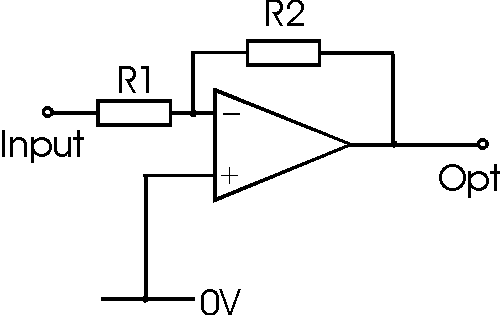
op-amp_basic_inv.gif

I'm having trouble seeing this. I understand how the basic voltage divider with one end at Vin and the other at ground can be replaced by its Thevenin equivalent but in this case it seems like the tail of R2 is connected just to some arbitrary output terminal. In fact ground is actually connected to the non-inverting input and it seems to me there's no easy way to create a Thevenin equivalent of the driving source without examining the opamp's innards.

The book goes as far as to redraw the inverting amplifier with the Input voltage in series with (R1,R2 parallel) connected to the inverting terminal with nothing connected to the opamp output so we are essentially have open loop gain. Surely this cannot be equivalent? To give some context, we are looking at the effects of input biasing currents so the Input voltage is grounded. I apologize if this last paragraph is confusing since I can't supply a picture.

My main question is just in what sense is it true that the impedance seen by the inverting input of an inverting amplifier is just the two feed back resistors, R1 and R2 in parallel? I'm struggling to reconcile this with my understanding of the more traditional voltage divider.

Thank you
 
Physics news on Phys.org
The inverting input is a 'virtual ground' due to the fact the non-inverting input is tied to ground. The inverted feedback signal nulls the input at the - input terminal as the output voltage changes to the level needed to maintain zero volts at the - terminal.

Maybe this can help. http://electriciantraining.tpub.com/14180/css/14180_107.htm

In fact, with the noninverting input grounded, the voltage at the inverting input to the operational amplifier is so small compared to other voltages in the circuit that it is considered to be VIRTUAL GROUND. (Remember, in a closed-loop operation the inverting and noninverting inputs are at the same potential.)
 
dsdsuster said:
The book I'm reading references the fact that the impedance seen by the inverting input of an inverting amplifier is just the two feed back resistors, R1 and R2 in parallel.
You are probably reading this in the context of DC off-sets, and being told that for optimum results, the OP-AMP's (+) input should be returned to ground via a resistor equal to the resistance seen by the (-) input of the OP-AMP. As always, to find the Thévenin impedance you short out the voltage sources, in this case Vin and Vout, and you are left with two resistors in parallel.

BTW, R1 is not a "feedback resistor". :approve:
 
Thank you guys for the replies.

Nascent Oxygen- The scenario you're describing is what I'm trying to do, setting the resistance the (-) terminal sees equal to what the (+) sees. I'm still having trouble seeing how this is related to a voltage divider though and finding the equivalent resistance (+) sees. I'm hoping you can spell things out a bit more for me.

Edit: Or actually I guess I can see where you get R1 and R2 in parallel from, by shorting (+) and ground. *Is this a fair assumption to make though, since we are trying to find the resistance at the (-) terminal to make Vout 0? *Aren't we assuming Vout is 0 before showing it is 0 by doing this?

Also how exactly will this eliminate the offset dc voltage caused by input bias current?
 
Last edited:
The input impedance of your circuit is R1 unless the amplifier output is saturated.

Adding a resistor from the + input to ground eliminates (in theory) output offset voltage due to input bias (not offset) currents. Input offset current = i02 - i01 where i01 and i02 are the bias currents flowing into each op amp input. Bias current = (i01 + i02)/2. You can eliminate bias current output voltage offset but not offset current output voltage offset.

To understand how a resistor from the + input to ground = R1||R2 eliminates bias current output voltage offset, label the - and + inputs as e1 and e2 respectively. Ground the R1 input and e2 and draw currents i0 flowing into the + and - inputs. Write nodal equations to compute the output Eo. Remember that e1 = e2 (no input offset voltage assumed). You should get Eo = + i0*R2.

Then put a resistor at the + input to ground = R1||R2. Now e2 = -i0*(R1||R2). Recompute your output Eo remembering that e1 = e2. You should get Eo = 0V.
 
  • Like
Likes   Reactions: 1 person
dsdsuster said:
Nascent Oxygen- The scenario you're describing is what I'm trying to do, setting the resistance the (-) terminal sees equal to what the (+) sees. I'm still having trouble seeing how this is related to a voltage divider though and finding the equivalent resistance (+) sees. I'm hoping you can spell things out a bit more for me.
It has nothing to do with a potential divider. Set all voltage sources to 0V, position yourself at the (-) terminal of the OP-AMP, and you see 3 resistances to ground all in parallel: R1 to ground, R2 to ground, and the infinite impedance of the OP-AMP's (-) input.

Also how exactly will this eliminate the offset dc voltage caused by input bias current?
I'd say rude man has explained this better than I could. It makes identical the impedances of the circuits feeding the input transistors forming the differential input of the OP-AMP block.
 

Similar threads

  • · Replies 4 ·
Replies
4
Views
3K
Replies
15
Views
3K
Replies
2
Views
3K
  • · Replies 5 ·
Replies
5
Views
2K
  • · Replies 6 ·
Replies
6
Views
3K
  • · Replies 1 ·
Replies
1
Views
4K
  • · Replies 1 ·
Replies
1
Views
2K
  • · Replies 3 ·
Replies
3
Views
2K
Replies
33
Views
6K
  • · Replies 7 ·
Replies
7
Views
2K