How would I draw this non-inverting amplifier?

  • Thread starter Thread starter marcadams267
  • Start date Start date
  • Tags Tags
    Amplifier
Click For Summary

Discussion Overview

The discussion revolves around the design and visualization of a non-inverting amplifier circuit using operational amplifiers, focusing on practical considerations such as input bias current, offset current, and resistor values for achieving a specific gain. Participants explore the implications of these factors on circuit design and performance.

Discussion Character

  • Technical explanation
  • Debate/contested

Main Points Raised

  • One participant expresses confusion about visualizing a practical op-amp circuit and questions the calculation of resistor values for a gain of 10.
  • Another participant suggests using resistor values of 91k and 10k as a closer approximation to achieve the desired gain using E24 preferred numbers.
  • A participant emphasizes the need to match the source impedance of the non-inverting and inverting inputs to avoid offset voltage due to input currents, proposing a specific resistor configuration.
  • Concerns are raised about the omission of offset current in previous posts, with participants debating whether it should be depicted as part of the bias current or as a separate current source.
  • Another participant questions the assumptions about the direction of bias currents at the inputs, suggesting a model that generates identical bias currents with a sinusoidal offset current.

Areas of Agreement / Disagreement

Participants do not reach a consensus on how to depict the offset current in the circuit diagram, with differing opinions on its importance and representation. There is also disagreement regarding the implications of bias current on the circuit's performance.

Contextual Notes

Participants acknowledge the complexity of accurately representing the offset current and its effects on the circuit, indicating that assumptions about bias currents and their behavior may influence the design choices discussed.

marcadams267
Messages
19
Reaction score
1
Summary: So far, I have only dealt with ideal operational amplifiers, so I am kind of lost trying to visualize how a practical op amp should look like.

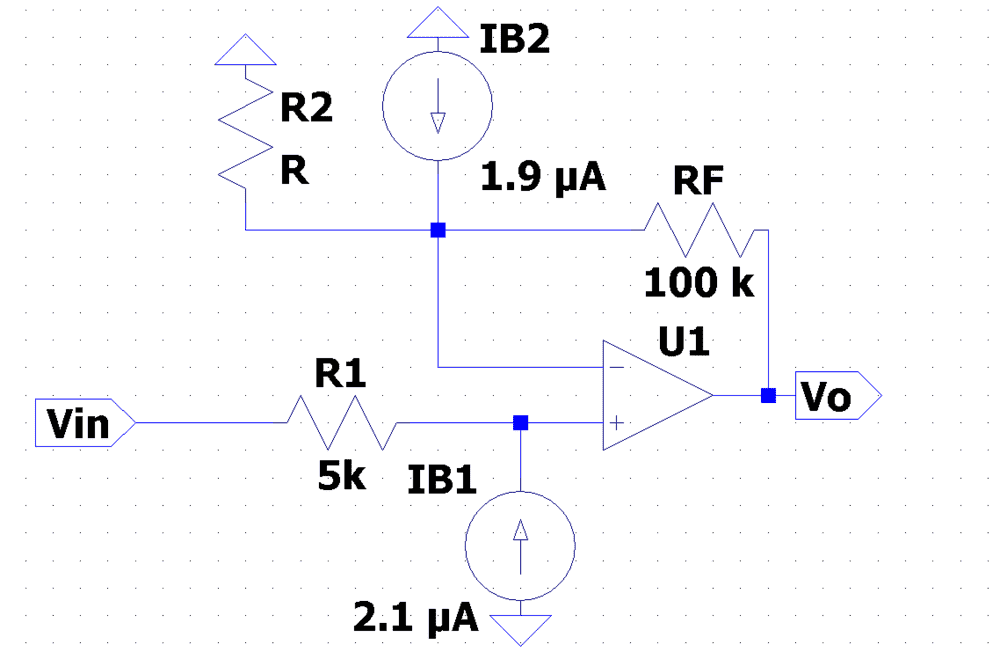
A non-inverting amplifier with a gain of 10 uses 100K as its feedback resistor. It gets its input from a signal source whose source resistance is 5K. The amplifier has zero offset voltage. However, it has an input bias current of 2 µA and an input offset current of 0.2 µA.
Draw the op-amp circuit.

Is this right?
Also, is R2 = 11.11k? I used A = 1 + RF/R2 to get this value
circuit.png
 
Physics news on Phys.org
Seems no issues with equivalent circuit schematic above.
Regarding G=10 non-inverting opamp, i prefer to use 91k and 10k, these values are closest approximation to G=10 using E24 preferred numbers series.
 
You have significant input current so you need to match the source impedance of the (–) and (+) inputs. The op-amp output can be seen as having a low impedance.
So with Rf = 100k, and R = 11k11, the source impedance on the (–) input will be Rf in parallel with
R, giving 10k0. To avoid offset voltage due to input currents you need to give the (+) input the same source impedance as the (–) input. The driver has Rsource = 5k0 now, so you need to add an external Rspecial = 5k in series to match the (–) input.

Draw your potential divider so it is obviously a potential divider by keeping the current flowing in a straight line.
Don't make a hedgehog with currents radiating out from the op-amp, keep parallel currents parallel.

gainx10.png
 
Post 2 is not showing the offset current.
 
rude man said:
Post 2 is not showing the offset current.
Or post #3? The offset current was left for later. I judged that matching the source resistance was more important and enough for a first step.
I expected @marcadams267 to have noticed the missing offset current from the way it was drawn. Maybe Ios needs to be drawn as a separate current source between the two input terminals.
 
Baluncore said:
Or post #3? The offset current was left for later. I judged that matching the source resistance was more important and enough for a first step.
I expected @marcadams267 to have noticed the missing offset current from the way it was drawn. Maybe Ios needs to be drawn as a separate current source between the two input terminals.
I couldn't see post#2 until now.
Offset current should be depicted exactly as the OP did in post 1, i.e. as part of bias current.
 
rude man said:
Offset current should be depicted exactly as the OP did in post 1, i.e. as part of bias current.
Then how can you know that the inverting input would be 1.9 uA and the non-inv input 2.1 uA? Could it not be the other way about?

A model should generate two identical 2u0 bias currents, with a sinusoidal offset current of 1u0 between the two inputs. With zero amplifier input that offset would show up on the output of the amplifier, revealing the sensitivity to the Ios max = 2u0 A.
Supply voltage and temperature dependence of bias current can be applied to the two identical current sources. Sweeping the offset current of the model is then independent of the bias.
 
  • Like
Likes   Reactions: Tom.G

Similar threads

Replies
15
Views
3K
Replies
34
Views
4K
  • · Replies 4 ·
Replies
4
Views
3K
  • · Replies 7 ·
Replies
7
Views
2K
  • · Replies 3 ·
Replies
3
Views
2K
  • · Replies 13 ·
Replies
13
Views
2K
Replies
2
Views
3K
  • · Replies 21 ·
Replies
21
Views
3K
  • · Replies 5 ·
Replies
5
Views
5K
  • · Replies 3 ·
Replies
3
Views
2K