Normal vector of curved surface

Click For Summary

Homework Help Overview

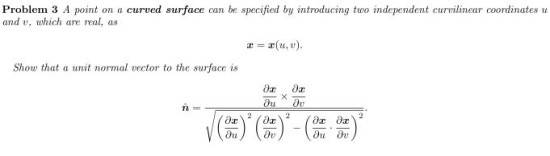
The discussion revolves around understanding the normal vector of a curved surface, particularly in the context of using parameters to describe surfaces in three-dimensional space.

Discussion Character

  • Exploratory, Conceptual clarification, Mathematical reasoning

Approaches and Questions Raised

  • Participants express difficulty in mathematically proving concepts related to normal vectors and the use of parameters. Questions arise about the relationship between cross products, tangent vectors, and the dimensionality of parametrization. Some participants seek clarification on how two parameters can describe a surface in three dimensions.

Discussion Status

Participants are engaging with each other's insights, with some guidance being offered regarding the relationships between tangent vectors, cross products, and angles. There is an ongoing exploration of concepts without a clear consensus or resolution yet.

Contextual Notes

Some participants mention the forum rules that require demonstrating effort before receiving help, indicating a structured approach to the discussion. There are also references to specific mathematical concepts such as partial derivatives and dot products, which are under examination.

Flotensia
Messages
15
Reaction score
0

Homework Statement


2-3.JPG


Homework Equations

The Attempt at a Solution


I can understand it intuitively, but can't prove mathematically...Can you help me??
 
Physics news on Phys.org
Flotensia said:

Homework Statement


2-3.JPG


Homework Equations

The Attempt at a Solution


I can understand it intuitively, but can't prove mathematically...Can you help me??

PF rules forbid us from offering help until you have demonstrated an effort and shown your work.
 
I'm so sorry. It was my first time to write in this forum. I know that cross product makes perpendicular vectors. But in this problem, I don't understand how we explain three dimension by using two parameter, u and v. I searched in internet and thought it is related to gradient. Is it right?
 
Flotensia said:
I'm so sorry. It was my first time to write in this forum. I know that cross product makes perpendicular vectors. But in this problem, I don't understand how we explain three dimension by using two parameter, u and v. I searched in internet and thought it is related to gradient. Is it right?

If you use 3 parameters to parametrize a region of space in ℝ3, what you get is a region covering some volume.
However, if you only use 2 parameters to parametrize a region of space in ℝ3, you get a "2D" curved surface located in that 3D space.
 
Ahh, I got what 2 parameters mean. Thanks. then could you help me more to solve that problem??
 
Flotensia said:
Ahh, I got what 2 parameters mean. Thanks. then could you help me more to solve that problem??

You know that the partial derivatives are tangent vectors, right? And you know that the cross product is orthogonal to the two vectors, I hope. And dot products are related to cosines of the included angle and cross products are related to sine? Put all of those ingredients together.
 
I can explain that in word and can image in mind, but i can't in numerical expression... That's my problem...
 
Flotensia said:
I can explain that in word and can image in mind, but i can't in numerical expression... That's my problem...

Look at the denominator in terms of the included angle ##\theta##. Use ##1-\cos^2(\theta)=\sin^2(\theta)##. Now does that help?
 
I was so silly. It helps me a lot. Thanks for your help!
 
  • #10
Flotensia said:
I was so silly. It helps me a lot. Thanks for your help!

A nudge is a good as a wink. And you are welcome!
 

Similar threads

Replies
4
Views
2K
Replies
2
Views
2K
  • · Replies 4 ·
Replies
4
Views
2K
  • · Replies 3 ·
Replies
3
Views
5K
Replies
4
Views
8K
  • · Replies 3 ·
Replies
3
Views
2K
  • · Replies 85 ·
3
Replies
85
Views
10K
  • · Replies 5 ·
Replies
5
Views
2K
Replies
2
Views
2K
Replies
14
Views
3K