penroseandpaper
- 21
- 0
- Homework Statement
- For a sine function, draw an odd and even extension to six pi (+-) when it is initially defined over an interval of two pi.
- Relevant Equations
- Sine curve
Hi everyone,
We've been looking at Fourier series and related topics in online class, touching upon odd and even periodic extensions. However, we haven't looked at what this translates to for sine and cosine functions - only sawtooth and line examples. So, I'm trying to do my own investigation.
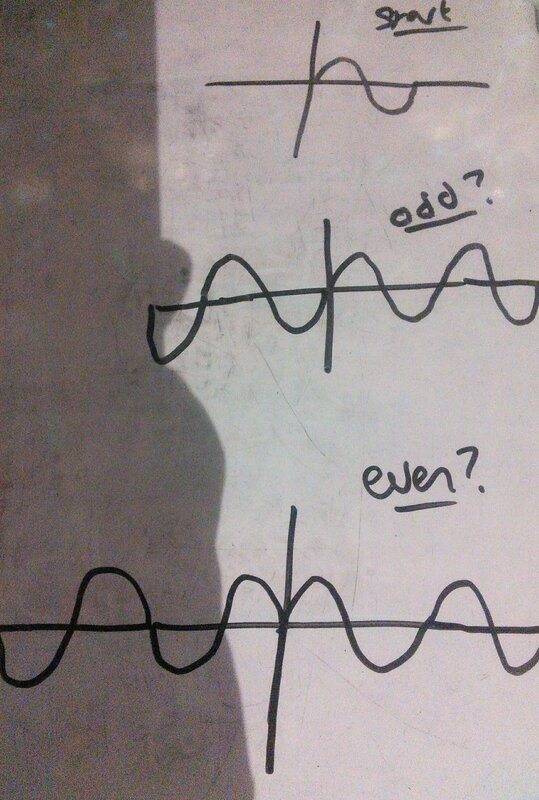
If we have a sine function defined over a period of 2 pi (such that it sits half above the X axis and half below - starting at the origin), how do we draw its odd and even extension to +-6 pi?
As it's an odd function itself, does its odd extension simply look like the sine curve carried on as normal?
And for the even extension, I did reflect it in the y axis, but can't see how to carry the plot on to find its final period as the shape at the y-axis doesn't seem to repeat?
I've attached an image of my thoughts on its shape below, but understand I haven't drawn them to the right extension of +- six pi - thought that would take too much space. Any advice is greatly appreciated on where I've gone astray.
Penn :)
We've been looking at Fourier series and related topics in online class, touching upon odd and even periodic extensions. However, we haven't looked at what this translates to for sine and cosine functions - only sawtooth and line examples. So, I'm trying to do my own investigation.
If we have a sine function defined over a period of 2 pi (such that it sits half above the X axis and half below - starting at the origin), how do we draw its odd and even extension to +-6 pi?
As it's an odd function itself, does its odd extension simply look like the sine curve carried on as normal?
And for the even extension, I did reflect it in the y axis, but can't see how to carry the plot on to find its final period as the shape at the y-axis doesn't seem to repeat?
I've attached an image of my thoughts on its shape below, but understand I haven't drawn them to the right extension of +- six pi - thought that would take too much space. Any advice is greatly appreciated on where I've gone astray.
Penn :)