Discussion Overview
The discussion revolves around the behavior of electromagnetic waves, particularly radio waves, when encountering objects of varying sizes relative to the wavelength. Participants explore concepts of diffraction, scattering, and the effects of polarization on wave interaction with objects, including both conductive and non-conductive materials.
Discussion Character
- Exploratory
- Debate/contested
- Technical explanation
Main Points Raised
- One participant claims that when electromagnetic waves meet an object smaller than the wavelength, they pass around it as if it does not exist.
- Another participant argues that this claim is false, stating that the wave would scatter, referencing Rayleigh scattering as a mechanism.
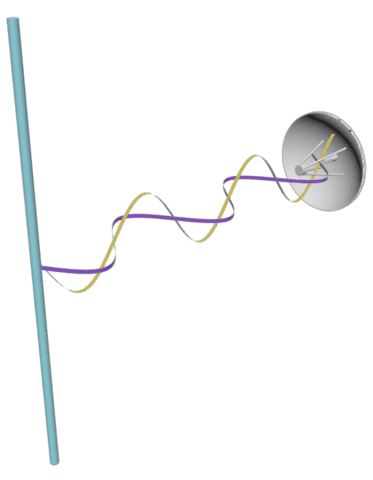
- It is suggested that the effect of a cylinder on a passing wave depends on the polarization of the electric field; if the field is parallel to the cylinder, scattering can be significant.
- A participant questions the visibility of objects smaller than the wavelength in optical microscopes, linking it to the discussion of wave behavior.
- Concerns are raised about the interaction of waves with objects of varying sizes, with one participant noting that when the object size is comparable to the wavelength, interaction must be considered.
- Another participant mentions that a conductor of any size will have some effect on an incident wave, implying that diffraction occurs regardless of the object's size.
- Questions are posed about the criteria for wave behavior in relation to object size, with a participant outlining three criteria based on the size of the object relative to the wavelength.
- One participant highlights that imaging techniques exist to visualize sub-wavelength objects, differentiating between wave propagation and imaging capabilities.
Areas of Agreement / Disagreement
Participants express disagreement regarding the initial claim about wave behavior around subwavelength objects, with some asserting that scattering occurs while others maintain the original assertion. The discussion remains unresolved with multiple competing views on the effects of object size and polarization on wave interaction.
Contextual Notes
Participants reference various scattering mechanisms and imaging techniques, indicating limitations in understanding wave behavior in different contexts. The discussion includes assumptions about the nature of materials (conductors vs. insulators) and the conditions under which diffraction and scattering are significant.