RoyalewithCh33s3
- 15
- 0
Hello everyone, I'm sorry if a question like this has been posted before, but I am trying to get my online work done for tonight and I have come across two problems that I just can't get past. I have gotten far into the problems but the website I enter values in on says theyre wrong. I appreciate any help I can get.
Question 1:
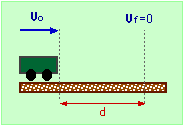
On a level road with its brakes on, the shortest distance in which a car traveling with 98 km/hr can stop is 92 m. The shortest stopping distance occurs when the driver uses anti-lock brakes, which means that the car brakes without skidding.
I found |a| to be: 4.027 m/s^2
Next it asks for b) What is the coefficient of static friction between the tires and the pavement?
I looked up the coefficient of friction for concrete and rubber and it says 1. Now when I put that in it says it's wrong. I was wondering how its possible to figure out a problem like this with no value for mass.
Question 2:
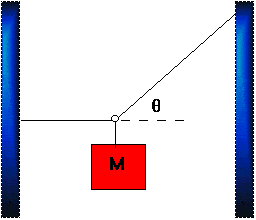
A block of mass M = 15 kg is suspended at rest by two strings attached to walls, as shown in the figure. The left string is horizontal and the right string makes an angle q = 50° with the horizontal. What is the tension in the left string? (Assume the ring where the strings come together is massless.)
Ok, this one I thought I had the right answer after working through it but the site says I'm wrong. Here's what I did:
15kg=147.15N
Since there are two strings holding up the block, 147.15/2=73.58
That means that the T in the y direction of the right string is 73.58N.
Then TRy=73.58/sin50 or 96.045 N
Now if I might be mistaken but that force doesn't really matter because what I can use is the T on the right string in the x direction is equal to the T on the left string in the x direction (because the system is in equilibrium).
So: F in x direction on the right string= 73.58/tan50
Which means that the T on the left string= 61.74 N
I might be missing a key concept here, but any help with this would be appreciated. Thanks! (And go easy on my please, I know what its like to read posts by newbies.)
Question 1:
On a level road with its brakes on, the shortest distance in which a car traveling with 98 km/hr can stop is 92 m. The shortest stopping distance occurs when the driver uses anti-lock brakes, which means that the car brakes without skidding.
I found |a| to be: 4.027 m/s^2
Next it asks for b) What is the coefficient of static friction between the tires and the pavement?
I looked up the coefficient of friction for concrete and rubber and it says 1. Now when I put that in it says it's wrong. I was wondering how its possible to figure out a problem like this with no value for mass.
Question 2:
A block of mass M = 15 kg is suspended at rest by two strings attached to walls, as shown in the figure. The left string is horizontal and the right string makes an angle q = 50° with the horizontal. What is the tension in the left string? (Assume the ring where the strings come together is massless.)
Ok, this one I thought I had the right answer after working through it but the site says I'm wrong. Here's what I did:
15kg=147.15N
Since there are two strings holding up the block, 147.15/2=73.58
That means that the T in the y direction of the right string is 73.58N.
Then TRy=73.58/sin50 or 96.045 N
Now if I might be mistaken but that force doesn't really matter because what I can use is the T on the right string in the x direction is equal to the T on the left string in the x direction (because the system is in equilibrium).
So: F in x direction on the right string= 73.58/tan50
Which means that the T on the left string= 61.74 N
I might be missing a key concept here, but any help with this would be appreciated. Thanks! (And go easy on my please, I know what its like to read posts by newbies.)
Attachments

