Operator r is a diagonal matrix in position representation

Click For Summary
SUMMARY

The discussion centers on the interpretation of the position operator, denoted as ##\hat{\mathbf{r}}##, in quantum mechanics, specifically in the position representation where the operator is represented as a diagonal matrix. The matrix element of the position operator is expressed as ##\langle \mathbf{r'} | \hat{\mathbf{r}} | \mathbf{r''} \rangle= \mathbf{r'} \delta(\mathbf{r'}-\mathbf{r''})##, indicating that it only has non-zero values along the diagonal, confirming that the operator is indeed diagonal in this representation. The reference to equation (3) from the provided Wolfram link clarifies the basis in which this representation is valid, specifically the ##|E_n>## basis.

PREREQUISITES
  • Understanding of quantum mechanics and operators
  • Familiarity with the position representation in quantum theory
  • Knowledge of Dirac notation and delta functions
  • Basic concepts of matrix representation in linear algebra
NEXT STEPS
  • Study the properties of diagonal matrices in quantum mechanics
  • Explore the implications of the position operator in different bases
  • Learn about the role of delta functions in quantum mechanics
  • Review the mathematical framework of quantum operators and their representations
USEFUL FOR

Quantum physicists, students of quantum mechanics, and researchers interested in operator theory and its applications in quantum systems.

Happiness
Messages
686
Reaction score
30
What does it mean by "In the position representation -- in which r is diagonal" in the paragraph below? How can we show that?
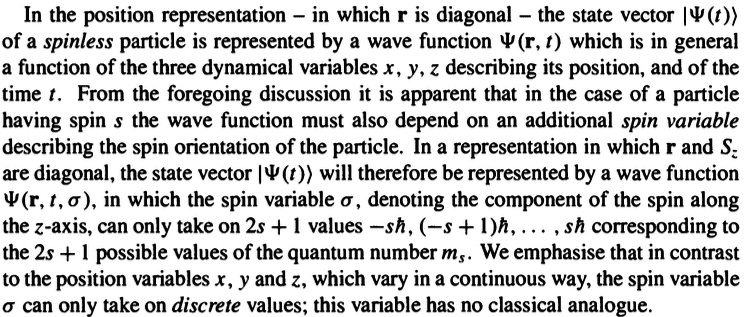
Screen Shot 2016-01-28 at 4.23.08 am.png


Does it mean equation (3) in http://scienceworld.wolfram.com/physics/PositionOperator.html? (where I believe the matrix is in the ##|E_n>## basis)
 
Physics news on Phys.org
The matrix element of position operator ##\hat{\mathbf{r}}## in position representation reads as
$$
\langle \mathbf{r'} | \hat{\mathbf{r}} | \mathbf{r''} \rangle= \mathbf{r'} \delta(\mathbf{r'}-\mathbf{r''})
$$
which vanishes for off-diagonal elements.
 
  • Like
Likes   Reactions: Happiness

Similar threads

  • · Replies 8 ·
Replies
8
Views
2K
  • · Replies 18 ·
Replies
18
Views
2K
  • · Replies 2 ·
Replies
2
Views
2K
  • · Replies 1 ·
Replies
1
Views
2K
  • · Replies 4 ·
Replies
4
Views
5K
  • · Replies 6 ·
Replies
6
Views
2K
  • · Replies 7 ·
Replies
7
Views
2K
  • · Replies 9 ·
Replies
9
Views
2K
Replies
0
Views
859
  • · Replies 27 ·
Replies
27
Views
4K