Optimizing Focal Plane Alignment for Optical Tweezers for Researchers

Click For Summary
To optimize focal plane alignment for optical tweezers, it's crucial to ensure that the laser beam's focus coincides with the microscope's focal plane. The discussion highlights the challenge of simultaneously imaging trapped particles and the laser beam, as they often cannot be focused together due to their differing positions. Adjusting the axial position of the beam focus can be achieved by 'detuning' the beam expander, which helps align the trapping beam with the objective lens. The conversation also touches on the importance of lens type and alignment techniques, emphasizing that proper lens orientation and back-reflection methods can enhance optical performance. Overall, careful adjustments and understanding of the optical setup are essential for successful imaging and trapping.
  • #31
kubikat said:
And here is the beam pattern that I see when beam comes out of the laser and hits the first lens after the focal point (this one is when the path length of the beam is rather short). I am not sure why I get the rings.
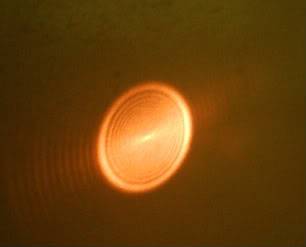
DSC07577.jpg


Here is how the beam profile changes as it travels longer distances. At certain distance I can make the "hole" in the center disappear and then the center of the beam seems to be gaussian.
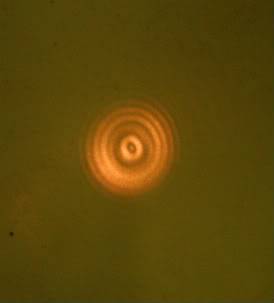
DSC07578.jpg

Before I get to these images, here's two photos of my setup:

[PLAIN]http://img585.imageshack.us/img585/3264/dsc01324u.jpg

[PLAIN]http://img691.imageshack.us/img691/5079/dsc3306.jpg

The tweezers are coupled into an upright microscope that uses infinity-corrected objectives, so the beam coming out of the tweezer module is (nearly) collimated. The top view of the module has the following components (in order): Nd:YAG laser, mirror, 40 mm plano-convex lens, mirror, 250 mm plano-convex lens. Inside the microscope there's another mirror, directing the beam down into the objective lens. the tweezer module sits on top of a 4-axis positioner (x, z, tip, tilt) that allows me to bring the tweezer beam into alignment with the optic axis of the microscope.

Here's an image of the spot at the sample plane:

[PLAIN]http://img707.imageshack.us/img707/1190/flycap0.jpg

and slightly defocused:

[PLAIN]http://img574.imageshack.us/img574/7902/flycap1.jpg

For these images, I used a 100x NA 0.9 objective- I generally trap with a 63X 0.9 dipping objective, tho. The two small dots/interference fringes are caused by the mirror in the microscope, and are not actually present at the sample, AFAIK.

Your beam images look ok, there's perhaps a hint of astigmatism (the spots are not perfectly symmetric, there appears to be a feature at about 45 degrees on one image). This can be minimized by tip/tilt adjustments of your lens. At the trap, astigmatism will manifest by a jet of particles shooting off to one side.

I'm not seeing any evidence that your laser is multimode- can you take some images of the focused spot? Put a mirror in place of the sample (lay a coverslip on top of the mirror if your objective requires one), and take a picture of the reflected spot.

Can you make a trap?
 
Last edited by a moderator:
Physics news on Phys.org
  • #32
Hi Andy! Thank you a lot for your pictures. They were really helpful, since now I had a better idea of what I was looking for, looking at the beam. I finally got trapping! It was really really exciting. The trap was very strong and kept literally sucking in the particles from within of like 30-50 micrometers. My friend and I decided it looked like a gravitational potential well except in optics. I was able to move the particles around as well. The weird thing is though, I got trapping when I only had one of the telescope lenses in (the one with the large wavelength) so the beam wasn't even close to filling up the back aperture. I put the other lens in afterwards and it seemed to have made the trap less strong, but I still need to play around with it some more.

Here is the image of the trapped spheres:

76018_10150323275960347_690610346_15972254_8118937_n.jpg


I am so happy it finally worked. Do you think it looks okay?
 
  • #33
Oh and the cluster of the particles on the bottom is where a beam used to be before I moved it. I can also use the beam to grab particles one by one and arrange them in shapes.
 
  • #34
kubikat said:
Hi Andy! Thank you a lot for your pictures. They were really helpful, since now I had a better idea of what I was looking for, looking at the beam. I finally got trapping! It was really really exciting. The trap was very strong and kept literally sucking in the particles from within of like 30-50 micrometers. My friend and I decided it looked like a gravitational potential well except in optics. I was able to move the particles around as well. The weird thing is though, I got trapping when I only had one of the telescope lenses in (the one with the large wavelength) so the beam wasn't even close to filling up the back aperture. I put the other lens in afterwards and it seemed to have made the trap less strong, but I still need to play around with it some more.

Here is the image of the trapped spheres:


I am so happy it finally worked. Do you think it looks okay?

kubikat said:
Oh and the cluster of the particles on the bottom is where a beam used to be before I moved it. I can also use the beam to grab particles one by one and arrange them in shapes.

Excellent- glad to hear it!

In response to your questions, here's my best guess:

1) You do not have a 3-D trap, you are pushing particles against the glass, where they stick due to electrostatic interactions. This may or may not be a problem, depending on your goal.

2) The optical trap does indeed share common characteristics with a gravitational well- the trapping energy is approximately a quadratic potential well, and dielectric particles 'fall' into it.

3) Your objective lens is not infinity-corrected, so the trap beam should not be collimated when it enters the objective. My suspicion is that you are focusing the trap beam with the singlet when the trap is optimized. If you want to fill the back aperture (which results in a 'stronger' trap) while still trapping objects in the focal plane, you need to adjust a few aspects of the telescope. It can get involved since the objective is not infinity corrected, and I'm not sure I can easily walk you through it- and I've never done it.

My design was based on this:

http://www.opticsinfobase.org/abstract.cfm?URI=ao-36-10-2107

and you may be able to get some ideas as well, especially from page 2109.
 
  • #35
This is a very helpful thread with some great information.

I'm currently doing a research project regarding laser tweezers and hope to build one after I learn enough about it. I've printed out the thread, and just wanted to let you three know that your work is greatly appreciated and probably helps more people than you realize. Thank You!
 
  • #36
Ah I was meaning to thank everyone who helped me build mine. That was extremely nice and finally allowed me to graduate :D

@hopeful: If you are an undergrad, I can probably help you out. I have written a manual on how to build a tweezer. But if you are a grad/have some optics experience, all of my writing is probably way below your level.
 
  • #37
kubikat, I would absolutely LOVE to see your manual! I'm positive your writing will be great since I only have a small amount of optics experience. I am a grad, but my major was math, and I'm just now getting into optics in a couple of undergrad courses.

Congratulations on graduating!
 
  • #38
Here is the link to where I posted my thesis paper + the manual.
https://sites.google.com/site/anyakash87/physics/optical-tweezers

It is written specifically for our equipment, so I don't know if it would be much help. Also it is written for college sophomores/juniors with no experience whatsoever, hence the lengthy description of how to turn on the laser diode controller or how to align the lenses. (I didn't know that stuff when I started working on them...)

Hope this helps at least a little :)

** Also it might have errors in it, since I didn't have anyone with optics background review it...
 
Last edited:
  • #39
Welcome to PF, hopeful. Good luck with your tweezers!
 
  • #40
Thank you very much, Redbelly.

Kubikat, your papers and presentation look great. Your diagrams, photos, and writing are very well done. Thank you for the link. It's exactly on the level I need since I started this project almost blind to the optics field. This gives me a fantastic guideline to go by.

As far as errors go, any optics formulas I include will be theoretically and experimentally tested by both my professor and myself. Even if I was using a formula directly from a paper by Ashkin, I would still need to do this step.

Thank you again. I will be sure to list your work in the bibliography and acknowledgment section when I get my presentation together.
 
  • #41
Kubikat, my professor is excited about your manual. I already overheard him telling one of the grad students about your work and he said we can use it as a guideline for building our own set up.

After re-reading my previous post from Feb 6, I think it sounds sort of funny. All I meant was that if there are errors, (which I haven't seen so far, nor do I expect to) then we will find them, since I have to go over anything I use for my presentation with a fine tooth comb.

Again, my professor and I both appreciate your help, and by extension that of Andy and Redbelly. :D
 

Similar threads

  • · Replies 0 ·
Replies
0
Views
3K
  • · Replies 0 ·
Replies
0
Views
3K
  • · Replies 5 ·
Replies
5
Views
4K
  • · Replies 2 ·
Replies
2
Views
4K
  • · Replies 4 ·
Replies
4
Views
2K
  • · Replies 7 ·
Replies
7
Views
2K
Replies
7
Views
3K
  • · Replies 7 ·
Replies
7
Views
2K
  • · Replies 9 ·
Replies
9
Views
3K
  • · Replies 10 ·
Replies
10
Views
2K