Thanks !
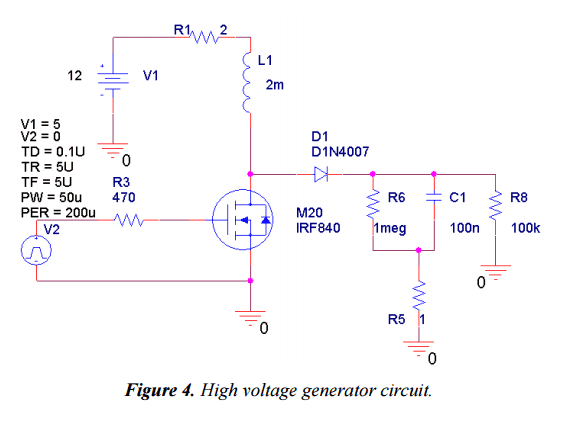
Still you haven't said what is "U" in the TD, TR, and TF terms. If it's short for "micro" why didn't they use μ like they did for PW and PER ?
I don't know a doggone thing about spice.
If i just assume they're sloppy typers and "U" also means "micro" ,
then every 200 microseconds we apply a 50 microsecond pulse of 12 volts through resistance of 2 ohms plus whatever is R of the mosfet ?
Were the mosfet perfect it'd be zero ohms, so let's assume that for simplicity
Current in a RL circuit is
so at end of 50 microseconds I = 12/2 X (1-e
-2X50E-6 / .002 ) = 6 X (1 - 0.9512) = 293 milliamps (check my arithmetic please)
which seems mighty little for a 5 amp transistor.
From where did your on-time come?
I think but do not know you probably need more current through your inductor so that when switched off it gives a healthy inductive kick.
The energy you add to the output capacitor's electric field must first get built up in the coil's magnetic field, ½LI
2 is all that's available to get dumped into the capacitor where some of it (hopefully a lot of it) becomes ½CV
2 .
That's how "Flyback" converters work.
We run into that in automobile ignitions. When the points are set too wide, they do not stay closed long enough between cylinder firings at high RPM for the coil current to rise high enough to make a healthy spark for the plugs. That limits how fast the car will go. You'll hear gearheads talking about "Dwell" which is a measure of what fraction of the time points stay open .
Since you're simulating, try 10X wider pulse width 1/10th as often and see what happens. Also shorten up fall time to a few nanoseconds.Wait a second what's this ?
V1 is shown as 12 volts adjacent the battery but 5 volts in the tabulation
and V2 is drawn adjacent a source that looks like a pulse but assigned 0 volts in the tabulation
You and i know what you meant but computers are sooooooo nitpicky... better double check what it's up to.
What does your simulation program do when you lengthen the pulse width and shorten the fall time ?