Optimizing RLC Circuit with Extra Resistors for Improved Performance

  • Thread starter Thread starter gfd43tg
  • Start date Start date
  • Tags Tags
    Resistors Rlc
Click For Summary

Discussion Overview

The discussion revolves around optimizing an RLC circuit with additional resistors to enhance performance. Participants explore various methods for analyzing the circuit, including the use of Thevenin equivalents and nodal analysis, while addressing issues related to damping and circuit behavior.

Discussion Character

  • Exploratory
  • Technical explanation
  • Mathematical reasoning

Main Points Raised

  • One participant expresses difficulty in applying standard solutions for series RLC circuits to their modified circuit and suggests using a Thevenin equivalent.
  • Another participant attempts to refine their solution using Thevenin's theorem but encounters discrepancies in their results compared to a referenced solution.
  • A participant notes that at t=0, the capacitor is fully charged, leading to zero current in the inductor, and questions the source of the general solution being used.
  • Alpha is identified as the damping coefficient, though there is a discussion about its units and whether it is dimensionless.
  • One participant suggests that the method appears correct but indicates that further steps are needed to determine the current through the capacitor.

Areas of Agreement / Disagreement

Participants do not reach a consensus on the correct approach or solution. Multiple competing views and methods are presented, and the discussion remains unresolved regarding the optimal analysis of the circuit.

Contextual Notes

There are limitations regarding the assumptions made about the circuit's initial conditions and the definitions of the damping coefficient. The discussion also highlights unresolved mathematical steps in the analysis.

Who May Find This Useful

This discussion may be useful for individuals interested in circuit analysis, particularly those exploring RLC circuits and the application of Thevenin's theorem in optimizing circuit performance.

gfd43tg
Gold Member
Messages
949
Reaction score
48
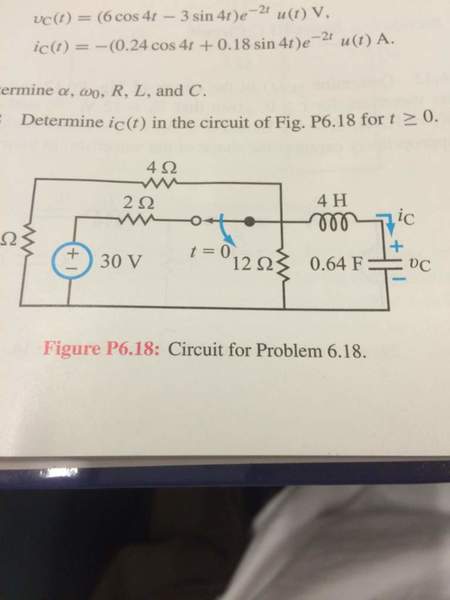
Hello, I am working on this problem
ImageUploadedByPhysics Forums1399243402.897536.jpg


I am having some difficulty finding the right answer. A few points I'd like to expand on so that one can understand my thought process. First off, there is a standard table with the solution to series RLC circuits. I don't think I can use that table with what I have in this circuit. So one idea I have us to modify the circuit to look like what I want with a thevenin equivalent.

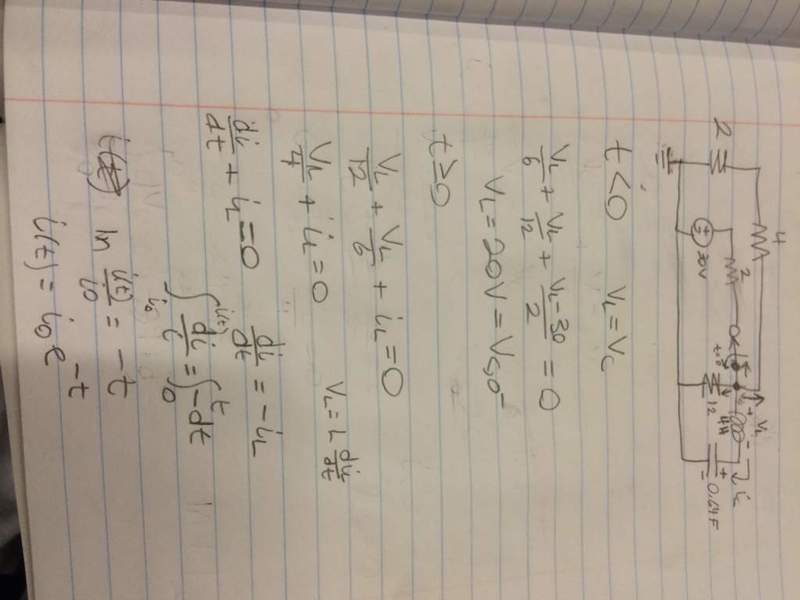
If the thevenin idea is wrong, I did nodal analysis and this is what my attempt looks like.
ImageUploadedByPhysics Forums1399243617.704557.jpg


I get an expression but the initial current is Zero, which proves troubling to integrate. I also can't tell the nature of damping in this circuit either
 
Physics news on Phys.org
I tried again with the thevenin, which brings me closer to the answer, but their value is

-13.33e^(-.5t)sin(.375t)

Mine is almost the same, but I have that extra -7.5 term that they don't. I get -20.83e^(-.5t)sin(.375t)

ImageUploadedByPhysics Forums1399245106.145250.jpg


ImageUploadedByPhysics Forums1399245125.039762.jpg
 
At t=0 the capacitor is, presumably, fully charged, so the inductor current and voltage at this time will both be 0.

It's a second order system, so the response will be a decaying sinusoid. Where did you copy the general solution from?

What is alpha described as?
 
Here is the table

Alpha is the damping coefficient

ImageUploadedByPhysics Forums1399689560.199109.jpg
 
Maylis said:
Here is the table

Alpha is the damping coefficient
Possibly not. Coefficients are usually dimensionless. Your alpha has units of sec⁻¹.

Your method looks right, but you haven't finished. To determine ic you now have to multiply that derivative by C.
 

Similar threads

  • · Replies 13 ·
Replies
13
Views
3K
  • · Replies 9 ·
Replies
9
Views
6K
  • · Replies 8 ·
Replies
8
Views
2K
Replies
19
Views
3K
  • · Replies 6 ·
Replies
6
Views
3K
  • · Replies 32 ·
2
Replies
32
Views
4K
  • · Replies 2 ·
Replies
2
Views
4K
  • · Replies 34 ·
2
Replies
34
Views
7K
  • · Replies 8 ·
Replies
8
Views
3K
  • · Replies 42 ·
2
Replies
42
Views
7K