Roy1984
- 2
- 1
Hello Everyone
I have got a question concerning the calculation of the overall energy input in random vehicle vibration tests.
I have got different power spectral density levels for different random vehicle vibration tests and would like to compare them with each other concerning the overall energy input of the different tests. What I'm aware of is the following: The energy input definitely depends on the mass that is placed on a "shaker" for such a vibration test. Therefore I guess it would make sense to calculate an energy per mass for these different tests.
Besides the power spectral density levels, I already know the Grms value for the different levels. What I now would like to calculate is the energy-per-mass-input when such a test is performed for a certain time. So just comparing the Grms values doesn't do the trick, since I want to compare different tests with different running times and different power spectral density levels (and therefore different Grms values).
Here are some of the levels I would like to compare:
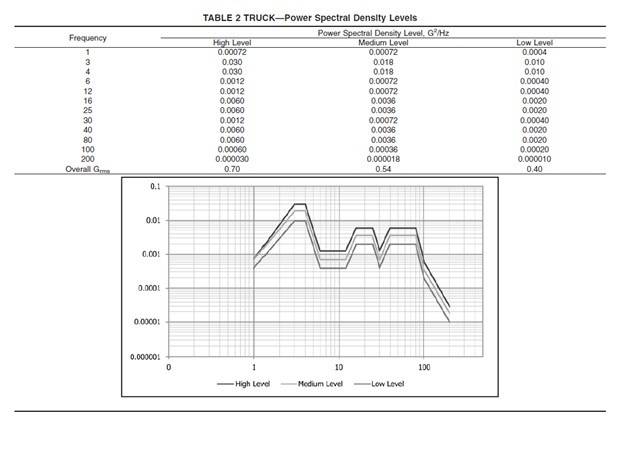
I hope anyone can help me on that subject. Thanks in advance.
Regards,
Roy
I have got a question concerning the calculation of the overall energy input in random vehicle vibration tests.
I have got different power spectral density levels for different random vehicle vibration tests and would like to compare them with each other concerning the overall energy input of the different tests. What I'm aware of is the following: The energy input definitely depends on the mass that is placed on a "shaker" for such a vibration test. Therefore I guess it would make sense to calculate an energy per mass for these different tests.
Besides the power spectral density levels, I already know the Grms value for the different levels. What I now would like to calculate is the energy-per-mass-input when such a test is performed for a certain time. So just comparing the Grms values doesn't do the trick, since I want to compare different tests with different running times and different power spectral density levels (and therefore different Grms values).
Here are some of the levels I would like to compare:
I hope anyone can help me on that subject. Thanks in advance.
Regards,
Roy