Discussion Overview
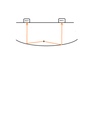
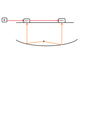
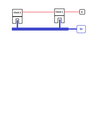
The discussion revolves around the feasibility of using a parabolic mirror to reflect light towards two horizontally spaced clocks in order to measure the one-way speed of light. Participants explore the conditions under which the reflected light can hit the clocks simultaneously and the implications for synchronizing the clocks.
Discussion Character
- Exploratory
- Technical explanation
- Debate/contested
- Conceptual clarification
Main Points Raised
- Some participants propose that a parabolic mirror can reflect light in parallel trajectories if the light source is positioned at the mirror's focal point.
- Others argue that the reflected light will not hit a flat surface simultaneously unless it strikes at a 90-degree angle, with any deviation causing time differences in arrival.
- A participant suggests that if the setup is ideal, the reflected rays could hit the surface simultaneously to within a fraction of a wavelength, depending on the quality of the optical surfaces.
- Concerns are raised about interference effects when the wavelength is significant compared to the reflector diameter, which could affect the results.
- One participant questions the practicality of using the mirror setup for synchronizing two clocks, suggesting that placing the clocks equidistant from the light source might be more effective.
- Another participant emphasizes that the concept of "simultaneous" is problematic, particularly when considering the one-way speed of light and its implications for clock synchronization.
- There is a discussion about the assumptions made regarding the isotropy of light speed and how this affects the validity of the proposed measurement setup.
Areas of Agreement / Disagreement
Participants express multiple competing views regarding the effectiveness of the proposed setup for measuring the one-way speed of light. There is no consensus on whether the reflected light can be considered to hit the clocks simultaneously or the implications of doing so.
Contextual Notes
Participants highlight limitations related to the assumptions about light speed, the precision required for synchronization, and the potential for interference effects in the optical setup.
Who May Find This Useful
This discussion may be of interest to those exploring experimental setups for measuring the speed of light, the principles of optics, and the challenges of synchronizing clocks in theoretical physics experiments.