Discussion Overview
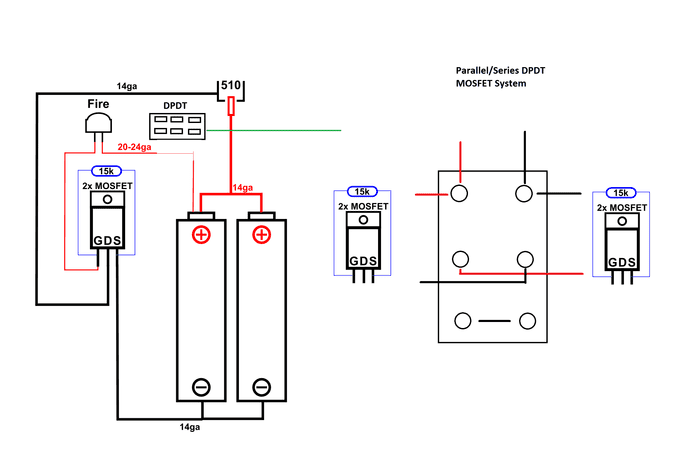
The discussion revolves around the wiring of a system using MOSFETs and a DPDT switch to create a toggle between series and parallel configurations for an electronic cigarette. Participants explore the implications of handling high current levels and the safety concerns associated with lithium-ion batteries.
Discussion Character
- Technical explanation
- Debate/contested
- Experimental/applied
Main Points Raised
- One participant seeks assistance with wiring a DPDT switch and MOSFETs for a system that allows switching between series and parallel configurations.
- Another participant questions whether the series and parallel connections refer to batteries or loads and expresses concern about the suitability of a switch for this application.
- It is noted that the series option would provide 8.4V at 30-40 amps, while the parallel option would provide 4.2V at the same current, specifically for an electronic cigarette where coil resistance can be adjusted.
- Concerns are raised about the complexity of the circuit and the potential dangers of using lithium-ion batteries if not handled correctly.
- Participants discuss the need for safety measures, such as ensuring that switches do not create shorts and considering the use of pull-up and pull-down resistors.
- Some suggest that a mechanical solution might be simpler than using MOSFETs, while others argue that the use of FETs is not trivial and may require additional components for safe operation.
- There is a discussion about the adequacy of gate drive voltages and the implications of using different types of batteries, particularly lithium-ion versus lead-acid.
- One participant proposes using PWM control for the "Fire" function to simplify the design and enhance safety.
Areas of Agreement / Disagreement
Participants express a range of views on the best approach to wiring the system, with no consensus reached on whether to use MOSFETs or mechanical switches. Concerns about safety and complexity are shared, but specific solutions remain contested.
Contextual Notes
Participants highlight the importance of safety in high-current applications, particularly with lithium-ion batteries, and the need for careful design to avoid shorts and ensure proper operation of the circuit.