Peculiar Opamp circuit behavior

Click For Summary

Discussion Overview

The discussion revolves around the behavior of an operational amplifier (opamp) circuit when the ideality assumption is altered, specifically by setting the opamp's voltage gain to a finite value of 7 instead of infinity. Participants explore the implications of this change on the overall circuit gain, Vout/Vin, and the role of feedback in determining gain characteristics.

Discussion Character

  • Exploratory
  • Technical explanation
  • Debate/contested

Main Points Raised

  • One participant notes that with a finite gain of 7, the calculated overall circuit gain can exceed 7, prompting a discussion on how this is possible.
  • Another participant expresses confusion about the assertion that the gain can exceed the open-loop gain of the opamp and questions the reasoning behind this claim.
  • A third participant draws a parallel to self-saturating magnetic amplifiers, suggesting that positive feedback can enhance the gain of a low-gain device, similar to the behavior of an opamp.
  • One participant reiterates that with an ideal opamp, the gain can compute to infinity under certain conditions, indicating a potential misunderstanding or miscommunication about the circuit's behavior.
  • Another participant provides a mathematical framework for understanding the gain in systems with positive feedback, detailing conditions under which Vout/Vin can exceed the opamp's gain.

Areas of Agreement / Disagreement

Participants express differing views on the implications of finite gain in opamp circuits, with some questioning the validity of exceeding the open-loop gain while others provide theoretical support for such behavior. The discussion remains unresolved, with multiple competing interpretations of the circuit's behavior.

Contextual Notes

There are unresolved assumptions regarding the definitions of feedback gain and the specific circuit configuration, which may influence the calculated gain. The discussion also highlights the complexity of feedback systems and their effects on overall circuit behavior.

The Electrician
Gold Member
Messages
1,402
Reaction score
210
An opamp circuit was given in the homework forum:
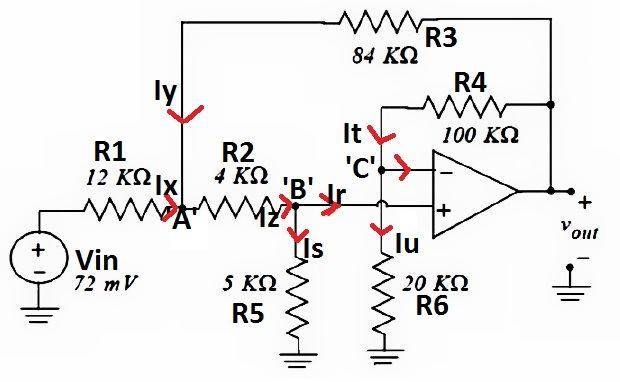
attachment.php?attachmentid=58430&stc=1&d=1367529007.jpg


There the circuit was analyzed with the usual assumptions of opamp ideality.

But, if the circuit is analyzed with one change to ideality, namely the opamp voltage gain is set to 7 rather than ∞ (this brings with it the change that v+ ≠ v- any more), the calculated overall circuit gain, Vout/Vin, is greater than 7.

How can this be?

I think I know the answer, but I pose this for the readers to think about and discuss.

Edit: I forgot to mention this: Exchange the + and - opamp inputs (or set the opamp gain to -7).
 

Attachments

  • OpAmpCircuit.jpg
    OpAmpCircuit.jpg
    26.3 KB · Views: 555
Last edited:
Engineering news on Phys.org
I'm not sure I follow. I think you're saying there's something odd about the gain from Vin to Vout being greater than the open-loop gain of the opamp. If that's the case, why do you think that?

Also, for an opamp open-loop gain of 7 (with its terminals swapped), I get a gain of -27.2 from Vin to Vout.
 
That's kinda how self saturating magnetic amplifiers work and it's a nice basic concept to have in your bag of tricks..

Positive feedback will increase the gain of an inherently low gain device.
If you take that positive-feedback-enhanced device and surround it with some negative feedback, you have treated it as an op-amp.
The old timers called them "Servomechannisms".
 
The Electrician said:
But, if the circuit is analyzed with one change to ideality, namely the opamp voltage gain is set to 7 rather than ∞ (this brings with it the change that v+ ≠ v- any more), the calculated overall circuit gain, Vout/Vin, is greater than 7.
When the OP-AMP here is ideal and has a gain of precisely 7 3/7 then
I think we find that Vout/Vin computes to infinity.

Looking good! :smile:
 
milesyoung said:
I'm not sure I follow. I think you're saying there's something odd about the gain from Vin to Vout being greater than the open-loop gain of the opamp. If that's the case, why do you think that?.

Why don't you think that?
 
The Electrician said:
Why don't you think that?
Because that's not all that unusual for systems with positive feedback. For an ideal opamp with its output fed back into its noninverting input and its inverting input used as the system input, we have:

V_\mathrm{out} = A(V_+ - V_-) = A(X V_\mathrm{out} - V_\mathrm{in}) \Leftrightarrow \frac{V_\mathrm{out}}{V_\mathrm{in}} = \frac{A}{A X - 1}
where X, 0 < X ≤ 1, is the positive feedback gain and A > 0.

For Vout/Vin > A, you'd just need 0 < AX - 1 < 1 ⇔ 1/A < X < 2/A.

For the circuit you posted, we have:
V_\mathrm{out} = A(V_+ - V_-) = A(X V_\mathrm{out} - Y V_\mathrm{out} - Z V_\mathrm{in}) \Leftrightarrow \frac{V_\mathrm{out}}{V_\mathrm{in}} = \frac{A Z}{A(X - Y) - 1}
and for Vout/Vin > A, you'd need 0 < A(X - Y) - 1 < Z ⇔ 1/A < X - Y < (Z + 1)/A.

You must then have X > Y, i.e. net positive feedback.
 

Similar threads

  • · Replies 5 ·
Replies
5
Views
2K
Replies
3
Views
2K
  • · Replies 10 ·
Replies
10
Views
3K
  • · Replies 22 ·
Replies
22
Views
7K
  • · Replies 5 ·
Replies
5
Views
5K
  • · Replies 14 ·
Replies
14
Views
2K
  • · Replies 4 ·
Replies
4
Views
2K
Replies
9
Views
4K
  • · Replies 10 ·
Replies
10
Views
2K
  • · Replies 9 ·
Replies
9
Views
2K