Periodic Complex exponential signal

Click For Summary
SUMMARY

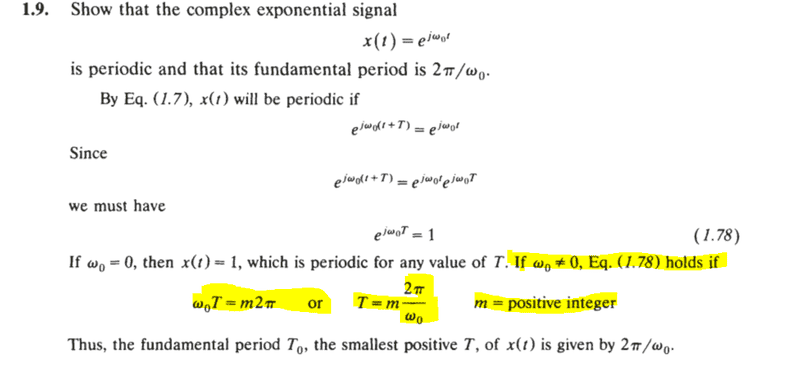
The discussion centers on understanding periodic complex exponential signals, specifically when the angular frequency \( \omega \) is non-zero. The user seeks clarification on the relationship between \( \omega_0 T \) and the conditions under which \( \cos(\omega_0 T) = 1 \) and \( \sin(\omega_0 T) = 0 \). The conclusion drawn is that these conditions hold true for integer multiples of \( 2\pi \), leading to the equations \( \omega_0 T = m \cdot 2\pi \) where \( m \) is a positive integer, confirming the periodic nature of the signal.

PREREQUISITES
  • Understanding of complex numbers and Euler's formula
  • Basic knowledge of periodic functions and trigonometry
  • Familiarity with angular frequency and its implications in signal processing
  • Concept of periodicity in mathematical functions
NEXT STEPS
  • Study the implications of Euler's formula in signal analysis
  • Learn about the properties of periodic functions in trigonometry
  • Explore the concept of angular frequency in detail
  • Investigate applications of complex exponential signals in engineering
USEFUL FOR

Students and professionals in electrical engineering, signal processing, and mathematics who are looking to deepen their understanding of periodic complex exponential signals and their properties.

bibo_dvd
Messages
37
Reaction score
0
hello guys ..
first of all , iam not sure that i should type this thread here . so excuse me for that

in this problem i can understand the part until it's said that w=0 then x(t)=1, which is periodic for any value of T
but i can't understand the part after that in the case of w is not equal to zero
so help me with this please :)
Thx guys
MVHb9lE.png
 
Physics news on Phys.org
Perhaps Euler's formula will be of help:
$$
e^{i \omega_0 T} = \cos(\omega_0 T) + i \sin (\omega_0 T)
$$
 
okay , i know Euler's formula but i can't understand " wt=m*2*pi " or "T=m*(2pi/w) m=positive integer"

how did this part was given ??
 
You want ##
e^{i \omega_0 T} = \cos(\omega_0 T) + i \sin (\omega_0 T) = 1
##, meaning that ##\cos(\omega_0 T)=1## and ##\sin (\omega_0 T)=0##. What are the values of ##\omega_0 T## for which these equalities hold?
 
omg , now i understand , we need cos(wT) to be always 1 , so cos (2*pi) and (4*pi) and so on , yaaaayyyyy :D
Thx man for help :)
 

Similar threads

Replies
6
Views
1K
Replies
7
Views
2K
  • · Replies 28 ·
Replies
28
Views
4K
  • · Replies 1 ·
Replies
1
Views
1K
  • · Replies 1 ·
Replies
1
Views
2K
  • · Replies 4 ·
Replies
4
Views
1K
  • · Replies 3 ·
Replies
3
Views
2K
  • · Replies 10 ·
Replies
10
Views
2K
  • · Replies 2 ·
Replies
2
Views
3K
  • · Replies 2 ·
Replies
2
Views
2K