Discussion Overview
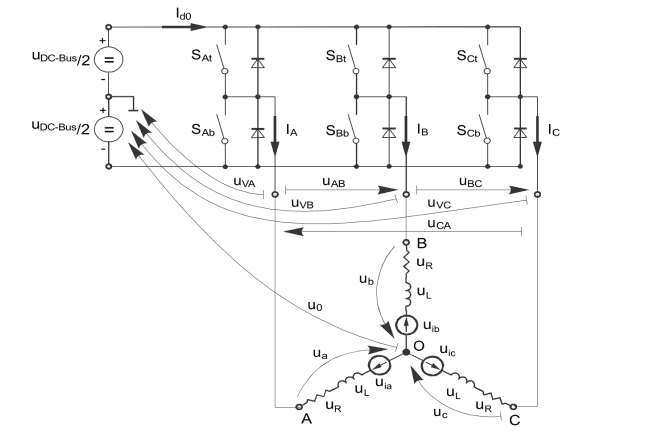
The discussion revolves around the relationship between phase voltage and line-to-line voltage in a circuit involving a wye transformer and possibly an inverter or motor drive. Participants are exploring the application of Kirchhoff's Voltage Law (KVL) to analyze the circuit and calculate voltages.
Discussion Character
- Technical explanation
- Mathematical reasoning
- Debate/contested
Main Points Raised
- One participant expresses uncertainty about their application of KVL in the circuit analysis, presenting an equation relating phase and line-to-line voltages.
- Another participant asserts that in a wye transformer configuration, the phase voltages UVA and UVB should be equal, both being 120V, and identifies UAB as the line-to-line voltage.
- A different participant suggests that the circuit may be part of a three-phase motor drive or inverter, noting that KVL should be applied for specific switch states due to changes in the network when switches are activated.
- Further details are provided about the inverter's operation, including various states and corresponding voltage equations for Ua, Ub, and Uc based on different switch configurations.
- The original poster seeks clarification on their KVL equations for different switch states, expressing confusion about their approach and the circuit's behavior.
Areas of Agreement / Disagreement
Participants do not reach a consensus on the correct application of KVL or the relationships between the voltages, as there are differing interpretations of the circuit's configuration and operation.
Contextual Notes
Participants mention specific assumptions about the circuit's configuration, such as the presence of ideal DC sources and the nature of the switches, which may affect the application of KVL. The discussion includes references to a user guide for further context.