Photoelectrons and Planck's constant

benca
Messages
19
Reaction score
0
Homework Statement
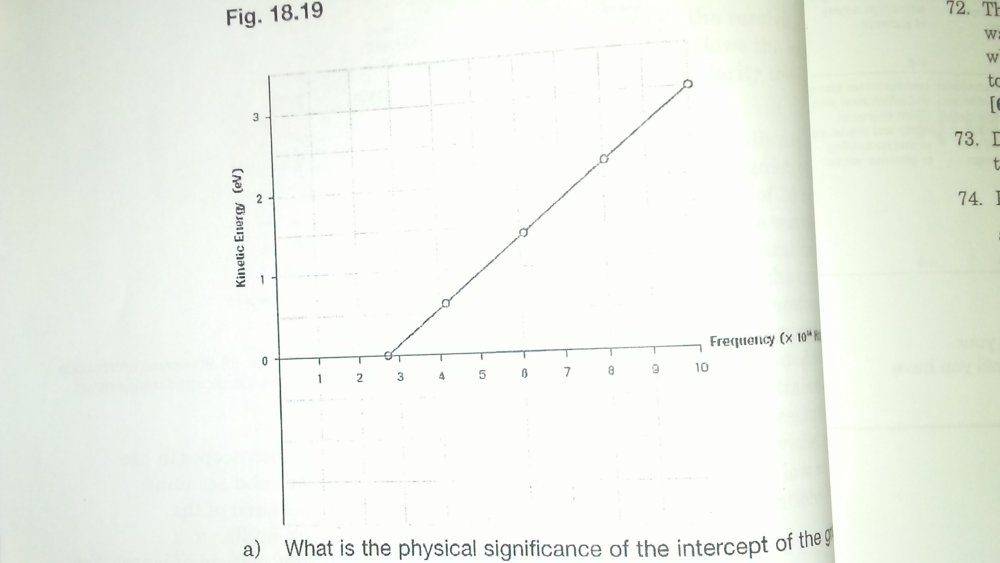
Use the graph to determine Planck's constant.
Relevant Equations
E = hf
Ek = hf - W

h = Planck's constant
f = frequency
W = work function
Attempt:

I was thinking of finding the slope of the graph but I only know the values for x = 10, y = 3 and y = 0. And without the y-intercept, I don't know the work function and can't solve for h. If you can't see from the picture, the last co-ordinate is (10,3) and the x-axis is measured in f x 10^14 Hz

I'm not sure what options I have left if I don't know how to figure out the slope or work function.
20191123_181808.jpg
 
The graph is of a straight line. Could you not simply extrapolate the line to find the y-intercept?

1574552712825.png
 
I thought of that too, but I wouldn't exactly get Planck's constant but instead a number close to Planck's constant. But if that's what I need to do then that's ok, thanks
 
benca said:
I thought of that too, but I wouldn't exactly get Planck's constant but instead a number close to Planck's constant. But if that's what I need to do then that's ok, thanks
Yup. You need to squeeze what you can from the given data. That's a truism for experimental science, where you collect measured data over a limited region and suggest reasonable extrapolations to complete the overall picture for purposes of analysis. In this case the graph is clearly linear, so a linear extrapolation would not be an unreasonable proposition.
 
gneill said:
Yup. You need to squeeze what you can from the given data. That's a truism for experimental science, where you collect measured data over a limited region and suggest reasonable extrapolations to complete the overall picture for purposes of analysis. In this case the graph is clearly linear, so a linear extrapolation would not be an unreasonable proposition.

Alright, thanks
 
benca said:
Alright, thanks
Happy to be of help! Cheers!
 
The straight line has the form ## y=mx+b ##. In this case ## y=E_k ## and ## x=f ##. The slope is found as Planck's constant ## h=m=\frac{y_2-y_1}{x_2-x_1} ##. From what I could see, you apparently need a brush up on your algebra. Here ## (x_1,y_1) ## and ## (x_2,y_2) ## are any two points on the straight line. ## \\ ## In addition, once you have ## m ##, you can then write ##m=\frac{y-y_1}{x-x_1} ##, and ultimately solve for ##b=-W ##, which is the y-intercept. This problem is a simple one, but you need to be able to do algebra.
 
Last edited:
benca said:
I thought of that too, but I wouldn't exactly get Planck's constant but instead a number close to Planck's constant. But if that's what I need to do then that's ok, thanks
You never get an exact value from measurements. That is the nature of empirical sciences.

Also, to spell out what others have noted: You only need two points on a line to determine its coefficients. Three will give you an overconstrained system and with measurement errors present you will typically need something like a least squares method to determine the best fitting line.
 
  • Like
Likes   Reactions: Charles Link
On this one, if you pick ##(10,3) ## and ##(2.75,0) ## as your two points, you do get close to two decimal place accuracy. ## \\ ## One thing that should be mentioned is that energy is in eV here, and you need to convert to joules to get a number that is approximately the accepted value of Planck's constant ##h=6.626 E-34 ## joule-sec. Otherwise, you get the number in eV-seconds. I would venture to guess that most physics people know this number as 6.626E-34 joule-sec, but don't know its value in units of eV-seconds.
 
Last edited:
  • #10
Charles Link said:
I would venture to guess that most physics people know this number as 6.626E-34 joule-sec
Most physicists I know (admittedly mainly particle phycisists) know the number as ##2\pi## due to preferring natural units.
 
  • Like
Likes   Reactions: Charles Link
  • #11
Orodruin said:
Most physicists I know (admittedly mainly particle phycisists) know the number as ##2\pi## due to preferring natural units.
That is a much more advanced version, where ## \hbar=c=1 ##, but here we are at the Physics 101 level. :smile:
 
  • #12
Charles Link said:
That is a much more advanced version, where ## \hbar=c=1 ##, but here we are at the Physics 101 level. :smile:
In a few weeks I will be giving an ”inspirational” lecture about the geometry of relativity to the same students I taught vector analysis the past spring and went on and on about making sure their physical dimensions always work out ... letting c = 1 should be great fun!
 
  • Like
Likes   Reactions: Charles Link
  • #13
Hopefully the OP @benca returns to complete the exercise. If he works it through, I think he will be surprised how close the result he gets is to ## h=6.626E-34 ##. From the data that was supplied, you can't get 3 decimal place accuracy, but you can get pretty close to two decimal places.
 
  • #14
Charles Link said:
That is a much more advanced version, where ## \hbar=c=1 ##, but here we are at the Physics 101 level. :smile:
As you suggested, much too advanced for an introductory physics homework forum.
 
  • Like
Likes   Reactions: Charles Link

Similar threads

  • · Replies 10 ·
Replies
10
Views
2K
  • · Replies 25 ·
Replies
25
Views
5K
  • · Replies 1 ·
Replies
1
Views
3K
  • · Replies 3 ·
Replies
3
Views
3K
  • · Replies 10 ·
Replies
10
Views
2K
  • · Replies 8 ·
Replies
8
Views
9K
  • · Replies 5 ·
Replies
5
Views
2K
  • · Replies 26 ·
Replies
26
Views
3K
  • · Replies 2 ·
Replies
2
Views
4K
  • · Replies 1 ·
Replies
1
Views
2K