Physics 2 Electric Fields, Circuits, Magnetism

Click For Summary
SUMMARY

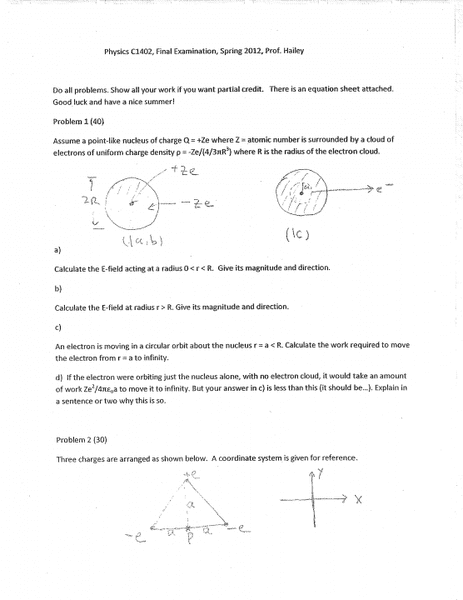
The discussion focuses on solving a practice test related to electric fields and circuits in Physics 2. For part 1a, the user correctly applies the formula E = kq/r², substituting +Ze for q when r < R, resulting in E = kZe/R². In part 1b, the user accurately concludes that the electric field E is zero when r > R, as the enclosed charge within the Gaussian surface cancels out (+Ze and -Ze). These calculations demonstrate a solid understanding of Gauss's Law and electric field concepts.

PREREQUISITES
  • Understanding of Gauss's Law
  • Familiarity with electric fields and their calculations
  • Knowledge of the concepts of enclosed charge
  • Basic proficiency in algebra and physics equations
NEXT STEPS
  • Study the applications of Gauss's Law in different geometries
  • Learn about electric field lines and their significance
  • Explore the relationship between electric fields and potential energy
  • Investigate the principles of circuits involving capacitors and resistors
USEFUL FOR

Students studying Physics 2, educators teaching electric fields and circuits, and anyone preparing for exams in electromagnetism.

Adeel Ahmad
Messages
45
Reaction score
0
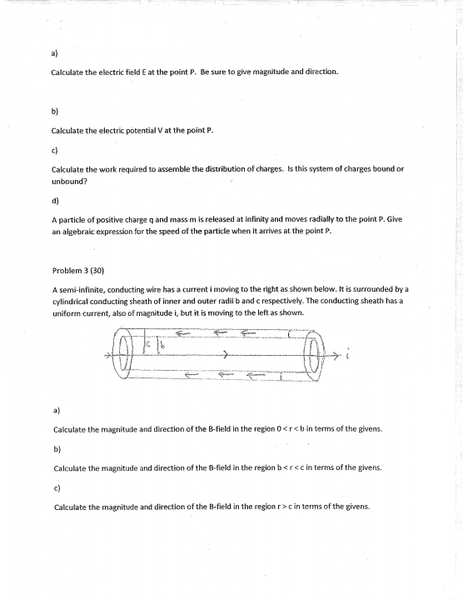
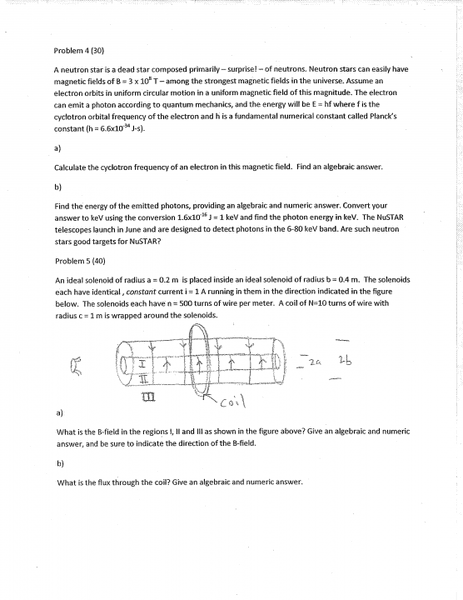
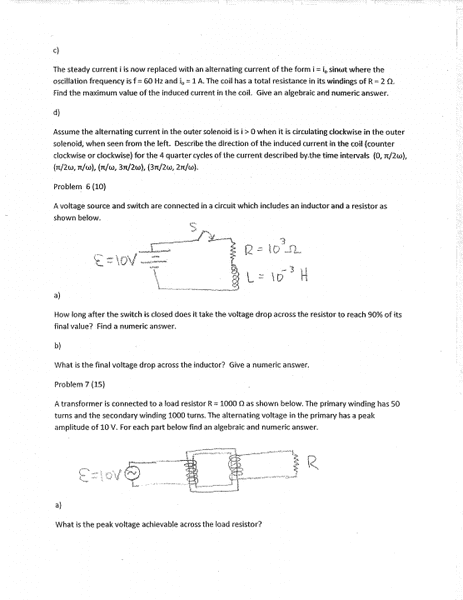
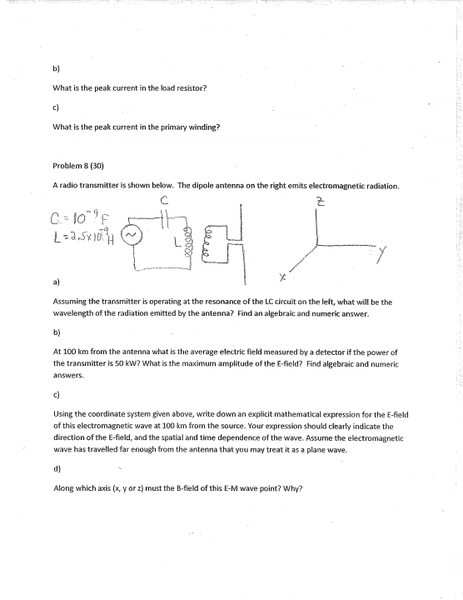
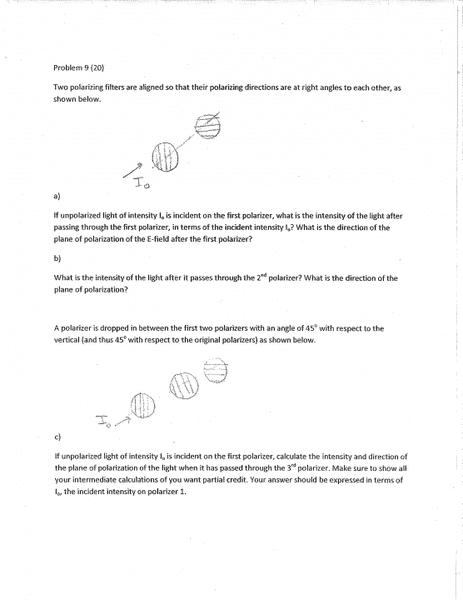
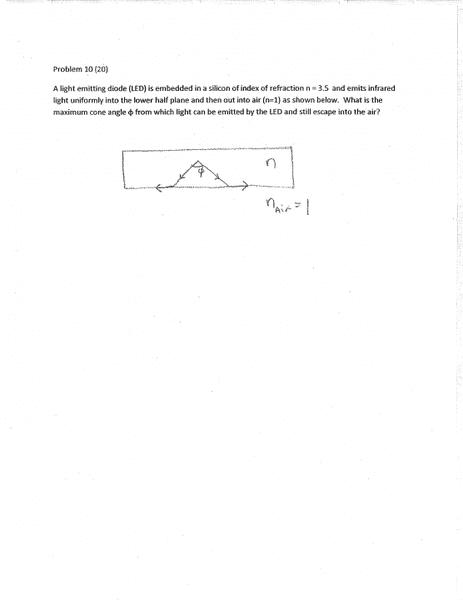
Can someone please help me out with this practice test and provide explanations?
upload_2016-5-6_21-3-24.png
upload_2016-5-6_21-4-14.png
upload_2016-5-6_21-4-47.png
upload_2016-5-6_21-5-14.png
upload_2016-5-6_21-5-33.png
upload_2016-5-6_21-5-52.png
upload_2016-5-6_21-6-6.png
upload_2016-5-6_21-3-24.png
upload_2016-5-6_21-4-14.png
upload_2016-5-6_21-4-47.png
upload_2016-5-6_21-5-14.png
upload_2016-5-6_21-5-33.png
upload_2016-5-6_21-5-52.png
upload_2016-5-6_21-6-6.png
upload_2016-5-6_21-3-24.png
upload_2016-5-6_21-4-14.png
upload_2016-5-6_21-5-33.png
upload_2016-5-6_21-5-52.png
upload_2016-5-6_21-6-6.png
upload_2016-5-6_21-5-14.png
upload_2016-5-6_21-4-47.png

upload_2016-5-6_21-3-24.png


upload_2016-5-6_21-4-14.png


upload_2016-5-6_21-4-47.png

upload_2016-5-6_21-5-14.png

upload_2016-5-6_21-5-33.png

upload_2016-5-6_21-5-52.png

upload_2016-5-6_21-6-6.png
 
Physics news on Phys.org
So for number 1 a, when r<R, I take +Ze as q and plug it into the equation E = kq/r2 and get E = kZe/R2. Not sure if that's correct
 
Then for number 1 b when r>R, I assume that E is zero since you set a Gaussian surface that encloses the entire thing so you take the enclosed charge which would be zero since it is +Ze and -Ze which cancels. So when you plug that into solve for E, you would get zero. Please lmk if this is correct.
 

Similar threads

  • · Replies 4 ·
Replies
4
Views
2K
Replies
14
Views
3K
Replies
11
Views
2K
  • · Replies 11 ·
Replies
11
Views
2K
  • · Replies 2 ·
Replies
2
Views
1K
Replies
1
Views
2K
  • · Replies 3 ·
Replies
3
Views
1K
  • · Replies 1 ·
Replies
1
Views
2K
Replies
10
Views
2K
  • · Replies 3 ·
Replies
3
Views
2K