Practical use of a quarter wave transformer

Click For Summary

Discussion Overview

The discussion revolves around the practical use of a quarter wave transformer for impedance matching in transmission lines. Participants explore various scenarios, applications, and methods for implementing quarter wave transformers, particularly in the context of coaxial and microstrip lines.

Discussion Character

  • Exploratory
  • Technical explanation
  • Debate/contested

Main Points Raised

  • One participant questions the practicality of using a quarter wave transformer if only standard coaxial impedances (50Ω or 75Ω) are available, suggesting a limitation in finding suitable transmission lines.
  • Another participant counters that coaxial cables come in various impedances beyond just 50Ω and 75Ω, indicating that options exist for matching.
  • It is noted that quarter wave transformers are commonly used in microstrip designs at UHF and microwave frequencies, where impedance can be tailored more easily.
  • A participant introduces the Smith Chart as a tool for matching both resistive and complex impedances using transmission lines.
  • Alternative methods are proposed for situations where suitable coaxial impedances are unavailable, such as using discrete components to create a matching network with PI or T configurations.
  • One participant mentions the utility of quarter wave transformers for driving multiple antennas in phase, providing a specific example of matching 50Ω antennas with a 75Ω coaxial line.
  • Another participant emphasizes that using microstrip or stripline is a straightforward method for realizing the required impedance for the quarter wave transformer.

Areas of Agreement / Disagreement

Participants express differing views on the practicality of using quarter wave transformers with standard coaxial impedances, with some suggesting that alternatives exist while others highlight potential limitations. The discussion remains unresolved regarding the best approach for specific applications.

Contextual Notes

Participants mention various methods for achieving impedance matching, including the use of the Smith Chart and discrete component networks, but do not resolve the effectiveness or applicability of these methods in all scenarios.

FrankJ777
Messages
140
Reaction score
6
Hi guys. I have some questions about the practical use of a quarter wave transformer to match loads. For my question please refer to the figure below...
According to my reading the input inpedance fo a quarter wave transformer is:
Zin = Z12/ZL
and to properly match the line with characteristic impedance Z0 to the load ZL, Z1 must be chosen so that:
Z1 = √Z0ZL

So it seems that for the quarter wave transformer to be useful I wave to be able to choose a transmission line of the appropriate impedance Z1. When would that be of practical use? If i have only coax of 50Ω or75Ω etc., it seems I would have a difficult time finding an instance where I could use a quarter wave transformer. Obviously I'm missing something.
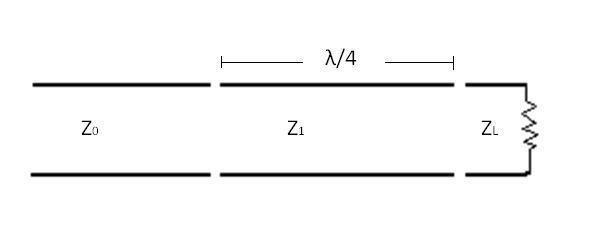
quarter wave xformer.jpg
 
Engineering news on Phys.org
First, coax comes in many different impedances so you needn't stick to 50 or 75 ohms.

Second, quarter wave transformers are usually used with microstrip at UHF and microwave frequencies where it is easy to design a length of transmission line at nearly any impedance.

Third, you don't say if you are familiar with the Smith Chart but if you are, you can use it to match not just resistive values but also complex impedances with a just transmission line.

Fourth, if you can't find a coax of the appropriate impedance and if microstrip isn't appropriate, you can create a network that works the same as a quarter wave transformer with discrete components. You would use either a PI or T network made of two capacitors and one inductor or vice versa in which each component has a reactance equal to the value of the transmission line you would need.

Example: If you are trying to match 50 ohms to 100 ohms and you need a 71 ohm transmission line, you could use anyone of 2 PI or 2 T networks of L-C-L or C-L-C where each L and each C has a reactance of 71 ohms.
 
Last edited:
If your lines are symmetric it's easy to create yours with the needed impedance, using rods. Commonly done for antennas.
 
Quarter wave lines are also useful for driving multiple antennas.

Suppose you have two antennas which have 50 ohm input impedance and you want to drive both of them in phase with a 50 ohm feedline from a transmitter.

One way of doing this is to get a quarter wavelength of 75 ohm coax attached to each antenna and then drive the two ends in parallel.

This works by stepping up the impedance of each antenna to 103 ohms according to the formula:
Zo2 = Z1 * Z2

so, 752 = 50 * Z2
Z2 = 752 / 50 = 103 ohms

Placing these in parallel gives a close match for a 50 ohm feedline.
 
Like Skeptic 2 said, using microstrip or stripline to realize the λ/4 line of Z1 is the easiest as you can design the impedance to Z1 easily as long as it is within reason. Or used discrete components in Pi network will work. If you are familiar with matching network design using Smith Chart, it would be very easy to find the value of the components.
 

Similar threads

  • · Replies 6 ·
Replies
6
Views
6K
  • · Replies 2 ·
Replies
2
Views
4K
  • · Replies 2 ·
Replies
2
Views
1K
Replies
33
Views
4K
  • · Replies 5 ·
Replies
5
Views
2K
  • · Replies 12 ·
Replies
12
Views
3K
  • · Replies 7 ·
Replies
7
Views
3K
Replies
20
Views
3K
  • · Replies 5 ·
Replies
5
Views
4K
  • · Replies 11 ·
Replies
11
Views
2K