Pressure differential through orifice plate

Click For Summary

Discussion Overview

The discussion revolves around calculating the pressure differential through an orifice plate in a test rig designed to measure flow rates. Participants explore the implications of orifice placement, flow conditions, and measurement accuracy, while addressing potential issues with the experimental setup.

Discussion Character

  • Exploratory
  • Technical explanation
  • Debate/contested
  • Experimental/applied

Main Points Raised

  • One participant seeks guidance on calculating the expected pressure differential when inserting an orifice plate at a specific flow rate, indicating uncertainty about the measurement process.
  • Another participant notes that the question is complex and suggests empirical relationships for orifice plates in circular tubes, but emphasizes the need for testing to verify results.
  • It is mentioned that the accuracy of flow measurements with orifices can be affected by the configuration of the setup, particularly the straight pipe lengths upstream and downstream of the orifice.
  • A suggestion is made to consult ASME PTC 19.5 for standards regarding orifice placement, highlighting concerns about potential turbulent flow due to the current setup.
  • One participant advises removing elements like the expansion chamber and turns in the test rig to improve measurement accuracy, suggesting that these could affect pressure readings.
  • A later reply expresses confusion regarding the role of the orifice in the presence of a downstream flow meter, indicating a need for clarification on the purpose of both components in the system.

Areas of Agreement / Disagreement

Participants do not reach a consensus on the best approach to measuring pressure differential through the orifice plate, with multiple competing views on setup configurations and measurement accuracy remaining unresolved.

Contextual Notes

Participants highlight limitations related to the experimental setup, including the positioning of the orifice plate and the influence of additional components on pressure readings. There are also unresolved assumptions regarding the flow conditions and the specific role of the orifice in the measurement process.

russguk
Messages
2
Reaction score
0
Hi,
This is probably an easy answer but I can't get my head round it! If I have a test rig that measures pressure differential in a test chamber at a set flow rate, how do I calculate what the pressure differential should be if I put an orfice plate in with a certain size diameter hole in the test chamber? I've attached a basic diagram of how the rig works.

Whilst using this test rig I've been obtaining some questionable results and wanted to verify that everything was as it should be with the rig. Therefore my thought was to set the rig with a flow rate of, say, 20 litres/second with an empty test chamber (closed obviously) and zero the PD meter. Then insert an orifice plate with a restriction hole in it and adjust the flow rate back to 20 litres per second and see if the PD meter reads approx the calculated value.

Could anybody please help me with this? Would be very much appreciated :)
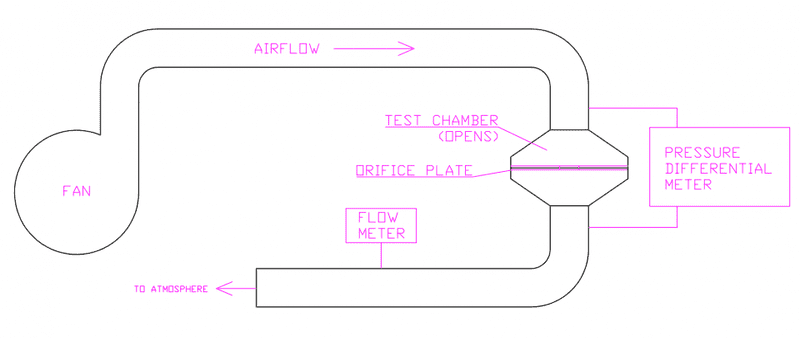
upload_2016-6-24_11-54-45.png
 
Engineering news on Phys.org
It's actually not an easy question. There are some empirical relationships that work reasonably well for situations where your orifice plate is situated in a circular tube, but how well they translate to the situation you have drawn above is not simple to ascertain. Wikipedia has a small entry on it, and I am sure you can find some better sources in engineering journals and literature, but your best bet is probably to just run some tests.
 
  • Like
Likes   Reactions: russguk
You can find significant information related to your issue by googling "orifice plate measurement accuracy standards". Based upon you diagram, one issue you should investigate is the recommended minimum approach and discharge straight pipe lengths for accurate flow measurements with orifices.
 
Last edited:
  • Like
Likes   Reactions: russguk
Get a copy of ASME PTC 19.5. The position of your plate in a divergent convergent nozzle looks dodgy, in general for flow measurement you're looking for 10 straight diameters upstream and five downstream, it looks to me that in the setup you have would produce turbulent flow.
 
  • Like
Likes   Reactions: russguk
OK, thank you for your help. Maybe it's probably best waiting until the meters are recalibrated and then make up a reference sample which we can use to verify the performance at periods inbetween.

Thanks once again.
 
if your test rig is only going to be used to measure flow rate through an orifice then
you should remove the expansion chamber from your test and also remove all of the turns
as these will affect the downstream pressure leading to the orifice and the upstream pressure
leading away from the orifice and remove the flow meter if it restricts any fluid flow.

get your differential pressure readings and then calculate the flow rate.
 
I need to start being more careful in looking at diagrams. I was so focused on the orifice segment that I totally overlooked the downstream flow meter. I had previously assumed that the orifice was your primary source of flow rate measurement for your system; but, now that I realize there is a downstream flow meter, I am confused about the purpose of the orifice in the test chamber that contains your test sample. Please clarify this issue.
 

Similar threads

Replies
4
Views
2K
Replies
5
Views
4K
  • · Replies 10 ·
Replies
10
Views
6K
  • · Replies 3 ·
Replies
3
Views
3K
  • · Replies 1 ·
Replies
1
Views
4K
  • · Replies 1 ·
Replies
1
Views
4K
  • · Replies 6 ·
Replies
6
Views
3K
  • · Replies 8 ·
Replies
8
Views
3K
  • · Replies 2 ·
Replies
2
Views
3K
Replies
1
Views
3K