Trying2Learn
- 375
- 57
- TL;DR
- How do you get the reaction forces that do no work
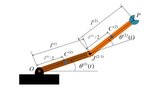
In this 2D figure below, I can place:
I can use Hamilton's principle, modified to the principle of virtual work and I can compute the motion of the linkage system.
I do not have to account for these force FOUR forces (in this planar problem):
However, how would I find those four reaction forces that do no work?
Would I first have to solve the entire problem using PVW, get the velocity, acceleration, angular velocity and angular acceleration?
And then, return to free body diagrams, and with the kinematics and inertial terms (mass and moment of inertia), go back and mathematically deduce what those forces SHOULD be?
How does software do it?
I have never seen a textbook discuss this. They just blithely (sometimes smugly) pronounce the power of PVW as being able to ignore forces that do no work (which is true and wonderful), but they never present a systematic way to go back and get those other forces that do no work.UNLESS: they enter as constraints, brought in by Lagrange multipliers. If so, then I must research that, alone (before bothering any of you--you have all been patient). However, in the absence of having to use that formality, how would YOU solve for these reaction forces that do no work? Can someone start me off so that I can then teach myself the Lagrange multipliers?
- a motor at O
- a motor at J
- gravity on each link
I can use Hamilton's principle, modified to the principle of virtual work and I can compute the motion of the linkage system.
I do not have to account for these force FOUR forces (in this planar problem):
- 2 Reaction forces at O (they do no work)
- 2 Reaction forces at J (they do no work)
However, how would I find those four reaction forces that do no work?
Would I first have to solve the entire problem using PVW, get the velocity, acceleration, angular velocity and angular acceleration?
And then, return to free body diagrams, and with the kinematics and inertial terms (mass and moment of inertia), go back and mathematically deduce what those forces SHOULD be?
How does software do it?
I have never seen a textbook discuss this. They just blithely (sometimes smugly) pronounce the power of PVW as being able to ignore forces that do no work (which is true and wonderful), but they never present a systematic way to go back and get those other forces that do no work.UNLESS: they enter as constraints, brought in by Lagrange multipliers. If so, then I must research that, alone (before bothering any of you--you have all been patient). However, in the absence of having to use that formality, how would YOU solve for these reaction forces that do no work? Can someone start me off so that I can then teach myself the Lagrange multipliers?
Attachments
Last edited: