Double Integral Problem: Incorrect Jacobian Calculation for Polar Coordinates

Click For Summary
The discussion centers on calculating a double integral over a specified region using polar coordinates, where the integrand involves y^2. A participant encounters an issue with the Jacobian calculation, obtaining a value of 2 instead of the expected 8 as per the professor's solution. The correct approach involves using a parametrization for the ellipse that simplifies the integration process, leading to the appropriate Jacobian factor. After adjustments, the integrals are correctly set up, confirming that the Jacobian should indeed yield a factor of 2, contributing to the overall calculations. The conversation emphasizes the importance of proper parametrization in double integrals involving polar coordinates.
Amaelle
Messages
309
Reaction score
54
Homework Statement
integral of int y^2 dxdy over a region (look to the formula inside the exercice)
Relevant Equations
y=rcos(theta)
calculate the double integral
1597319551559.png


over the region of integration is
x^2 + y^2 ≤ 4; x^2 + (y/4)^2 ≥ 1
the integrals have been made over two regions
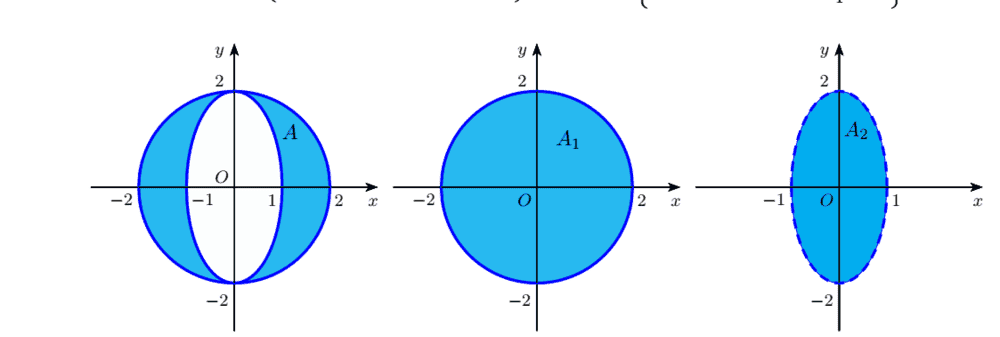
1597319752949.png


my problem is that when I go to the polar coordinate for the ellipsis and use the jacobian i got 2 instead of 8 ( the following is the professor solution)
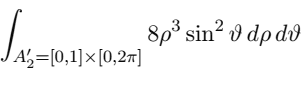
1597319891086.png


Any help?
many thanks in advance!
 
Physics news on Phys.org
\int_{A_1}y^2 dx dy = \int_0^{2\pi} d\theta \int_0^2 d\rho\ \rho^3 \sin^2\theta = 16 \int_0^{2\pi} d\theta \int_0^1 d\rho \ \rho^3 \sin^2\theta
A half of it,
\int_{A_2}y^2 dx dy = 8 \int_0^{2\pi} d\theta \int_0^1 d\rho \ \rho^3 \sin^2\theta=\int_{A_1-A_2}y^2 dx dy
What Jacobian you get ?
 
Last edited:
  • Like
Likes Amaelle
Amaelle said:
Homework Statement:: integral of int y^2 dxdy over a region (look to the formula inside the exercice)
Relevant Equations:: y=rcos(theta)

calculate the double integral
<br /> \int y^2\,dx\,dy<br />over the region of integration is
x^2 + y^2 ≤ 4; x^2 + (y/4)^2 ≥ 1
the integrals have been made over two regions

my problem is that when I go to the polar coordinate for the ellipsis and use the jacobian i got 2 instead of 8 ( the following is the professor solution)

Any help?
many thanks in advance!

For the ellipse, you need to use the parametrization <br /> \begin{align*} x &amp;= \rho \cos \vartheta, \\ y &amp;= 2\rho\sin \vartheta. \end{align*} With this choice, the ellipse is at \rho = 1, rather than the complicated function of \vartheta you would get from actual polar coordinates.

You should obtain a factor of 2 from the jacobian and a further two factors from the integrand.
 
  • Like
Likes Amaelle
Thanks a lot
so first change
u=x
v=y/2
so the jacobian equal 2
after
v=2rsin(theta)
v^2=4[sin(theta)]^2

I got it now
 
anuttarasammyak said:
\int_{A_1}y^2 dx dy = \int_0^{2\pi} d\theta \int_0^2 d\rho\ \rho^3 \sin^2\theta = 16 \int_0^{2\pi} d\theta \int_0^1 d\rho \ \rho^3 \sin^2\theta
A half of it,
\int_{A_2}y^2 dx dy = 8 \int_0^{2\pi} d\theta \int_0^1 d\rho \ \rho^3 \sin^2\theta=\int_{A_1-A_2}y^2 dx dy
What Jacobian you get ?
Thanks a lot!
 
Question: A clock's minute hand has length 4 and its hour hand has length 3. What is the distance between the tips at the moment when it is increasing most rapidly?(Putnam Exam Question) Answer: Making assumption that both the hands moves at constant angular velocities, the answer is ## \sqrt{7} .## But don't you think this assumption is somewhat doubtful and wrong?

Similar threads

  • · Replies 19 ·
Replies
19
Views
2K
Replies
3
Views
2K
Replies
2
Views
2K
Replies
4
Views
1K
  • · Replies 4 ·
Replies
4
Views
1K
Replies
10
Views
2K
  • · Replies 3 ·
Replies
3
Views
2K
  • · Replies 7 ·
Replies
7
Views
2K
  • · Replies 24 ·
Replies
24
Views
3K
  • · Replies 5 ·
Replies
5
Views
2K