Projectile from certain height

  • Context: High School 
  • Thread starter Thread starter gracy
  • Start date Start date
  • Tags Tags
    Height Projectile
Click For Summary

Discussion Overview

The discussion revolves around the application of projectile motion formulas when an object is launched from a height, as opposed to being launched from ground level. Participants explore the validity of various equations related to time of flight, range, and maximum height in this context.

Discussion Character

  • Technical explanation
  • Debate/contested
  • Mathematical reasoning

Main Points Raised

  • Some participants assert that the formula for time of flight, 2usin theta/g, is only applicable when the object is launched from the ground.
  • Others agree that this formula does not apply when the object is launched from a certain height.
  • Questions are raised regarding the applicability of the range formula (u^2sin 2 theta/g) and the maximum height formula (u^2 sin^2 theta/2g) in the case of launch from height.
  • One participant suggests starting from basic equations rather than memorizing formulas for special cases, indicating a preference for foundational understanding.
  • A participant describes a method of dividing the trajectory into two parts to derive time of flight and range, while also addressing maximum height.
  • Concerns are raised about the sign convention used in the equations, particularly regarding the initial velocity's contribution when taking downward as positive.
  • Corrections are made regarding the sign in the formula for vertical displacement, indicating a potential misunderstanding in the initial approach.

Areas of Agreement / Disagreement

Participants generally agree that the standard formulas for projectile motion may not apply when launched from a height, but there is disagreement on the specifics of the equations and the correct application of sign conventions in calculations.

Contextual Notes

Some participants express uncertainty about the correct application of formulas and the implications of sign conventions, indicating that assumptions about directionality and initial conditions are critical to the discussion.

gracy
Messages
2,486
Reaction score
83
Formula for time of flight in projectile motion is 2usin theta/g but I think it is only applicable for when object is launched from ground i.e in the case below
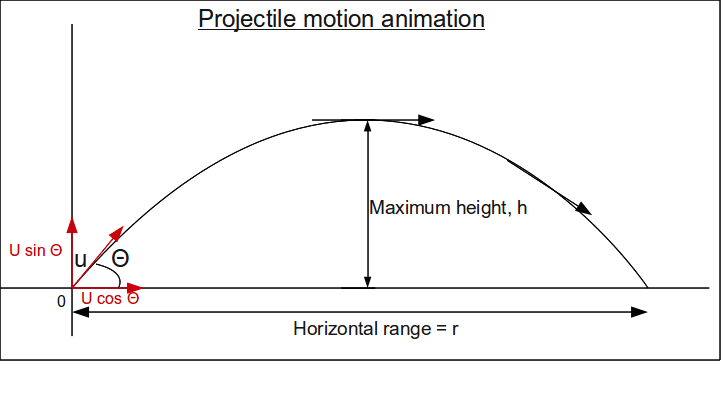
Projectile-motion-animation.png

But when it is launched from certain height this formula is no longer in use.
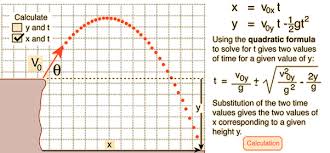
images?q=tbn:ANd9GcRjK4KyeUxJLwX90VQcMPICChwZ8V-Z5iL49ZLZ4wSKeiaxe-sE6Q.jpg
 
Last edited:
Physics news on Phys.org
Is there a question here?

Zz.
 
Am I right in my first post.
 
Yes, it does not work in the second case.
 
And what about range and maximum height.Formula for range=u^2sin 2 theta/g
and maximum height =u^2 sin^2 theta/2g
Are these formulas also not applicable for second case.
 
I think it would be more beneficial for you to try to answer these starting from the basic equations.
This is the way to study. Not memorizing some formulas for special cases.
 
  • Like
Likes   Reactions: sophiecentaur and PeroK
nasu said:
I think it would be more beneficial for you to try to answer these starting from the basic equations.
This is the way to study. Not memorizing some formulas for special cases.
I think ,you are right.I have done some calculations.Check whether I am correct.
 
I have divided the trajectory into two parts.
upload_2015-4-17_12-20-43.png


Now
S sub y (distance covered in y direction)=V0 sin theta T +1/2 g T^2
h=V0 sin theta T+1/2 g T^2
where T =time of flight
Now we can solve for T as other variables are given.The above equation forms quadratic equation.so we will gwt two values for T one of which will be negative ,as time can never be negative we will take the other one(positive value of T)
(I have taken downward direction to be positive)
And S sub x=(distance covered in x direction)=V0 cos theta t
If we put t=T in the equation we get
Vo cos theta T
which is nothing but Range.
For maximum height
I have again divided the trajectory in two parts

upload_2015-4-17_12-37-0.png

Now we can see the maximum height=h+h'
where h' is same as in case of object projected from horizontal surface and lands on the same horizontal surface.And h is given,hence we can find maximum height.
Is my work fine?
 
  • #10
If you take the downward direction to be positive then your formula for Sy as a function of time has the wrong sign on the contribution from the object's initial velocity.
 
  • Like
Likes   Reactions: gracy
  • #11
jbriggs444 said:
If you take the downward direction to be positive then your formula for Sy as a function of time has the wrong sign on the contribution from the object's initial velocity.
It should be as follows.
gracy said:
h=V0 sin theta T+1/2 g T^2
h= - V0 sin theta T +1/2g T^2
Right?
 
  • #12
Right.
 
  • #13
Thanks.
 

Similar threads

  • · Replies 4 ·
Replies
4
Views
2K
  • · Replies 1 ·
Replies
1
Views
3K
  • · Replies 4 ·
Replies
4
Views
2K
  • · Replies 2 ·
Replies
2
Views
2K
  • · Replies 9 ·
Replies
9
Views
16K
  • · Replies 25 ·
Replies
25
Views
4K
  • · Replies 3 ·
Replies
3
Views
16K
  • · Replies 4 ·
Replies
4
Views
2K
Replies
14
Views
2K
Replies
1
Views
2K