Projectile motion of tabletop ball?

Join the discussion
Ask a follow-up here, or get your own question answered by working scientists, mathematicians and engineers — people, not an autocomplete.
Real named experts · corrections over time · the nuance an AI answer skips
12 replies · 3K views
Sagrebella
Messages
61
Reaction score
2
Hello,

Could someone please check my answers to this physics problem? All my work and equations are clearly shown in the pictures below. If I got the problem wrong, please provide me with some suggestions as to how I can get it right . I'm not expecting anyone to just give me the answers :)

Thanks!

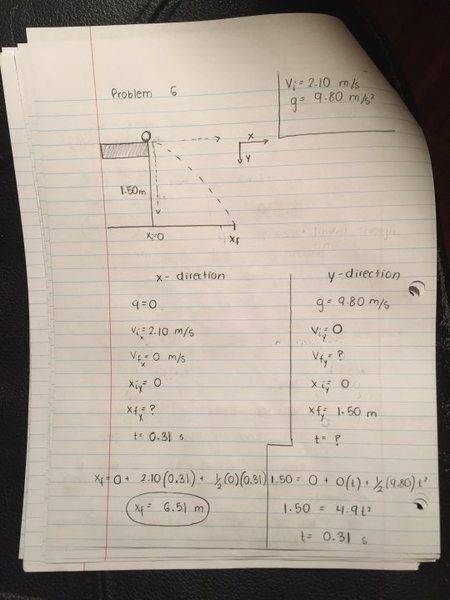
Problem 6

You flick a ball from a tabletop, so that the ball lands on the floor 1.50 m below. The ball's initial speed is 2.10 m/s. Use g = 9.80 m/s2.

(a) f the ball is launched off the table horizontally, what is the horizontal distance between the launch point and the point where the ball hits the floor?
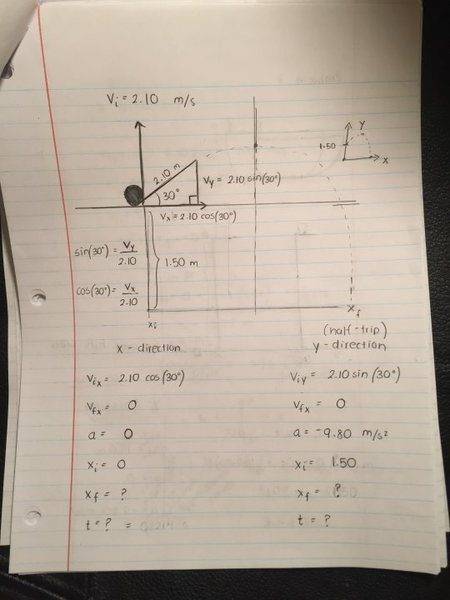
(b) If the ball is launched off the table at a 30° angle above the horizontal, what is the horizontal distance between the launch point and the point where the ball hits the floor?
IMG_3082 2.JPG
IMG_3083 2.JPG
IMG_3084 2.JPG
IMG_3085 2.JPG
 
on Phys.org
My compliments for your neat style of working !

Don't you think it's strange the ball should travel so far in part a) ? Check your math for 2.10 * 0.31 = ...

And if you find a flight time of 0.31 s in part a), wouldn't you expect it to be in the air a little longer in part b) ?

The mistake here is that you let it land with a ##v_{f, y}=0##. Just before impact that is definitely not true !.
You want to use one of the other SUVAT equations; can you determine which one you need ?
 
A few more suggestions: In a), ##v_{\rm f, x} = 0 \ ## is not right: there is no force in the x-direction (you yourself write ##a=0## too), so the motion is uniform with constant speed in that direction: ##v_{\rm f, x} = v_{\rm i, x} = 2.10 \;##m/s.

In b) you confuse yourself using ##v_{\rm f,x} ## for ##v_{\rm f,y} ##. And itis not zero.

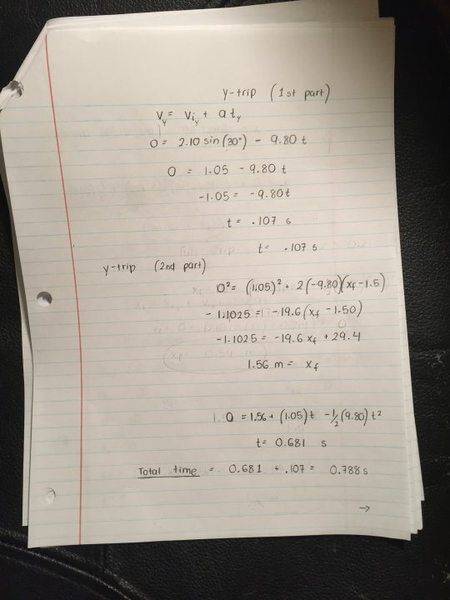
I have to admit to a too hasty response: I now see you split up the trip in two parts. One to the highest point and one from there to ground. Let me re-read and hopefully stand corrected ...
 
Alas, I can follow the 2nd part of the trip to the point ##x_f = 1.5056 ## m (rounding off is not such a good idea here, I think... --- and I would use a notation that has only ##y## in the y direction, but never mind...).

Then I see ##0 = ...## where you mix the initial ##y## at time t= 0.107 s and the initial ##v_{\rm i, y} ## at time t = 0. That's where things are going wrong. Fortunately, it's easy to fix: take both at t = 0 and solve the quadratic equation (you have to do that anyway) -- saves you half a page of extra work too !
 
Hi BvU,

thank you for your thorough explanation, and thanks for the compliment :wink:. Hopefully I interpreted your suggestions correctly when revising my work.

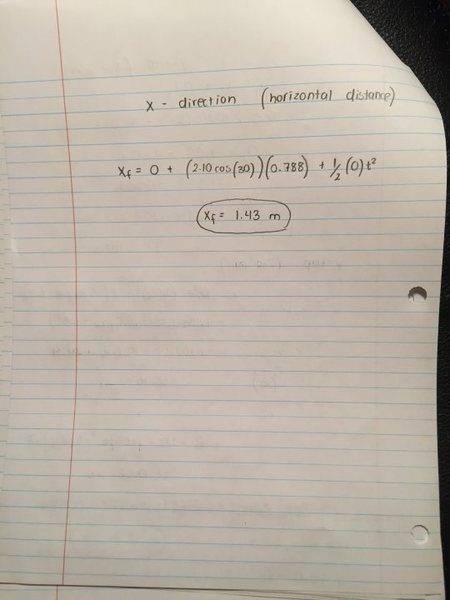
For part a) I rechecked my multiplication and got and got 0.65 meters. Hopefully that's correct

and I redid my work for part b) too (work posted below in the pictures). Would please mind checking again? Thanks

IMG_3086.JPG
IMG_3087.JPG
IMG_3088.JPG
 
Sagrebella said:
For part a) I rechecked my multiplication and got and got 0.65 meters. Hopefully that's correct
For part (a) you wrote:
upload_2017-2-13_13-55-49.png

Check the calculation you did for the last line.
 
Thanks @gneill , I sure missed that one !

@Sagrebella:

For part b) you now find the right answer, again in two steps: from 1.5 m to ##y_{\rm max}## and then from ##y_{\rm max}## to 0.
Do you realize you can do it in one step by solving $$y(t) = 0 = y_0 + v_0\cos\left ({\pi\over 6}\right ) t - {1\over 2} g t^2 \quad \rm ?$$
 
gneill said:
For part (a) you wrote:
View attachment 113149
Check the calculation you did for the last line.

thank you for catching that error. There are so many equations and numbers its hard to keep track sometimes :P
 
BvU said:
Thanks @gneill , I sure missed that one !

@Sagrebella:

For part b) you now find the right answer, again in two steps: from 1.5 m to ##y_{\rm max}## and then from ##y_{\rm max}## to 0.
Do you realize you can do it in one step by solving $$y(t) = 0 = y_0 + v_0\cos\left ({\pi\over 6}\right ) t - {1\over 2} g t^2 \quad \rm ?$$

Thanks for checking my answer. And actually I was going to ask you about solving it in one step; I still don't quite understand. Would you mind elaborating a little more please?
 
Sagrebella said:
Would you mind elaborating a little more please?
I believe there should be sin(π/6) instead of cos in BvU's equation for y(t).

The y displacement of the ball is -1.5m when it hits the floor. Instead of writing it in two parts, you can write it in a single equation that BvU wrote. Take v=2.10sin30, a=-9.81 m/s2 and y= -1.5m.
 
  • Like
Likes   Reactions: BvU
cnh1995 said:
I believe there should be sin(π/6) instead of cos in BvU's equation for y(t).

The y displacement of the ball is -1.5m when it hits the floor. Instead of writing it in two parts, you can write it in a single equation that BvU wrote. Take v=2.10sin30, a=-9.81 m/s2 and y= -1.5m.

Hello,

I know I asked this question a while ago, but I'm looking over my latest threads in order to review for a physics exam i'll be taking soon. I think I understand this problem, but would you mind explaining part b.) again please. How is it that I can solve for the total flight time of the ball using this one equation instead of breaking up the trip into two steps in the y-direction? Doesn't one have to consider the fact that the ball initially travels above the horizontal before landing on the ground?
 
Sagrebella said:
Doesn't one have to consider the fact that the ball initially travels above the horizontal before landing on the ground?
You have already considered that when you use vsin30° as the initial velocity and -g as the acceleration.