Proportional plus derivative controller

Click For Summary
SUMMARY

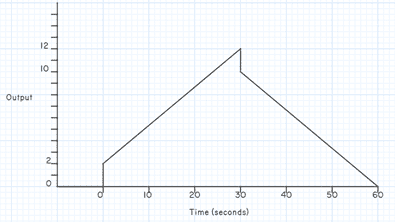
The discussion centers on the Proportional-Plus-Derivative (PD) controller, specifically addressing the calculation of gain and the resulting control signal behavior. The user identifies a proportional band (PB) of 20%, leading to a gain of 5, and calculates a derivative action based on a time delay of 0.1 minutes (6 seconds). The peak response is noted to reach 10 units at 30 seconds, with a subsequent reduction influenced by the derivative component. The conversation seeks additional resources to clarify the principles of PD control and validate the user's findings.

PREREQUISITES
  • Understanding of Proportional-Plus-Derivative (PD) control theory
  • Familiarity with control signal calculations and gain settings
  • Knowledge of time delay effects in control systems
  • Basic mathematical skills for analyzing control system responses
NEXT STEPS
  • Research "Proportional-Plus-Derivative controller design" for foundational concepts
  • Study "Control system response analysis" to understand peak and settling times
  • Explore "Gain scheduling in control systems" for advanced techniques
  • Investigate "Mathematical modeling of control systems" for practical applications
USEFUL FOR

Control engineers, automation specialists, and students studying control systems who seek to deepen their understanding of Proportional-Plus-Derivative controllers and their applications in system dynamics.

Jason-Li
Messages
119
Reaction score
14
Homework Statement
FIGURE 6 shows a proportional plus derivative controller that has a proportional band of 20% and a derivative action time of 0.1 minutes. Construct the shape of the output waveform for the triangular input waveform shown, if the input rises and falls at the rate of 4 units per minute.
Relevant Equations
None required
Hello,

There is a thread related to this question however it was marked correct but doesn't look correct to me?

https://www.physicsforums.com/threads/step-change-in-a-proportional-plus-integral-controller.961180/

I think I have it but it is quite different to other answers I have seen?
I have found
PB=20% hence gain=5
dAT = 0.1min = 6s
Would rise and peak at 2units at 30s however due to gain this will be 10units, hence change due to derivative would be:
10/30 * 6s = 2units, then once peaked at 30s it would reduce by the same derivative and create the following graph:
1610371239922.png
 
Physics news on Phys.org
spoto2 said:
Find out information about proportional-plus-derivative control. Control in which the control signal is a linear combination of the error signal and its derivative.
Can you post some links to such information that would be helpful for the Original Poster (OP)? Thanks.
 
@spoto2 @berkeman

Sorry I've looked at a few different sources but my graph still looks correct to me, any advice?
 
Not one of my areas of expertise, unfortunately. Jim is no longer with us (RIP), but @rude man still is at PF... :smile:
 
Hi Jason, Just wondered what your maths is behind this?
 
Tromso80 said:
Hi Jason, Just wondered what your maths is behind this?

The maths is in the first post, which part are you unsure of?
 

Similar threads

  • · Replies 14 ·
Replies
14
Views
4K
  • · Replies 0 ·
Replies
0
Views
2K
  • · Replies 11 ·
Replies
11
Views
4K
  • · Replies 6 ·
Replies
6
Views
2K
  • · Replies 12 ·
Replies
12
Views
4K
Replies
1
Views
2K
  • · Replies 7 ·
Replies
7
Views
2K
  • · Replies 3 ·
Replies
3
Views
3K
  • · Replies 5 ·
Replies
5
Views
3K
  • · Replies 6 ·
Replies
6
Views
3K