MHB Proving Subspace Properties for Sets of Polynomials in P3

  • Thread starter Thread starter chukkitty
  • Start date Start date
  • Tags Tags
    Subspace
Click For Summary
The discussion focuses on determining whether two sets of polynomials in P3 are subspaces. For item 1, it is concluded that the set is not a subspace because it fails to be closed under scalar multiplication when irrational numbers are involved. A counter-example is provided to illustrate this point. In contrast, item 2 is shown to be a subspace since it contains the zero vector and is closed under both vector addition and scalar multiplication. The participants emphasize the importance of verifying these conditions to establish subspace properties.
chukkitty
Messages
2
Reaction score
0
Hello,

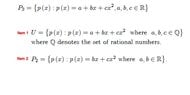
I want ask some subspace problems. Attachment is a question.
contains all polynomials with degree less than 3 and with real coefficients.

I want prove that item 1 and item 2 are subspace or not.

Am I insert real number to the item 1& 2 equation to test as follows:
(a) 0 ∈ S.
(b) S is closed under vector addition.
(c) S is closed under scalar multiplication.

Would you mind tell me how Determine whether the following sets are subspaces of P3. If it is a subspace, prove it. If it is not a subspace, give a counter-example.

Best Regard
Kitty
 

Attachments

  • subspace.jpg
    subspace.jpg
    14.4 KB · Views: 103
Physics news on Phys.org
Indeed what you have to do is to provide a proof that the sets have the 0, are closed to addition and scalar multiplication.

The important thing, that works for all problems of this type is that, when you have a set $\{ x: C(x) \}$, where $C(x)$ is the condition for the x to belong to the set, to verify that:

1-C(0) is true. This implies that 0 is in the set;
2-If C(x) and C(y) is true (equivalently, if x and y are in the set), then C(x+y) is true. This implies that x+y is in the set;
3- If C(x) is true, then $C(ax)$ is true, where $a$ is a scalar. This implies that $ax$ is in the set.The condition C for the first set in your exercise is a condition on a polinomial p. $C(p)$ is $p=a+bx+cx^2 \wedge a,b,c\in \mathbb{Q}$.

Teach a man how to fish... ;)
 
chukkitty said:
(a) 0 ∈ S.
(b) S is closed under vector addition.
(c) S is closed under scalar multiplication.

In general the first is not needed since it is already covered in the third condition . Since the set of rational numbers is closed under addition and multiplications , item 1 forms a subspace .

For item 2 , I think there is a mistake since you are not specifying what is c ?
 
ZaidAlyafey said:
In general the first is not needed since it is already covered in the third condition . Since the set of rational numbers is closed under addition and multiplications , item 1 forms a subspace .

For item 2 , I think there is a mistake since you are not specifying what is c ?

I think item 1 is not a subspace because it is not closed by multiplication by real scalars.
 
ModusPonens said:
I think item 1 is not a subspace because it is not closed by multiplication by real scalars.

Yup , I missed that . Thanks .
 
ZaidAlyafey said:
In general the first is not needed since it is already covered in the third condition

Not always. Previously we need to prove that $S\neq \emptyset$ (so, the best is to prove $0\in S$).
 
Dear All,

Thank you for your assistance.

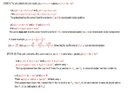
I would try to prove two items to belong subspace or not. Because I don't know to write some Maths symbol on internet. So please refer to attachment of my work image.

(ITEM 1) The set contains the zero vector, as a=b=c=0 given p(x)=0+0x+0x².
Let p₁(x)=a₁+b₁x+c₁x² and p₂(x)=a₂+b₂x+c₂x².
Then p₁(x)+p₂(x)=(a₁+a₂)+(b₁+b₂)x+(c₁+c₂)x²
This polynomial has the correct form for a vector in U, so U is closed under vector addition.
Let p(x)=a+bx+cx² and α=ℝ and a,b,c∈ℚ.
Then αp(x)=(αa)+(αb)x+(αc)x²
This vector does not have the correct form for a vector in U if α can be irrational number, so U is not closed under scalar multiplication.
A counter-example: p(x)=(1/7)+(2/(11))x+(5/3)x²
Let α=√(13), then αp(x)=((√(13))/7)+((2√(13))/(11))x+((5√(13))/3)x². Show that the coefficients of x⁰,x¹,x² are not rational number. (ITEM 2) The set contains the zero vector, as b=0 and any c given p(x)=0x+0x².
Let p₁(x)=b₁x+cx² and p₂(x)=b₂x+cx²
p₁(x)+p₂(x)= (b₁+b₂)x+(2c)x², where any c
This polynomial has the correct form for a vector in P₂, so P₂ is closed under vector addition.

Let p(x)=bx+cx² and α=ℝ
Then αp(x)=(αb)x+(αc)x² , where any c
This polynomial has the correct form for a vector in P₂, so P₂ is closed under scalar multiplication.
So P₂ is a subspace of P₃.

Please give me advise.

Thank you very much!

Kitty
 

Attachments

  • subspace-prove.jpg
    subspace-prove.jpg
    50.4 KB · Views: 111

Similar threads

  • · Replies 19 ·
Replies
19
Views
5K
Replies
6
Views
2K
  • · Replies 3 ·
Replies
3
Views
2K
  • · Replies 1 ·
Replies
1
Views
2K
  • · Replies 1 ·
Replies
1
Views
1K
  • · Replies 2 ·
Replies
2
Views
2K
  • · Replies 5 ·
Replies
5
Views
2K
  • · Replies 8 ·
Replies
8
Views
2K
  • · Replies 3 ·
Replies
3
Views
2K
  • · Replies 3 ·
Replies
3
Views
2K