Buzz Bloom
Gold Member
- 2,517
- 465
This thread is prompted by a closed thread which left it’s OP’s original question unanswered.
->https://www.physicsforums.com/threads/average-wavelength-for-blackbody-radiation.423536/
The original question asked:
I am guessing that the answer to this question is YES, but I am hopeful someone can cite a reference that confirms this. Also, the OP gave 1.84 as the value of this ratio for some unspecified temperature, but did not provide any references, so I would also like see a reference that will validate that this value is correct. If someone who can’t provide a citation knows with confidence that YES is correct or not, and/or that the ratio 1.84 is correct or not, I would much appreciate your letting me know this.
The OP also gave the value 0.29 for the product of peak wavelength and temperature, but gave no units. I found that this product is called the
->https://www.physicsforums.com/threads/average-wavelength-for-blackbody-radiation.423536/
The original question asked:
is the ratio, of (a) the wavelength corresponding to the average energy in the Planck’s Law distribution
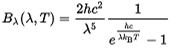
to (b) the wave length corresponding to the peak (maximum value) of this distribution, independent of temperature?
to (b) the wave length corresponding to the peak (maximum value) of this distribution, independent of temperature?
I am guessing that the answer to this question is YES, but I am hopeful someone can cite a reference that confirms this. Also, the OP gave 1.84 as the value of this ratio for some unspecified temperature, but did not provide any references, so I would also like see a reference that will validate that this value is correct. If someone who can’t provide a citation knows with confidence that YES is correct or not, and/or that the ratio 1.84 is correct or not, I would much appreciate your letting me know this.
The OP also gave the value 0.29 for the product of peak wavelength and temperature, but gave no units. I found that this product is called the
Wien wavelength displacement law constant,
and it is represented by “b” and has the value-b = 2.8977729(17) x 10^-3 m K.
http://physics.nist.gov/cgi-bin/cuu/Value?bwien
http://physics.nist.gov/cgi-bin/cuu/Value?bwien


