Quantum mechanics - infinite square well problem

12 replies · 3K views · last reply
Graham87
Messages
72
Reaction score
16
Homework Statement
For a wave function evaluate the following integral
Relevant Equations
Infinite square well equations
Typeset problem parts c and d: c) asks to show that Psi(x,0) = sqrt(3) times the sum from n=1 to infinity of (1/2^n) psi_n(x) is normalized; d) asks to evaluate the integral from 0 to a of sin(2pi x/a) cos(2pi x/a) Psi(x,0) dx.


I have solved c), but don’t know how to solve the integral in d.
It looks like an integral to get c_n (photo below), but I still can’t figure out what to make of c) in the integral of d).
Handwritten formula for the expansion coefficient c_n: c_n = sqrt(2/a) times the integral from 0 to a of sin(nπ/a x) multiplied by Ψ(x,0) dx, written inside a rectangular box on grid paper.


I also thought maybe you can rewrite c) into an initial wave function (photo below) with A,x,a but don’t know how.
Textbook figure of the initial wave function Psi(x, 0) for a particle in an infinite square well, a parabolic arch rising from zero at x = 0 to a peak of Aa^2/4 and falling back to zero at x = a, with zero outside the well.

Thanks!
 
  • Like
Likes   Reactions: Delta2
Graham87 said:
I have solved c), but don’t know how to solve the integral in d.

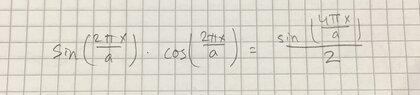
Consider using a trig identity to write ##\sin\left(\frac{2\pi}{a}x\right)\cos\left(\frac{2\pi}{a}x\right)## in a way that will be helpful in evaluating the integral.
 
  • Like
Likes   Reactions: Graham87 and Delta2
I tried like this already, but I still don’t know how to deal with c) in the integral.
 
Attachments
  • Handwritten trig identity on grid paper: sin(2πx/a) · cos(2πx/a) = sin(4πx/a) / 2.
    8BE62874-9E0F-4B97-A101-BABE052364B9.jpeg
    18.1 KB · Views: 169
Graham87 said:
I tried like this already, but I still don’t know how to deal with c) in the integral.
OK, good. Can you relate ##\large\frac{\sin\left(\frac{4\pi x}{a}\right)}{2}## to one of the ##\psi_n(x)##?
 
  • Like
Likes   Reactions: Graham87 and Delta2
TSny said:
OK, good. Can you relate ##\large\frac{\sin\left(\frac{4\pi x}{a}\right)}{2}## to one of the ##\psi_n(x)##?
ψ4(x) ?
 
  • Like
Likes   Reactions: Delta2
Graham87 said:
ψ4(x) ?
Exactly what is the relation between ##\large\frac{\sin\left(\frac{4\pi x}{a}\right)}{2}## and ##\psi_4(x)##?
 
  • Like
Likes   Reactions: Graham87 and Delta2
TSny said:
Exactly what is the relation between ##\large\frac{\sin\left(\frac{4\pi x}{a}\right)}{2}## and ##\psi_4(x)##?
Same n?
How does this look?
Handwritten derivation on grid paper: integral from 0 to a of sin(4πx/a)/2 times Ψ(x,0) dx equals integral from 0 to a of sin(4πx/a)/2 times sqrt(3) times (1/2^4) times sqrt(2/a) sin(4πx/a) dx, which equals sqrt(6/a) times (1/2^5) times integral from 0 to a of sin²(4πx/a) dx.


I don’t think it’s correct because c_4 is not the same answer.
 
Graham87 said:
How does this look?View attachment 303556
That will work.

However, it's maybe a little nicer to show ##\large\frac{\sin\left(\frac{4\pi x}{a}\right)}{2} = \frac{\sqrt{2a}}{4}\psi_4(x)## . Then you don't need to do any explicit integration. Just use the orthonormality of the ##\psi_n(x)##.
 
  • Like
Likes   Reactions: Delta2, Graham87, PeroK and 1 other person
TSny said:
That will work.

However, it's maybe a little nicer to show ##\large\frac{\sin\left(\frac{4\pi x}{a}\right)}{2} = \frac{\sqrt{2a}}{4}\psi_4(x)## . Then you don't need to do any explicit integration. Just use the orthonormality of the ##\psi_n(x)##.
So like this?
Handwritten integral on graph paper: the integral of sqrt(2a)/4 times psi_4 times psi_4 dx, set equal to sqrt(2a)/4, underlined twice.


I found the integral d) similar to this.
Handwritten boxed formula: c_n = sqrt(2/a) integral from 0 to a of sin(n pi x / a) Psi(x,0) dx, written on grid paper.

Is it wrong to assume that c_4 should be the same as my answer in d)?
In that case my answer in d is not correct.
 
You're asking, are
$$\frac{\sqrt{2a}}{4} \int \psi_4^2\,dx$$ and $$\int \psi_4^2\,dx$$ equal? I think you should be able to answer that on your own. :)
 
  • Like
Likes   Reactions: Graham87
You need to calculate ##\int_0^a{\sin\left(\frac{2\pi x}{a}\right)\cos\left(\frac{2\pi x}{a}\right)}\Psi(x,0)dx##

Write this as ##\frac{\sqrt{2a}}{4}\int_0^a\psi_4(x)\Psi(x,0)dx##.

Substitute the given expression for ##\Psi(x,0)## and evaluate using the orthonormality of the ##\psi_n(x)##.

You should get the same answer as you got in post #7.
 
  • Like
  • Love
Likes   Reactions: Delta2, PeroK and Graham87
Graham87 said:
Big thanks! Got it!
In general, it's a good habit to use the notation ##\psi_n(x)## and use the general properties of eigenfunctions - especially orthonormality - as much as possible. And only resort to the specific eigenfunctions when necessary.
 
  • Like
  • Informative
Likes   Reactions: Graham87, Delta2 and TSny