Question about a double integral region

Click For Summary
SUMMARY

The discussion centers on determining the correct region of integration for a double integral involving the curves y = √x and y = 2 - x. The user initially miscalculated the intersection points, mistakenly identifying x = 5 as a solution. The correct intersection points are x = 1 and x = 4, with the valid region for integration defined as x in [0, 1] and y in [0, √2]. The analytical confusion was clarified through graphical representation and inequality analysis.

PREREQUISITES
  • Understanding of double integrals in calculus
  • Familiarity with curve intersections and inequalities
  • Knowledge of the functions y = √x and y = 2 - x
  • Ability to graph functions in the xy-plane
NEXT STEPS
  • Study the method of determining regions of integration for double integrals
  • Learn about inequalities in calculus and their applications in integration
  • Explore graphical methods for visualizing function intersections
  • Review the properties of the functions y = √x and y = 2 - x in detail
USEFUL FOR

Students and professionals in mathematics, particularly those studying calculus and integration techniques, as well as educators looking to clarify concepts related to double integrals and graphical analysis.

Amaelle
Messages
309
Reaction score
54
Homework Statement
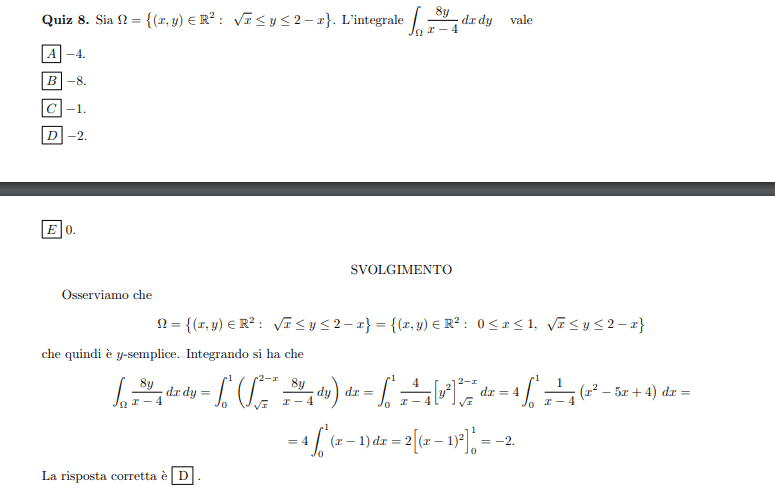
look at the image
Relevant Equations
double integral
Greetings All!

I have a problem finding the correct solution at first glance

My error was to determine the region of integration , for doing so I had to the intersection between y= sqrt(x) and y=2-x

to do so
x=(2-x)^2
to find at the end that x=1 or x=5

while graphically we can see that the region start from x=0 they intersect in x=1 and never meet again!

could someone help me with my confusion ?

Thank you!
1644410525129.png


Attachments

  • 1644410449256.png
    1644410449256.png
    19 KB · Views: 152
Physics news on Phys.org
Drawing the region on xy plane would help you.
 
anuttarasammyak said:
Drawing the region on xy plane would help you.
yes this i what I done
I just want to know why my analitical results was wrong
 
Where exactly was your confusion? The region looks like this:
https://www.wolframalpha.com/input?i=root(x)+<+y+<+2-x
##x## is in ##[0,1]## and ##y## in ##[0,\sqrt{2}]##.

I don't see where you got ##x=5## from. Say ##t:=\sqrt{x}##. Then ##t^2+t-2=\left(t+1/2\right)^2-(1.5)^2\leq 0## and so ##0\leq t = \sqrt{x} \leq 1.5-0.5=1##.
 
The solutions are x=1 and x=4 but the x=4 solution is not accepted because we want 2-x to be greater than zero. Remember that the inequality is $$0\leq \sqrt x\leq y\leq 2-x$$
 
Delta2 said:
The solutions are x=1 and x=4 but the x=4 solution is not accepted because we want 2-x to be greater than zero. Remember that the inequality is $$0\leq \sqrt x\leq y\leq 2-x$$
thanks a million! you nail it!
 
Question: A clock's minute hand has length 4 and its hour hand has length 3. What is the distance between the tips at the moment when it is increasing most rapidly?(Putnam Exam Question) Answer: Making assumption that both the hands moves at constant angular velocities, the answer is ## \sqrt{7} .## But don't you think this assumption is somewhat doubtful and wrong?

Similar threads

  • · Replies 19 ·
Replies
19
Views
2K
  • · Replies 17 ·
Replies
17
Views
4K
  • · Replies 3 ·
Replies
3
Views
2K
  • · Replies 27 ·
Replies
27
Views
3K
Replies
2
Views
2K
Replies
9
Views
1K
Replies
4
Views
2K
  • · Replies 10 ·
Replies
10
Views
2K
Replies
4
Views
2K
  • · Replies 2 ·
Replies
2
Views
1K