Question about current flow and diode?

Click For Summary

Discussion Overview

The discussion revolves around the behavior of diodes in a circuit simulation, specifically addressing the direction of current flow and the voltage characteristics when a diode is included in the circuit. Participants explore the implications of the diode's symbol and its effect on current and voltage in a practical scenario.

Discussion Character

  • Technical explanation
  • Debate/contested
  • Mathematical reasoning

Main Points Raised

  • One participant expresses confusion about the direction of current flow indicated by the diode symbol, questioning whether diodes block current in the direction of the arrow.
  • Some participants assert that current flows in the direction of the arrow in the diode symbol, with one noting that conventional current flows in that direction while electron current flows in the opposite direction.
  • Another participant explains that a silicon diode does not conduct until the voltage across it reaches approximately 0.7V, suggesting that the diode limits current flow when the voltage is below this threshold.
  • A participant questions why the voltage drops when it is positive, expecting the diode to allow positive flow and impede negative flow.
  • One participant clarifies that the observed voltage drop is due to the diode clamping the output voltage at around 0.7V when it conducts, rather than an issue with current flow.
  • A later reply acknowledges the explanation and indicates a change in understanding regarding the voltage and current relationship in the circuit.

Areas of Agreement / Disagreement

Participants express differing views on the interpretation of current flow and voltage behavior in the presence of a diode. While some clarify the operation of the diode, the initial confusion about current direction and voltage drop indicates that the discussion remains somewhat unresolved.

Contextual Notes

Participants reference the specific voltage threshold for silicon diodes and the distinction between conventional and electron current, which may depend on definitions and assumptions about current flow in circuits.
Ascendant78
Messages
327
Reaction score
0
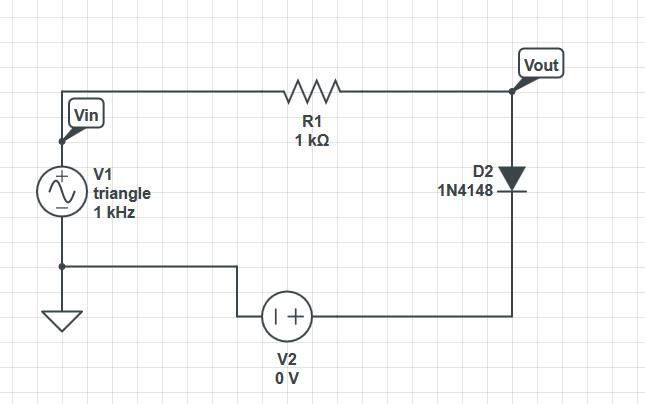
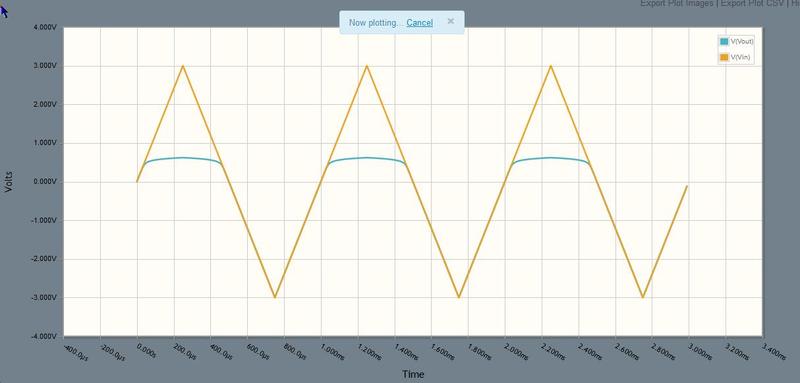
Ok, I'm trying to simulate a circuit containing a diode and I am a bit confused. I thought the arrow direction on the diode symbol shows which direction the current is able to flow through it. However, in my simulation, it is showing that the diode is limiting current flow in the exact opposite direction. Here are the images

Screen_Shot009.jpg


Screen_Shot010.jpg


Can someone please make sense of this to me? Do diodes actually block current in the direction of the arrow on their symbol? This just doesn't seem right to me.
 
Engineering news on Phys.org
jedishrfu said:
Current flows in the direction of the arrow in the diode.

https://en.m.wikipedia.org/wiki/Diode
Conventional current flows in the direction of the arrow in the diode.

Electron current flows in the other direction
 
  • Like
Likes   Reactions: Dr. Funkytron, Ascendant78 and jedishrfu
it is showing that the diode is limiting current flow in the exact opposite direction
The diode doesn't start conducting until the voltage across it reaches around 0.7v ( for silicon). As V1 increases positive, the IR takes up the rest of the voltage.
 
  • Like
Likes   Reactions: Ascendant78
That's what I thought, but then why is my voltage dropping when it is positive? I would think with this setup, the diode should allow the positive to flow, but impede the negative?
 
You are not looking at current flow, you are looking at voltage.

If the diode were an open circuit, then Vin and Vout would always be equal ( a full triangle wave).

Put in the diode, and Vout cannot go above 0.7V because the diode turns on and conducts current at that point, clamping the voltage at ~0.7V.

Look at the current through V2 (or anywhere for that matter).
 
  • Like
Likes   Reactions: Dr. Funkytron, jedishrfu, davenn and 1 other person
Oh, ok I get it now. I was simply looking at it wrong. Thank you.
 
meBigGuy said:
You are not looking at current flow, you are looking at voltage.

If the diode were an open circuit, then Vin and Vout would always be equal ( a full triangle wave).

Put in the diode, and Vout cannot go above 0.7V because the diode turns on and conducts current at that point, clamping the voltage at ~0.7V.

Look at the current through V2 (or anywhere for that matter).

nice explanation ... I should have known that haha :wink:Dave
 

Similar threads

  • · Replies 2 ·
Replies
2
Views
2K
Replies
3
Views
2K
  • · Replies 4 ·
Replies
4
Views
2K
Replies
7
Views
3K
  • · Replies 6 ·
Replies
6
Views
3K
  • · Replies 14 ·
Replies
14
Views
3K
  • · Replies 11 ·
Replies
11
Views
4K
  • · Replies 12 ·
Replies
12
Views
2K
  • · Replies 5 ·
Replies
5
Views
5K
Replies
19
Views
7K