Questions about the workings of a phase locked loop

  • Context: Engineering 
  • Thread starter Thread starter Master1022
  • Start date Start date
  • Tags Tags
    Loop Phase
Click For Summary

Discussion Overview

The discussion revolves around the operation of a Phase Locked Loop (PLL), specifically addressing the role of low-pass filters within the system, the relationship between filter bandwidth and locking range, and the behavior of the PLL under various conditions. Participants explore both theoretical and practical aspects of PLL functionality, including its application in frequency modulation.

Discussion Character

  • Exploratory
  • Technical explanation
  • Debate/contested
  • Mathematical reasoning

Main Points Raised

  • Some participants question the necessity of an additional low-pass filter ## G_f (s) ## after the initial filtering, suggesting that the PLL could function without it.
  • There is a discussion about the definitions of capture range and locking range, with some participants clarifying that the capture range is the frequency range the PLL can initially sync with, while the locking range is the range it can maintain lock after acquiring it.
  • Some participants propose that the loop filter bandwidth influences the PLL's performance, affecting capture, lock, and speed, although others argue that the locking range is more dependent on the VCO and phase detector characteristics.
  • One participant raises the question of whether the PLL remains locked despite instantaneous discrepancies between the reference and VCO output, with responses indicating that it can remain locked within reasonable limits.
  • There is a query regarding the output signal behavior when the reference input frequency is outside the PLL range, with responses indicating that the output becomes chaotic under such conditions.
  • Another participant suggests that the final filter may be necessary to manage harmonics generated by the PLL, although this is contested based on the absence of a frequency divider in the circuit.

Areas of Agreement / Disagreement

Participants express uncertainty about the necessity and role of the additional low-pass filter, and there is no consensus on the exact relationship between filter bandwidth and locking range. The discussion remains unresolved regarding the implications of PLL behavior when the reference frequency is outside its operational range.

Contextual Notes

Participants note that the definitions of capture range and locking range may depend on specific system requirements, and the influence of the loop filter on performance is acknowledged but not fully resolved. The discussion also highlights the complexity of PLL behavior in practical applications.

Master1022
Messages
590
Reaction score
116
Homework Statement
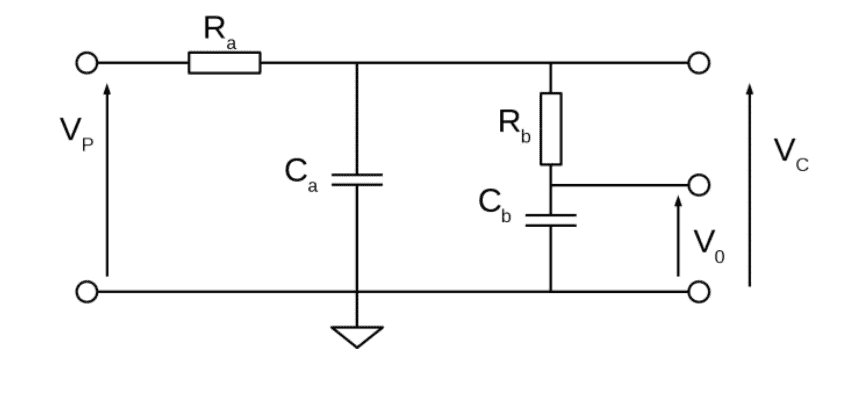
1) What is the point of having another (low-pass) filter ## G_f (s) ## for ## V_o ## after already passing the voltage through a low pass filter?
2) Is there any particular relationship between the bandwidth of the low pass filter and the locking range of the PLL?
Relevant Equations
LPF
Hi,

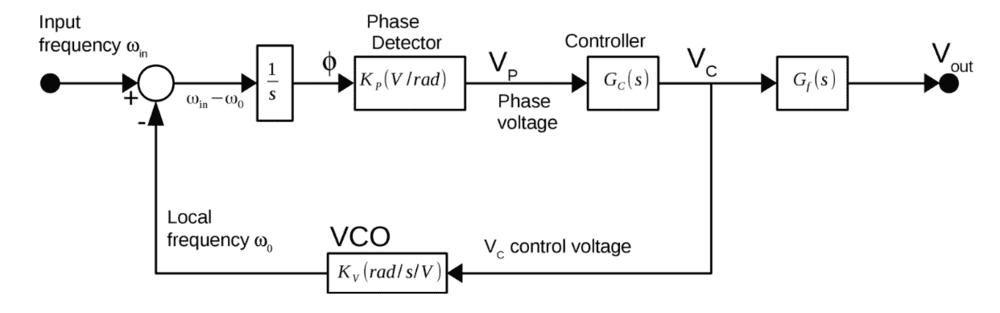
I had one or two questions about the operation of a PLL, which refer to the diagrams below - a control representation of the system and a diagram of the low pass filter circuit.
Screen Shot 2021-03-01 at 9.55.53 PM.png


Screen Shot 2021-03-01 at 9.55.35 PM.png


Questions:
1) What is the point of having another (low-pass) filter ## G_f (s) ## for ## V_o ## after already passing the voltage through a low pass filter?

I know that we want to filter the pulses output from the phase detector to form a voltage to input into the VCO. However, why is there another filter ## G_f (s) ## that acts before the output ## V_o##?

2) Is there any particular relationship between the bandwidth of the low pass filter and the locking range of the PLL?
I think I am slightly confused as to what these terms mean. Is the locking range the frequency range over which the PLL works (i.e. can detect signal frequencies between ## x ## and ## y ##)? The bandwidth of the low pass filter determines the speed of response of the PLL?

Any help is greatly appreciated.
 
Physics news on Phys.org
Master1022 said:
1) What is the point of having another (low-pass) filter Gf(s) for Vo after already passing the voltage through a low pass filter?
I know that we want to filter the pulses output from the phase detector to form a voltage to input into the VCO. However, why is there another filter Gf(s) that acts before the output Vo?
I don't understand either. The PLL function ends at Vc, the frequency feedback. After all, you could disconnect Vo from Vc and you'd still have a perfectly functional PLL. You'll have to find the person that drew that block diagram and ask them. There are lots of reasons you may want to filter signals in a system, but you need to know about the system requirements to discuss those design aspects.

Master1022 said:
2) Is there any particular relationship between the bandwidth of the low pass filter and the locking range of the PLL?
I think I am slightly confused as to what these terms mean. Is the locking range the frequency range over which the PLL works (i.e. can detect signal frequencies between x and y)? The bandwidth of the low pass filter determines the speed of response of the PLL?
The capture range is the range of input frequencies that the PLL can sync with starting from the un-locked state.

The locking range is the range of input frequencies the loop can follow (stay locked to) after it has acquired lock within it's capture range. Of course, the locking range is always at least as large as the capture range.

The question about the effect of the loop filters is hard to answer. In general, that filter determines almost everything about how the loop works. So, yes, capture, lock, speed, all of it depends on the loop gain. Normally the phase detector and VCO are assumed to not really have any frequency dependence beyond the fundamental stuff they have to have, like phase being the integral of frequency.

edit: On second thought, the loop filter bandwidth is often irrelevant in determining the lock range, that usually has more to do with the VCO and phase detector or integrator ranges. The assumption is that the frequency is changed slowly when determining the locking range.
 
  • Like
Likes   Reactions: Master1022
Thank you @DaveE !

DaveE said:
I don't understand either. The PLL function ends at Vc, the frequency feedback. After all, you could disconnect Vo from Vc and you'd still have a perfectly functional PLL. You'll have to find the person that drew that block diagram and ask them. There are lots of reasons you may want to filter signals in a system, but you need to know about the system requirements to discuss those design aspects.
Yes, I will try to find who has created that diagram.

DaveE said:
The capture range is the range of input frequencies that the PLL can sync with starting from the un-locked state.

The locking range is the range of input frequencies the loop can follow (stay locked to) after it has acquired lock within it's capture range. Of course, the locking range is always at least as large as the capture range.
Okay, thanks. Do we say that the signal remains locked even if there is an instantaneous discrepancy between the reference and VCO output (due to the time the feedback loop takes)?

Follow up question relating to FM signal demodulation:
For FM modulation example above, the instantaneous frequency varies proportional to the message signal ##f_{instantaneous} = f_{center} + ks(t) ## and ##s(t)## is the message signal. Just as a follow up to check my understanding, am I correct in thinking that ##V_c ## (signal that feeds into VCO) is the signal that would track the information component in a frequency modulated signal? Would we want the center frequency of our to be in the capture range, whilst having the maximum and minimum frequencies ## f_ {center} \pm k|s(t)_{max}|## at least within the lock range?

DaveE said:
The question about the effect of the loop filters is hard to answer. In general, that filter determines almost everything about how the loop works. So, yes, capture, lock, speed, all of it depends on the loop gain. Normally the phase detector and VCO are assumed to not really have any frequency dependence beyond the fundamental stuff they have to have, like phase being the integral of frequency.

edit: On second thought, the loop filter bandwidth is often irrelevant in determining the lock range, that usually has more to do with the VCO and phase detector or integrator ranges. The assumption is that the frequency is changed slowly when determining the locking range.
Okay that makes more sense.
 
Is the reason for the final filter because the PLL can generate frequencies that are multiples (harmonics) of the input frequency? Just asking.
 
Master1022 said:
Okay, thanks. Do we say that the signal remains locked even if there is an instantaneous discrepancy between the reference and VCO output (due to the time the feedback loop takes)?
Yes, within reasonable limits. If the PLL isn't locked you will see somewhat chaotic deviations in the VCO as the phase detector output varies greatly.

Master1022 said:
Would we want the center frequency of our to be in the capture range, whilst having the maximum and minimum frequencies fcenter±k|s(t)max| at least within the lock range?
I'm not sure, that's kind of a complicated question. I would guess that the PLL will lock ok. But, theoretically, you could have a DC signal that is outside of the capture range.

In practice the FM deviation is usually rather small so it is easy to have all of in within the capture range. In more sophisticated systems, people will adjust the bandwith/gain of the loop based on the locked/unlock status so an unlocked loop has wider bandwith. Then if you need the performance of a narrow bandwidth, you do that after the loop is locked.
 
Last edited:
  • Like
Likes   Reactions: Master1022
Thank you once again for your response.

DaveE said:
Yes, within reasonable limits. If the PLL isn't locked you will see somewhat chaotic deviations in the VCO as the phase detector output varies greatly.
Okay cool.

One final question I have is what happens when the reference input frequency is outside of the PLL range? What does the output signal look like then?
 
Thanks for your post @Fred Wright .

Fred Wright said:
Is the reason for the final filter because the PLL can generate frequencies that are multiples (harmonics) of the input frequency? Just asking.
That's a good point. However, and please do correct me if I am wrong, I believe that requires there to be a frequency divider in the (feedback loop of the) control system/circuit. Unless the frequency divider is included in one of the elements, I don't think this particular circuit has that component.
 
Master1022 said:
One final question I have is what happens when the reference input frequency is outside of the PLL range? What does the output signal look like then?
It's vary chaotic. Since the output of the phase detector is always changing. Phase detection only makes sense for signals with the same frequency.

Of course the loop filter plays a roll in this. If it is very slow then it may average the PD output somewhat, so VCO can't change as quickly or reach it's extreme values. But when the PLL is locked then the PD output can be more stable at extreme values which can then get through the loop filter. This is one reason why the capture range is smaller than the lock range. It also explains why you will sometimes see a PLL that captures an extreme input very slowly; the average VCO input isn't always in the center of the range and then will bias the PD output in turn. As the average VCO input moves, so does the capture range. It's a very complicated subject if you examine it closely.
 
Fred Wright said:
Is the reason for the final filter because the PLL can generate frequencies that are multiples (harmonics) of the input frequency? Just asking.
Maybe, but recall that the output in this case is the lower frequency (filtered) PD output/VCO input. The "baseband" not the "carrier". So, much of that filtering can be done in the loop filter. Still there may be filtering requirements that they don't want messing up their PLL feedback loop. For example many HF receivers offer FM in both "wide" and "narrow" modes. This is undoubtedly filtering after the PLL that tracks/demodulates the carrier. More related to downstream functions like AGC or audio output.

Anyway, it's not a generalized thing. It all depends on what sort of machine these guys want.
 
  • #10
What they are calling the phase detector has only one input. Seems foreign to me.
 
  • #11
Averagesupernova said:
What they are calling the phase detector has only one input. Seems foreign to me.
Yes, the summer, integrator, and phase detector are all part of the same thing. But I do like that they explicitly show the integration function in the loop. That's the part that many don't understand.

There are different types of phase detectors, but the xor gate is one of the most common. It is a 1 bit summer, so these diagrams are often drawn this way. Maybe because it looks like conventional feedback systems?
 
  • Like
Likes   Reactions: alan123hk

Similar threads

Replies
2
Views
2K
Replies
26
Views
7K
  • · Replies 3 ·
Replies
3
Views
3K
  • · Replies 3 ·
Replies
3
Views
2K
  • · Replies 4 ·
Replies
4
Views
3K
Replies
2
Views
2K
Replies
2
Views
2K
Replies
2
Views
3K
  • · Replies 2 ·
Replies
2
Views
2K
  • · Replies 1 ·
Replies
1
Views
3K