gnurf said:
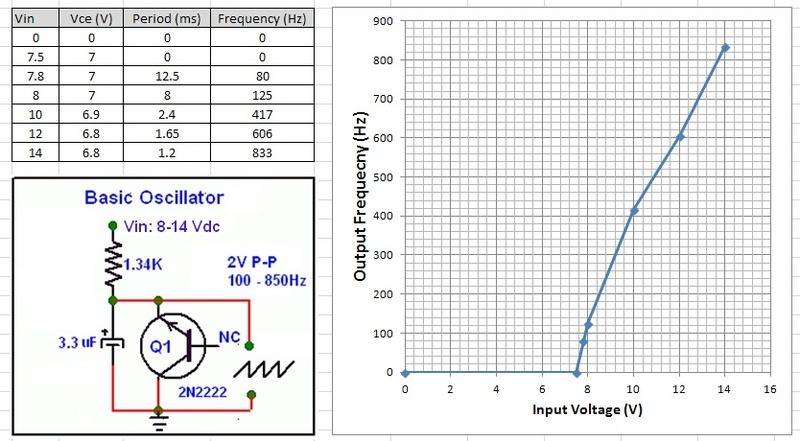
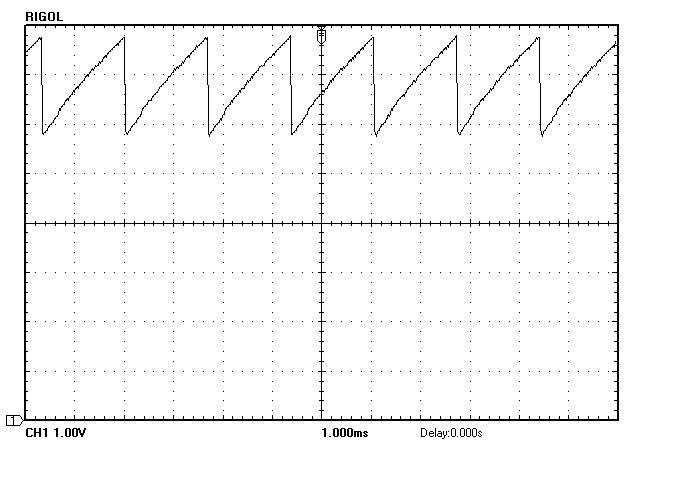
Simulator? The circuit and waveform are real.
My oops!
As Jony130 observed that
- the (small)
reverse current gain does not drop the breakdown voltage of a PNP with open base,
- this is
consistent with only NPN oscillating
- and with the explanation through (reversed)
Vces and Vceo.
-----
The few times I tested a
reverse beta for PNP, it has nothing shocking. There was some gain, not strikingly lower than for an NPN, so I suppose this is
not a sufficient explanation.
-----
My complementary explanation, but it's not trivial.
Avalanche is not symmetric. To sustain itself, it needs new electrons and holes be brought in the impact zone, otherwise the avalanche is just blown away by lack of one carrier. This, in conjunction with a varying field strength, is used in some particle detectors (proportional avalanche) to multiply the charge without runaway.
Now,
electrons are more efficient than holes to create new pairs. It's a matter of mass (similar to impedance matching, fit E and p instead of U and I) between already energetic carriers and the E and p of the bandgap.
Reverse-avalanche the emitter-base of an
NPN: electrons are injected in the emitter, holes in the not-depleted base region, and
at the limit holes don't create new electrons efficiently by impact. Now, these holes make a base current which the reverse beta can amplify, letting the
collector inject fresh electrons in the base which supplement the inefficient impact of holes. So (reverse)
beta helps an NPN avalanche.
In a
PNP, electrons leave the depleted zone in the base, and these can create new holes by impact efficiently. So
beta helps avalanche less in a PNP (a reversed PNP).
-----
There can be more reasons. Production processes aren't symmetric, for instance As (N dopant) diffuses very little in Si, B diffuses faster and P even faster, so As emitters achieve a steeper emitter profile that improves NPN transistors. Electrons are more mobile as well, and so on.
Current gain has much to do with doping profile and ratio (and very little with carrier lifetime, sorry books and teachers) so the reverse beta is not easy to justify. Compare doping in thee xpiaxial collector with doping in the base very near to the junction, and as well the dopant gradient within the base...