Rate of change when filling container
- Context: MHB
- Thread starter Milly
- Start date
Click For Summary
Discussion Overview
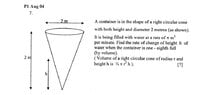
The discussion revolves around determining the rate of change of volume when filling a container shaped like a cone. Participants explore the relationship between volume and height, using mathematical reasoning and geometric principles. The conversation includes attempts to derive formulas and clarify concepts related to the problem.
Discussion Character
- Exploratory, Technical explanation, Mathematical reasoning, Homework-related
Main Points Raised
- Some participants assert that the answer is 4, while others seek clarification and assistance in solving the problem.
- One participant suggests utilizing similar triangles to simplify the problem into a one-variable equation.
- Another participant proposes setting up a formula for the volume as a function of height, specifically asking for the volume when the container is filled to 1/8 and the corresponding height.
- Several participants discuss the volume of a right circular cone and the relationship between height and radius, with one participant noting the volume formula for a cone.
- One participant mentions having calculated the volume as $\pi/12$ and the height as 1/4, but expresses uncertainty about how to proceed with these values.
- Another participant questions the assumption that the volume formula applies to a cone filled to a certain height, noting that the volume distribution differs in a cone compared to a cylinder.
- There are discussions about substituting values into the volume formula and deriving relationships between height and radius, with one participant concluding that the radius is half the height when the cone is filled.
- One participant successfully derives the volume formula as $\frac{{h}^{3}\pi}{12}$ and expresses gratitude for the assistance received.
Areas of Agreement / Disagreement
Participants do not reach a consensus on the final answer, as some assert the answer is 4 while others are still working through the problem. Multiple competing views and approaches remain evident throughout the discussion.
Contextual Notes
Participants express uncertainty regarding the application of formulas and the relationships between variables. Some calculations and assumptions are not fully resolved, particularly concerning the volume distribution in a cone versus a cylinder.
Who May Find This Useful
Students and individuals interested in calculus, geometry, and related mathematical problems involving rates of change and volume calculations may find this discussion beneficial.
Similar threads
- · Replies 2 ·
- · Replies 7 ·
- · Replies 3 ·
- · Replies 3 ·
- · Replies 2 ·
- · Replies 4 ·
- · Replies 1 ·
- · Replies 2 ·
- · Replies 2 ·
- · Replies 5 ·