Jimmy87 said:
Why can't you do this for the one I posted at the start? Since the image formed by the eyepiece will be bigger than the one formed by the objective lens wouldn't it?
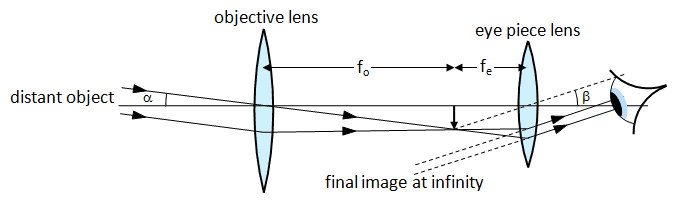
Yes. In fact, I can easily change the magnification of my telescope just by changing out the eyepiece. Note that a telescope, consisting of an objective lens and an eyepiece, is a complex optical system, not a simple one like a magnifier. The object the eyepiece is viewing is actually the image formed by the objective lens. The eyepiece acts as a short focal length magnifier for the image produced by the long focal length objective. Since you typically focus the telescope so that rays entering your eye are nearly parallel you can't just trace the rays back to their point of convergence (since there isn't one for parallel rays).
Jimmy87 said:
Which configuration do telescopes actually use because there seems to be one when the focal length are matched as shown above and ones were they overlap so that the image is more magnified like this one:
That I don't know.
Merlin3189 said:
As a myope I would have to disagree. Unlike people with normal vision, whose eye lens focuses parallel rays to form an image on their retina, my eye lenses focus parallel rays rather short of my retina producing a blurred image. To see objects distant enough for their rays to be near parallel, I wear spectacles (eye glasses) to produce a virtual image about 40cm away from my eye. My eye lens can then focus the light from this to form a sharp real image on my retina. When I use a telescope, microscope or binoculars, I adjust the eyepiece to similarly produce a virtual image at 40cm, as shown in the second diagram. Using my eye lenses to focus diverging rays does not cause me eyestrain any more than a normal person using his eye lenses to focus parallel rays. (*)
Obviously my description above only applies to folks with normal vision and not you and I that are nearsighted.
Merlin3189 said:
I am not aware of the images I view through a telescope being any closer than infinity. The rays that enter my eye require exactly the same focusing as the rays I see from any distant object when wearing spectacles.
But it is interesting that in everyday life, when wearing specs, distant objects do not seem closer. I think this must be due to the fact that eye lens focus is either not a cue to depth perception at all, or is a very minor cue.
Indeed. Humans generally don't gauge distance using focus. An image that is 'focused at infinity' is one that doesn't require you to exert effort to bring the object into focus. For us nearsighted folks this means that the rays entering our eyes aren't actually parallel, but are diverging slightly.
And even though they are concave lenses, I am not aware that objects look smaller, even at the moment of first putting them on. (I think this is the point about angular magnification made by SophieC.)
That's right. Eyeglasses aren't typically strong enough to cause any noticeable magnification change. I think this may have something to do with the eye being well inside the focal length of the lens, but I'm not sure.
Merlin3189 said:
(*) Incidentally, I wonder why using ones eye lenses to focus rays should ever cause eyestrain? Does reading normally cause eyestrain?
As far as I know it does. And the closer the reading material is to your eye, the harder you have to focus and the quicker you'll tire your eye out. Try reading a book that's 2-3 inches from your face for more than a minute or two. You'll feel it.
Merlin3189 said:
Most people do not use spectacles to enable them to read using parallel rays.
Well, if they did, then anything further away than the book would appear blurry since your eye wouldn't be able to bring those rays into focus. Most people expend a small/moderate effort to bring the diverging rays from the book into focus instead of having a set of eyeglasses that they'd have to take off every time they look up. Although, now that I think about it, reading glasses may do this to some extent. I've tried my parents' reading glasses on before. I can't see anything far away at all. It's like looking through a magnifying glass (which is essentially what reading glasses are).
Merlin3189 said:
My guess is that eyestrain - if indeed the condition exists - is more likely caused by looking at unclear images, where the eye is continually refocusing in a vain attempt to clarify the image. If a sharp image can be obtained somewhere between your near point and your far point, then think neither parallel nor divergent rays should cause any problem.
The condition is real. It's called
asthenopia.
More references and information:
http://eyewiki.aao.org/Asthenopia
http://www.eyehealthweb.com/eye-strain/
http://vision.about.com/od/eyediseasesandconditions/g/Asthenopia.htm
http://www.ncbi.nlm.nih.gov/pubmed/14627938
Note that the sustained effort of focusing on nearby objects is only one cause of asthenopia.