SUMMARY
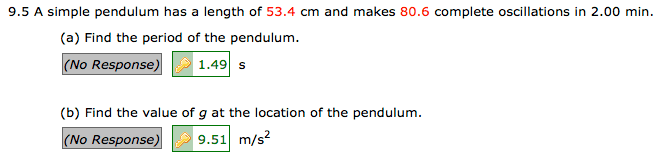
The period of a simple pendulum can be calculated using the formula T = 2π√(L/g), where T is the period, L is the length of the pendulum, and g is the acceleration due to gravity. In the discussion, the user incorrectly calculated the period using L = 53.4 meters and g = 9.8 m/s², resulting in T = 14.6 seconds. The correct interpretation of units and the values used is crucial for accurate calculations. Additionally, the user was advised to consider the number of oscillations made in a given time frame for further analysis.
PREREQUISITES
- Understanding of basic physics concepts related to pendulums
- Familiarity with the formula for the period of a simple pendulum
- Knowledge of units for length (meters) and acceleration due to gravity (m/s²)
- Ability to perform square root calculations and basic algebra
NEXT STEPS
- Research the derivation of the simple pendulum formula T = 2π√(L/g)
- Learn about the effects of air resistance on pendulum motion
- Explore the concept of harmonic motion and its applications
- Investigate how to calculate the period for different pendulum lengths and gravitational forces
USEFUL FOR
Students studying physics, educators teaching mechanics, and anyone interested in understanding pendulum dynamics and oscillatory motion.