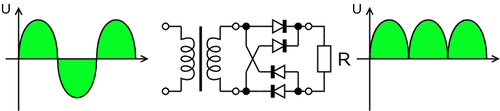
Rectification and fluctuating DC

  • Thread starter Thread starter Mr_Bojingles
  • Start date Start date
  • Tags Tags
    Dc
Click For Summary
SUMMARY

The discussion centers on the rectification of AC to DC using diodes, specifically addressing the characteristics of half-wave and full-wave rectification. It is established that rectification inherently creates a fluctuating DC wave, but methods such as the Fullwave bridge filter circuit can smooth out this ripple using capacitors. The conversation highlights the importance of understanding diode behavior, as they function like one-way valves in electrical circuits, allowing current to flow in one direction. Additionally, it is noted that fluctuating DC can power devices like flashlights without noticeable flicker if the frequency exceeds the flicker fusion frequency of the human eye.

PREREQUISITES
  • Understanding of diode functionality and behavior
  • Knowledge of half-wave and full-wave rectification methods
  • Familiarity with AC and DC current characteristics
  • Basic concepts of electrical circuits and components
NEXT STEPS
  • Research Fullwave bridge filter circuit design and implementation
  • Learn about the effects of ripple in DC circuits and methods to minimize it
  • Study the flicker fusion frequency and its implications for lighting applications
  • Explore advanced rectification techniques using multiple AC phases
USEFUL FOR

Electronics enthusiasts, electrical engineers, and students seeking to deepen their understanding of rectification processes and diode applications in AC and DC circuits.

Mr_Bojingles
Messages
78
Reaction score
0
Does rectification of AC into DC with the use of diodes always create a fluctuating DC wave? Are there methods of rectification which create a steady DC current or do you always have to smooth the current out afterwards?

I'm having a hard time grasping the concept of half-wave and full-wave rectification. Are there any advantages to half-wave rectification or is it only used because it's a simpler method of rectification?

Wikipedia has good diagrams of half-wave and full-wave rectification circuits.
500px-Halfwave.rectifier.en.png

500px-Gratz.rectifier.en.png
 
Last edited:
Engineering news on Phys.org
The key to understanding rectification is to undersand the behavior of a diode. Have you read through this wikipedia page?

http://en.wikipedia.org/wiki/Diode'

Let us know if you have questions about how a diode works, and that will help you understand the rectifiers that you are asking about.
 
Last edited by a moderator:
I've read about most common electronic components on wikipedia but I still don't fully understand diodes and when it comes to transistors I'm completely lost.

The only thing I really understand about diodes is that they are the electronic equivalent of a one way valve in a water pipe system. I have no idea what the purpose of diodes are in a DC current. Before I get into semiconductor diodes and LED's I want to learn the purpose of regular diodes in AC and DC circuits.

I can see why an AC current flowing through a diode would create a half wave rectification. I haven't tried to understand full wave rectification circuits yet. Would a fluctuating DC current perform as well as a steady DC current in a basic circuit like a flash light? I'd imagine a half wave DC current would make the light flicker since the voltage constantly goes on and off but would a full-wave DC current power the light bulb the exact same way a steady non fluctuating current would?
 
Mr_Bojingles said:
IThe only thing I really understand about diodes is that they are the electronic equivalent of a one way valve in a water pipe system. I have no idea what the purpose of diodes are in a DC current.

lessee AC corrent alternates direction. it goes back and forth.

DC current is in only one direction. does not go back and forth.

might a one-way valve be useful in coaxing something that alternates direction into something that flows in only one direction?
 
Mr_Bojingles said:
I've read about most common electronic components on wikipedia but I still don't fully understand diodes and when it comes to transistors I'm completely lost.

The only thing I really understand about diodes is that they are the electronic equivalent of a one way valve in a water pipe system. I have no idea what the purpose of diodes are in a DC current. Before I get into semiconductor diodes and LED's I want to learn the purpose of regular diodes in AC and DC circuits.

The one-way valve is a reasonable analogy. Basically you get no back-current through the diode.

Mr_Bojingles said:
I can see why an AC current flowing through a diode would create a half wave rectification. I haven't tried to understand full wave rectification circuits yet. Would a fluctuating DC current perform as well as a steady DC current in a basic circuit like a flash light? I'd imagine a half wave DC current would make the light flicker since the voltage constantly goes on and off but would a full-wave DC current power the light bulb the exact same way a steady non fluctuating current would?

If the DC current is fluctuation, but never going in reverse, then the diode stays forward biased, and the only effect is that you get about a 0.7V forward drop across it.

You can drive a light with an AC or fluctuating DC current, and as long as the fluctuations are at a frequency above the "flicker fusion frequency" of the human eye (around 70-80Hz, I think for most people), then no flicker will be perceived.
 
Berkeman overlooked that a filament in a flashlight lightbulb is a slowly responding load. It won't flicker using halfwave rectified voltage at 50 or 60Hz, because the supply pulses more rapidly than the filament has time to heat up and cool down. It is also a simple way to make a dimming switch. Using a fullwave supply for bright light and halfwave supply for dimmer light.

To further help you understand rectifier circuits, here are some http://www.allaboutcircuits.com/vol_3/chpt_3/4.html
 
Ouabache said:
Berkeman overlooked that a filament in a flashlight lightbulb is a slowly responding load. It won't flicker using halfwave rectified voltage at 50 or 60Hz, because the supply pulses more rapidly than the filament has time to heat up and cool down. [/url]

Yes, good point. Thanks for pointing that out, Ouabache.
 
There is a circuit configuration called Fullwave bridge filter circuit. A capacitor is used between the output and load. This reduces the ripple and smooths out the current.

You should look into this.
 
pooface said:
There is a circuit configuration called Fullwave bridge filter circuit. A capacitor is used between the output and load. This reduces the ripple and smooths out the current.
Does one have a link.

I found this - http://www.allaboutcircuits.com/vol_3/chpt_3/4.html

I think there will always be some ripple. In addition to pooface's recommendation, there are system using multiple AC phases in which each is separately rectivity, and one can always increase the AC frequency to high frequencies. One does not have to be constrained to 50/60 Hz if the generator is isolated/alone.
 

Similar threads

  • · Replies 8 ·
Replies
8
Views
2K
Replies
9
Views
2K
  • · Replies 7 ·
Replies
7
Views
3K
  • · Replies 10 ·
Replies
10
Views
4K
Replies
6
Views
2K
  • · Replies 39 ·
2
Replies
39
Views
4K
  • · Replies 26 ·
Replies
26
Views
4K
Replies
13
Views
3K
  • · Replies 2 ·
Replies
2
Views
2K
  • · Replies 7 ·
Replies
7
Views
4K