Relation between position vector and velocity vector

Click For Summary
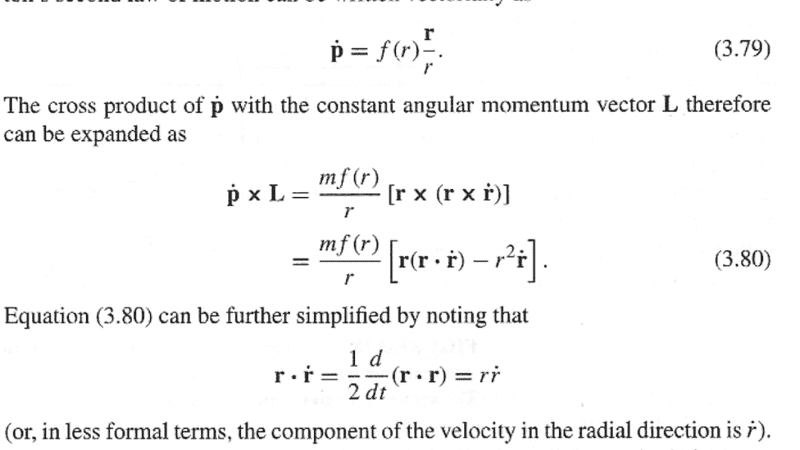
The discussion clarifies that the velocity vector ##\vec{\dot{r}}## is not always parallel to the position vector ##\vec{r}}##, as a particle can move in any direction. It highlights that the equation in question pertains to the acceleration vector for a central force, which aligns with the position vector. The conversation emphasizes the distinction between the radial and angular components of motion, noting that the last equation refers specifically to the radial component of velocity. Additionally, there is a clarification that ##\vec{\dot{r}}## represents the velocity vector, while ##\vec{\ddot{r}}## denotes the acceleration vector. Overall, the key takeaway is understanding the relationship between velocity and acceleration in the context of central forces.
Happiness
Messages
686
Reaction score
30
The equation following (3.80) seems to suggest that the velocity vector ##\vec{\dot{r}}## must always be parallel to the position vector ##\vec{r}##. But clearly this is not true as a particle's velocity can be in any direction.

What's wrong?

image.png
 
Physics news on Phys.org
That looks like the acceleration vector for a central force, which must indeed be in the direction of the position vector (from the central point).

The last equation says "the component of the velocity in the radial direction". There is an angular component as well.
 
PeroK said:
That looks like the acceleration vector for a central force, which must indeed be in the direction of the position vector (from the central point).

The last equation says "the component of the velocity in the radial direction". There is an angular component as well.

##\vec{\dot{r}}##should be the velocity vector. The acceleration vector should be ##\vec{\ddot{r}}##.

I think I get it. ##\dot{r}\neq|\vec{\dot{r}}|##.
 
For simple comparison, I think the same thought process can be followed as a block slides down a hill, - for block down hill, simple starting PE of mgh to final max KE 0.5mv^2 - comparing PE1 to max KE2 would result in finding the work friction did through the process. efficiency is just 100*KE2/PE1. If a mousetrap car travels along a flat surface, a starting PE of 0.5 k th^2 can be measured and maximum velocity of the car can also be measured. If energy efficiency is defined by...

Similar threads

  • · Replies 1 ·
Replies
1
Views
2K
Replies
26
Views
3K
  • · Replies 12 ·
Replies
12
Views
4K
  • · Replies 14 ·
Replies
14
Views
3K
Replies
42
Views
7K
  • · Replies 24 ·
Replies
24
Views
5K
  • · Replies 5 ·
Replies
5
Views
1K
  • · Replies 4 ·
Replies
4
Views
1K
  • · Replies 1 ·
Replies
1
Views
1K
  • · Replies 1 ·
Replies
1
Views
2K