Relationship between the Volume of a balloon and the time it takes to deflate

Click For Summary
SUMMARY

The discussion centers on the relationship between the volume of a balloon and the time it takes to deflate, particularly in the context of balloon hovercraft experiments. The user has plotted a graph showing a seemingly exponential trend between the volume of air pumped into the balloon and the hovercraft's flight time. Recommendations include fitting empirical equations to the data using spreadsheet software, with suggested forms such as linear, quadratic, and power functions. The conversation emphasizes the importance of experimental data over theoretical models and encourages hands-on experimentation.

PREREQUISITES
  • Understanding of basic physics principles related to gas behavior.
  • Familiarity with spreadsheet software for data analysis.
  • Knowledge of curve fitting techniques and error analysis.
  • Basic concepts of balloon mechanics and aerodynamics.
NEXT STEPS
  • Learn how to perform curve fitting in Excel or Google Sheets.
  • Study the ideal gas law and its implications for balloon behavior.
  • Explore advanced modeling techniques for stress-strain behavior in materials.
  • Investigate the effects of pressure on balloon volume and deflation time.
USEFUL FOR

Students conducting physics experiments, educators teaching gas laws and mechanics, and hobbyists interested in hands-on science projects involving balloon dynamics.

Quentin_Phys
Messages
1
Reaction score
2
I would like to ask a question on whether there is a proportionality between volume of a balloon, and the time it takes to deflate.
I have conducted several balloon hovercraft experiments. I need to find the relationship between the amount of air pumped into the balloon and how long the hovercraft hovers. The balloon is tied on a sport bottle cap, with an acrylic disc as its base. The cap is glued onto the disc.
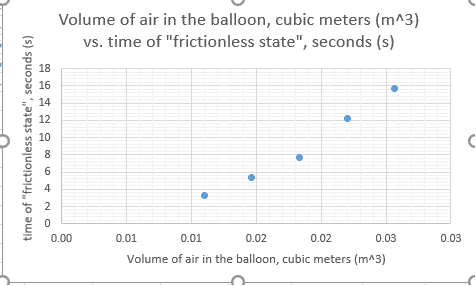
I have plotted such a graph, with volume on the x-axis and time of flight on the other. I have achievement a seemingly exponential trend. I would like to know if there is a formula that can find my proportionality of the relationship between volume and how long the it takes for the balloon to deflate (the hovercraft to float).
Thank you.

Here is a sample of the theoretical data:
242347
 
Last edited:
  • Like
Likes   Reactions: jrmichler and PeroK
Physics news on Phys.org
Quentin_Phys said:
I would like to ask a question on whether there is a proportionality between volume of a balloon, and the time it takes to deflate.
I have conducted several balloon hovercraft experiments. I need to find the relationship between the amount of air pumped into the balloon and how long the hovercraft hovers. The balloon is tied on a sport bottle cap, with an acrylic disc as its base. The cap is glued onto the disc.
I have plotted such a graph, with volume on the x-axis and time of flight on the other. I have achievement a seemingly exponential trend. I would like to know if there is a formula that can find my proportionality of the relationship between volume and how long the it takes for the balloon to deflate (the hovercraft to float).
Thank you.

A theorectical model would be interesting, but your experimental data is the real thing and trumps any hypothetical model!
 
  • Like
Likes   Reactions: russ_watters
You can fit an equation to your data, but keep in mind that the equation will not have a theoretical basis. It will just be an empirical curve fit. Which is perfectly fine for a high school student. If you were a grad student, we would expect more.

Here's how to fit an equation to your data using a spreadsheet. Start with the volume in Column A, and the time in Column B. Then decide the form of the equation. Some possibilities:

1) Linear: y = m*x + b, or time = m * volume + b (a constant)
2) Quadratic: y = C * x^2, where C is a constant and x is volume
3) Power function: y = C * x^n, where C is a constant and n is another constant

Column C will the estimated time from your equation. As an example of how to do Form 1 (linear): (cell C1) =A1 * $F$1 + $F$2, where m is in cell F1 and b is in cell F2. Put some random numbers into cells F1 and F2.

Column D will be the squares of the errors. This is the difference between the measured time and the time from your equation, with that difference squared. For Cell D1: = (B1 - C1)^2.

Under the bottom of Column D, put the sum of the squared errors: This is the sum of squares of your errors. I label this cell as SSErr.

Now create a chart showing your data, and the results of your equation.

Next, start adjusting the numbers in Cells F1 and F2 to make the SSErr as small as possible. Your spreadsheet may have a solver that will do this automagically, but it's good practice to to do manually at least once. When you get the SSErr as small as possible, your equation should be the best possible fit to the data. If the best fit is not good enough, and a linear equation will have obvious deficiencies, then look at a different form of equation. A quadratic equation should better fit the data than a linear equation. It will look better on the plot, and the SSErr will be less. Keep going until your equation fits the data "good enough" or until you run out of ambition.

Try adding a set of points at 0, 0 on the grounds that zero volume equals zero time, and see what effect that has on your results. Experiment, and have fun.

BTW, if you measure balloon pressure vs volume, you will find that it is nonlinear. This makes it very difficult to find a theoretical equation for time vs volume. Don't worry about, you have a good enough project fitting an equation to your data.

And, good job on making your measurements. Your data has very little scatter. One last note: It's experimental data, not theoretical data.
 
was trying to find more topic to play physics with my toddler and love this balloon topic ;)
i know he is a bit young... ;)
can't blame me for having fun and taking care of him.
 
To do this calculation properly (from first principles), you would need to first measure the 2 dimensional stress-strain behavior of a sheet of the balloon material. You could then formulate a model involving the the stresses and strains in the balloon membrane and the ideal gas behavior of the gas inside the balloon.
 
sassyinpink said:
was trying to find more topic to play physics with my toddler and love this balloon topic ;)
i know he is a bit young... ;)
can't blame me for having fun and taking care of him.
There are loads of affordable scientific toys available these days. Water rockets, growing crystals, cartesian divers - the list goes on. Then there are a thousand simple electrical circuits that you can build when he's a bit older.
 

Similar threads

Replies
2
Views
3K
  • · Replies 12 ·
Replies
12
Views
5K
  • · Replies 1 ·
Replies
1
Views
2K
  • · Replies 7 ·
Replies
7
Views
3K
  • · Replies 22 ·
Replies
22
Views
17K
  • · Replies 10 ·
Replies
10
Views
3K
  • · Replies 2 ·
Replies
2
Views
5K
Replies
58
Views
6K
Replies
6
Views
4K
  • · Replies 152 ·
6
Replies
152
Views
11K