Discussion Overview
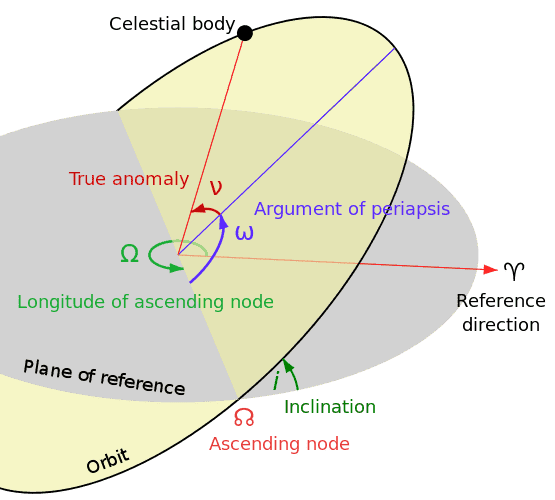
The discussion revolves around the measurement and understanding of Mercury's orbital precession, specifically the observed value of 43 arcseconds per century. Participants explore the implications of this measurement in the context of general relativity and the dynamics of planetary orbits, including the effects of nodal precession and gravitational perturbations from other celestial bodies.
Discussion Character
- Exploratory
- Technical explanation
- Debate/contested
- Mathematical reasoning
Main Points Raised
- Some participants inquire about how the 43 arcseconds per century measurement was obtained and what specific angles or vectors are involved.
- There is a discussion about the nature of Mercury's orbit, with some asserting that it is a precessing ellipse while others question the implications of its inclination.
- One participant suggests that the 43 arcseconds per century anomaly might be a geometric effect related to nodal precession.
- Another participant emphasizes that the precession of Mercury's perihelion occurs entirely within its orbital plane, independent of the orientation of that plane relative to others.
- Some participants express confusion about the measurements that lead to the 43 arcseconds discrepancy, seeking clarification on what values were subtracted to arrive at this figure.
- There is a mention of the gravitational influences of other planets and the Sun's oblateness as factors in the overall precession measurement.
- Several participants discuss the concept of nodal precession and its relevance to the overall understanding of orbital dynamics.
Areas of Agreement / Disagreement
Participants express differing views on the nature of Mercury's precession, particularly regarding the role of nodal precession and the interpretation of the 43 arcseconds per century measurement. There is no consensus on the specifics of how this measurement is derived or the implications of the various precession types.
Contextual Notes
Participants note the complexity of measuring orbital precession and the potential for confusion regarding the definitions and relationships between different angles and vectors involved in the measurements. The discussion highlights the need for clarity on the assumptions and definitions used in the context of orbital dynamics.