When you apply voltage to a motor, you get a current. That current starts at zero, and increases with time until it reaches a value. The rate of increase and the peak value depend on voltage, resistance, inductance, BEMF, and time.
At any instant in time, the motor has a torque that is proportional to the current (not the voltage). The motor, along with any external load, has friction, windage, and inertia. At any instant in time, if the torque is greater than the friction plus windage, the motor accelerates. The rate of acceleration is calculated from net torque and inertia. Velocity is acceleration times time, and position is velocity times time.
I have mentioned a number of terms - motor, resistance, inductance, BEMF, windage, torque, inertia, friction, acceleration, etc. It would be necessary to write book to fully explain these terms. But fortunately, they are easily searched, and lead to good explanations. I know this because I checked.
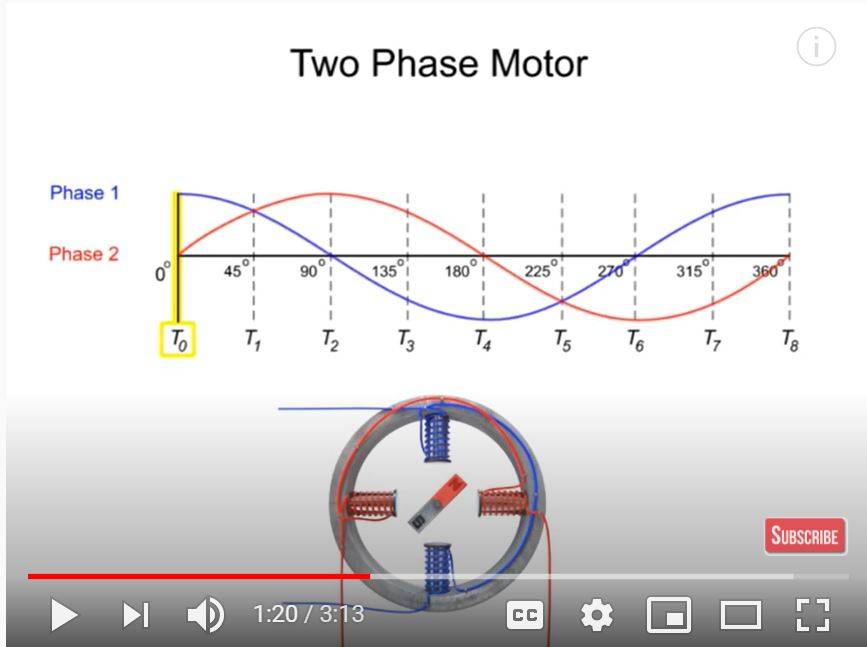
So, yes, a voltage applied for a tiny fraction of a second make the motor turn, or at least try to turn. If or how much it turns is calculated as above. All of this is for DC motors. AC induction motors, as in your YouTube video, are more complicated. And the simplified motor shown in Post #10 is simplified so much that torque varies with both current and rotor position. It probably has at least one position where it will not self start at all.