Reynolds Transport Theorem Derivation Sign Enquiry

Join the discussion
Registration is free. Start your own thread to ask a follow-up.
7 replies · 4K views
williamcarter
Messages
153
Reaction score
4
Hi,

Our lecturer explained us the Reynold Transport theorem, its derivation , but I don't get where the - sign in control surface 1 comes from? He said that the Area goes in opposite direction compared with this system.
I can't visualise this on our picture.

Can you please help me understand why we have the negative sign on the control surface 1 and at the end of the theorem we have +ve everywhere?
The pictures are attached below
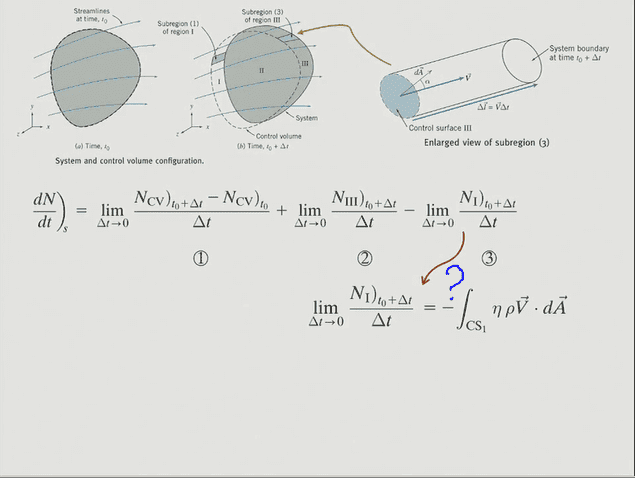
Capture.PNG

Fig1-Illustrates the - sign enquiry with regards to control surface 1. Why is it - here? and not +
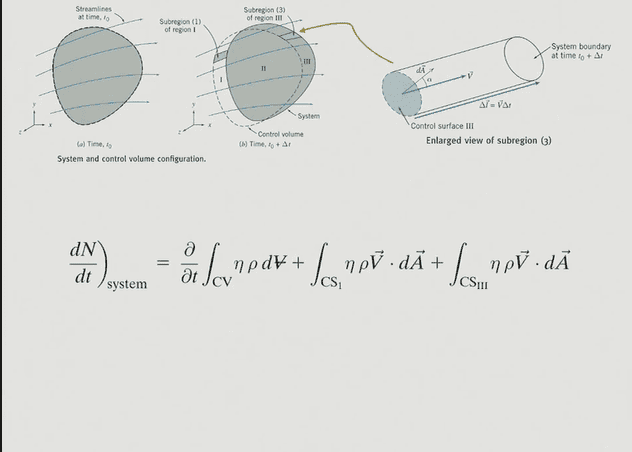
Capture2.PNG

Fig2-Illustrates the final form of the Reynolds Transport theorem where all signs are +, why?How to know when the Area is in same direction as the system velocity ? and how to know when the Area goes opposite direction with regards to the system velocity?

Thank you in advance.
 
Last edited:
Engineering news on Phys.org
##\vec{dA}## is defined as the scalar dA multiplied by an outwardly directed unit vector from the control volume.
 
  • Like
Likes   Reactions: williamcarter
Chestermiller said:
##\vec{dA}## is defined as the scalar dA multiplied by an outwardly directed unit vector from the control volume.
Alright, thank you but why in control surface 1 is -ve and in control surface 3 is + ve? How can we sense that?

How to know when is in same direction as the system velocity and when is opposite?

Thanks
 
Last edited:
williamcarter said:
Alright, thank you but why in control surface 1 is -ve and in control surface 3 is + ve? How can we sense that?

How to know when is in same direction as the system velocity and when is opposite?

Thanks
The dot product of the outwardly directed unit vector with the velocity vector is either positive or negative. If flow is entering, then it comes out negative; if flow is leaving, then it comes out positive.
 
  • Like
Likes   Reactions: williamcarter
Chestermiller said:
The dot product of the outwardly directed unit vector with the velocity vector is either positive or negative. If flow is entering, then it comes out negative; if flow is leaving, then it comes out positive.
Thank you, how come it ends up as positive(control surface1) in figure/picture 2? Because initially control surface 1 was negative but in picture 2 in final form of Reynold Transport Theorem ends up as +ve
 
williamcarter said:
Thank you, how come it ends up as positive(control surface1) in figure/picture 2? Because initially control surface 1 was negative but in picture 2 in final form of Reynold Transport Theorem ends up as +ve
I don't understand the figures too well. Just remember what I said, and you will be OK.
 
Chestermiller said:
The dot product of the outwardly directed unit vector with the velocity vector is either positive or negative. If flow is entering, then it comes out negative; if flow is leaving, then it comes out positive.
Alright, but why? In both cases the outwardly directed unit vector with the velocity vector are parallel. What makes it positive or negative?
 
williamcarter said:
Alright, but why? In both cases the outwardly directed unit vector with the velocity vector are parallel. What makes it positive or negative?
in a region where fluid flow is entering the control volume, the unit outwardly directed normal dotted with the (inwardly directed) velocity vector is negative.