Kinematics of a Pendulum with Two Different Masses

  • Thread starter Thread starter Kokobird321
  • Start date Start date
  • Tags Tags
    Rod
Click For Summary
SUMMARY

The discussion focuses on the kinematics of a pendulum involving two different masses, utilizing the Lagrangian formulation to derive equations of motion. The user employs a rotational matrix to analyze the pendulum's behavior at a 30-degree angle and considers the conservation of mechanical energy as a method for solving the problem. Key equations derived include the Lagrangian, kinetic and potential energy expressions, and the application of the Euler-Lagrange equation to establish the motion dynamics of the system.

PREREQUISITES
  • Understanding of Lagrangian mechanics and the Euler-Lagrange equation
  • Familiarity with rotational matrices and vector transformations
  • Knowledge of kinetic and potential energy concepts in classical mechanics
  • Ability to perform calculus operations, particularly derivatives and integrals
NEXT STEPS
  • Explore advanced topics in Lagrangian mechanics, particularly generalized coordinates
  • Learn about energy conservation principles in mechanical systems
  • Study the application of rotational matrices in physics problems
  • Investigate numerical methods for solving differential equations in dynamic systems
USEFUL FOR

Physics students, mechanical engineers, and anyone interested in advanced dynamics and kinematics of multi-mass systems.

Kokobird321
Messages
3
Reaction score
0
Summary:: Classical problem about a pendulum!

The problem itself:
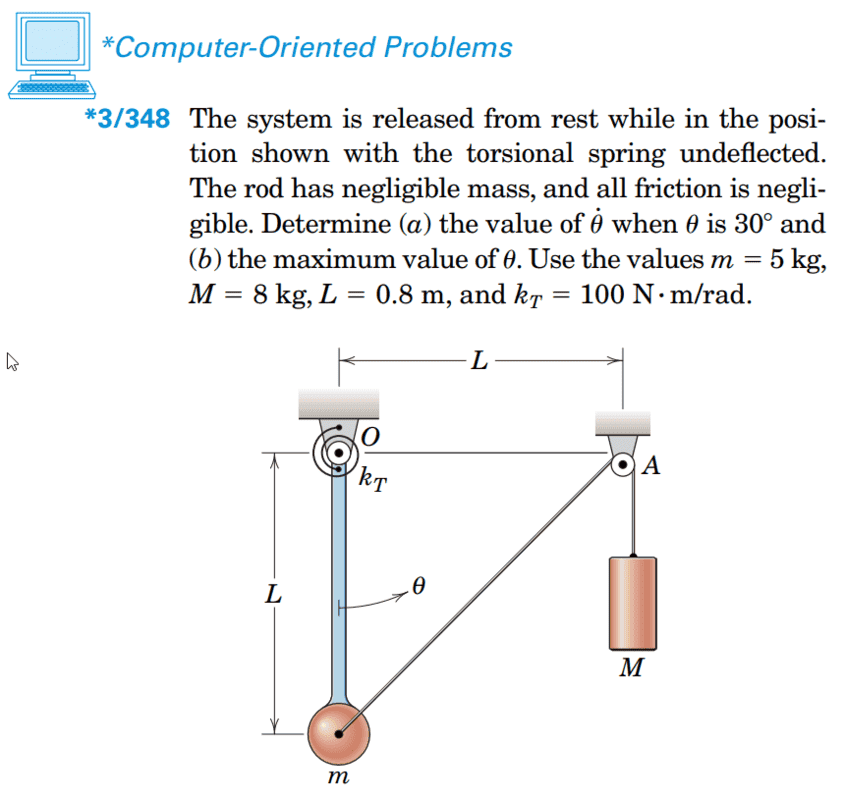
1600115362092.png


My FBD:
1600115379023.png

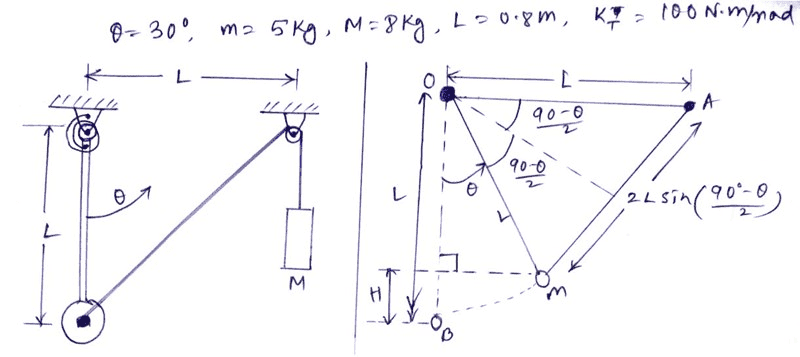
I want to solve the problem with vectors, I think that you can use energy principle somehow. If we define the vector ##\vec{O}_B=\begin{bmatrix}0\\ -1\end{bmatrix}## and define a rotational matrix where

$$R=\begin{bmatrix}cos\varphi & -\sin\varphi\\ \sin\varphi & \cos\varphi\end{bmatrix}$$

just to rotate the vector ##O_B## 30 degrees counterclockwise, but I will need to know its velocity ##\dot{\theta}## when ##\theta=30^{\circ}## somehow. Not sure how to proceed though.
 
Last edited:
Physics news on Phys.org
I think mechanical energy conservation is the way to go. Start with total mechanical energy equal to zero and then sort out the various kinetic and potential energies when the angle is 30o.
 
It becomes very trivial, I wanted a different approach :smile:
 
Kokobird321 said:
It becomes very trivial, I wanted a different approach :smile:
Lagrangian formulation? I am not sure whether the equations of motion are solvable analytically.
 
Sure why not! For the lagrangian I get

$$\mathcal{L}=T-V=\frac{1}{2}m(L\dot{\theta})^2+\frac{1}{2}M(L\dot{\theta})^2+\frac{1}{2}k_T\theta^2-(Mgh-mgH)$$

so

$$\mathcal{L}=T-V=\frac{1}{2}m(L\dot{\theta})^2+\frac{1}{2}M(L\dot{\theta})^2+\frac{1}{2}k_T\theta^2-Mg\left[\sqrt{2}L-2Lsin\left(\frac{90-\theta}{2}\right)\right]+mg\left[L-L\cos\theta\right]$$

$$\frac{\partial\mathcal{L}}{\partial\theta}=k_T\theta-MgL\frac{1}{2}\cos\left(45-\frac{\theta}{2}\right)+mgL\sin\theta$$

and

$$\frac{\partial\mathcal{L}}{\partial \dot{\theta}}=mL^2\dot{\theta}+ML^2\dot{\theta}\Longrightarrow\frac{d}{dt}\left(\frac{\partial\mathcal{L}}{\partial\dot{\theta}}\right)=mL^2\ddot{\theta}+ML^2\ddot{\theta}=\ddot{\theta}(mL^2+ML^2).$$

Euler-Lagrange gives

$$\frac{d}{dt}\left(\frac{\partial\mathcal{L}}{\partial\dot{\theta}}\right)=\frac{\partial\mathcal{L}}{\partial\theta}\iff \ddot{\theta}(mL^2+ML^2)=k_T\theta-MgL\frac{1}{2}\cos\left(45-\frac{\theta}{2}\right)+mgL\sin\theta$$

$$\ddot{\theta}=\frac{1}{mL^2+ML^2}\left[k_T\theta-MgL\frac{1}{2}\cos\left(45-\frac{\theta}{2}\right)+mgL\sin\theta\right]$$

How do I proceed from here? :smile:
 
Last edited:
What are your generalized coordinates? What are the constraints?

The term ##\dfrac{1}{2}ML^2\dot \theta^2## doesn't look right to me for the kinetic energy of the vertically hanging mass.
 

Similar threads

Replies
2
Views
2K
  • · Replies 1 ·
Replies
1
Views
4K
  • · Replies 12 ·
Replies
12
Views
2K
  • · Replies 2 ·
Replies
2
Views
2K
  • · Replies 6 ·
Replies
6
Views
3K
  • · Replies 1 ·
Replies
1
Views
2K
  • · Replies 31 ·
2
Replies
31
Views
2K
Replies
1
Views
2K
  • · Replies 1 ·
Replies
1
Views
2K
  • · Replies 3 ·
Replies
3
Views
1K