Rolling without slipping taking the contact point as pivot

Click For Summary
SUMMARY

This discussion focuses on the dynamics of a disk experiencing both slipping and rolling motion, specifically analyzing the effects of kinetic friction on angular velocity and acceleration. When the pivot point is the center of mass, the equations indicate a non-zero angular acceleration, while using the ground contact point as the pivot results in zero torque and thus zero angular acceleration. The confusion arises from the assumption that angular velocity remains constant across different pivot points, which is incorrect in cases of slipping. The key takeaway is that when slipping occurs, the equations governing motion must account for the absence of rolling motion.

PREREQUISITES
  • Understanding of Newton's laws of motion
  • Familiarity with rotational dynamics and torque
  • Knowledge of the parallel axis theorem
  • Concept of kinetic friction and its effects on motion
NEXT STEPS
  • Study the implications of the parallel axis theorem in rotational dynamics
  • Learn about the conditions for rolling without slipping in rigid body dynamics
  • Explore the role of kinetic friction in both slipping and rolling scenarios
  • Investigate the effects of different pivot points on angular motion
USEFUL FOR

Physics students, mechanical engineers, and anyone studying dynamics of rigid bodies, particularly those interested in the complexities of rolling and slipping motion.

Soren4
Messages
127
Reaction score
2
I'm confused about this rolling without (or better with) slipping situation. Suppose to have a disk with initial velocity ##v## and angular velocity ##\omega##. The motion is to the right but the angular velocity is counterclockwise.
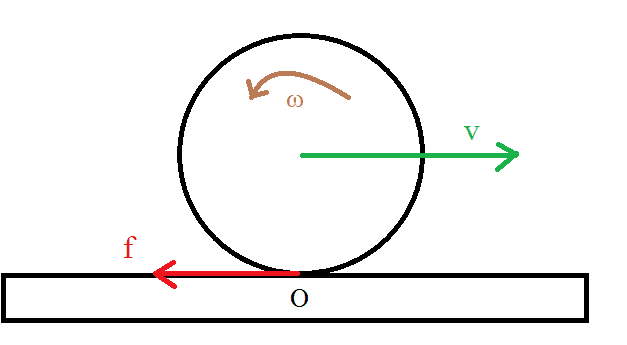
55555555555555555555555555555555555.png

There are no forces acting on the disk besides the kinetic friction##\mathbf{f}##.

Things are ok if I take as pivot point the center of mass.
$$\{\begin{matrix} - \mathbf{f} = m\mathbf{a_{CM}}\\ - \mathbf{r} \times \mathbf{f} =I_{cm} \mathbf{\alpha} \end{matrix}\tag{1}$$

But if I take the point ##O## on the ground, then the kinetic friction has zero torque.

$$\{\begin{matrix} - \mathbf{f} = m\mathbf{a_{CM}}\\ 0 =I_{O} \mathbf{\alpha} \end{matrix}\tag{2}$$

I assumed that the angular velocity (and so $\alpha$) is the same it I take as pivot the center of mass or the point##O##.

If this is the case than parallel axis theorem can be used and $$I_O=I_{cm}+m \mathbf{r}^2$$But there is a contradiction since I get ##\alpha=0## from ##(2)## and ##\alpha\neq0## from##(1)##.

How can that be? Maybe##\alpha## is not the same in the two cases?
 
Last edited:
Physics news on Phys.org
Soren4 said:
I'm confused about this rolling without slipping situation. Suppose to have a disk with initial velocity vvv and angular velocity ωω\omega. The motion is to the right but the angular velocity is counterclockwise.

i fail to see a counter clockwise angular velocity when the disk is moving to the right side.
 
  • Like
Likes   Reactions: Soren4
drvrm said:
i fail to see a counter clockwise angular velocity when the disk is moving to the right side.
I'm sorry the disk is actually slipping, I called this rolling without slippping problem, because usually in these problems you have to find the conditions for rolling without slipping indeed.

Just ignore it, the disk is slipping, of course
 
Soren4 said:
I'm sorry the disk is actually slipping, I called this rolling without slippping problem, because usually in these problems you have to find the conditions for rolling without slipping indeed.

Just ignore it, the disk is slipping, of course

if the disk is slipping only ,then there is no rolling motion;

then the equations for the motion of center of mass only and
the frictional force will be slowly decelerating the motion - no rotation of the disk.

if you consider both rolling and slipping combined then only the torque due to friction will operate about an axis passing through center of mass,
 
If the disk is sliding, O is not a pivot point, and could not be used as a basis for parallel axis method. The bottom point on the disk would be a pivot point, but it's sliding and decelerating.

You could consider the contact point of the sliding disk as a pivot point, but it's an accelerating (decelerating) frame of reference, so there would be a fictitious force effectively applied to the center of mass of the disk, related to the acceleration (deceleration) of the disk.
 
Last edited:

Similar threads

  • · Replies 4 ·
Replies
4
Views
2K
  • · Replies 7 ·
Replies
7
Views
5K
  • · Replies 41 ·
2
Replies
41
Views
6K
  • · Replies 1 ·
Replies
1
Views
2K
  • · Replies 4 ·
Replies
4
Views
3K
  • · Replies 4 ·
Replies
4
Views
2K
  • · Replies 11 ·
Replies
11
Views
4K
Replies
4
Views
3K
  • · Replies 37 ·
2
Replies
37
Views
4K
  • · Replies 42 ·
2
Replies
42
Views
3K