Rotating ring on a rough surface- but with a twist

Join the discussion
Registration is free. Ask a follow-up in this thread, or start your own.
151 replies · 7K views
palaphys said:
friction does not oppose relative motion?
Static friction is a fickle mistress. Here its opposing that an atom on the wheel is not passing through an atom on the road.
 
Physics news on Phys.org
erobz said:
Static friction is a fickle mistress. Here its opposing that an atom on the wheel is not passing through an atom on the road.
Ok but how do u find the frictional force here. I thought about it for a while and now I accept that friction is towards the right. Pls tell me how to find it.I will try 5ma_cm,x =f_s
 
palaphys said:
Ok but how do u find the frictional force here. I thought about it for a while and now I accept that friction is towards the right. Pls tell me how to find it.I will try 5ma_cm,x =f_s
Its 12 am here (I'm probably already going to have trouble relaxing now). I'm signing off. You'll get there, it takes time.
 
palaphys said:
How is the CM accelerating to the right? You said it was a cycloid path right? Also check the screenshot I posted.how can I conclude that it is horizontal?
The acceleration of the CM has both horizontal and vertical components. The vertical component of the acceleration is provided by the vertical component of the net force. The horizontal component is provided by the horizontal component of the net force. If the CM has zero horizontal component it will have to fly off the surface or sink into it. Is that what's happening here?

As for the diagram that you drew, you assume that the CM is rotating about the center of the ring. No, no, no. We have already established that it rotates about the point of contact O and calculated the torque and moment of inertia about that point. When you write the tangential acceleration ##a_T=\alpha r##, what does ##r## represent?
 
Last edited:
Reply
  • Like
Likes   Reactions: Lnewqban
kuruman said:
The acceleration of the CM has both horizontal and vertical components. The vertical component of the acceleration is provided by the vertical component of the net force. The horizontal component is provided by the horizontal component of the net force. If the CM has zero horizontal component it will have to fly off the surface or sink into it. Is that what's happening here?

As for the diagram that you drew, you assume that the CM is rotating about the center of the ring. No, no, no. We have already established that it rotates about the point of contact O and calculate the torque and moment of inertia about that point. When you write the tangential acceleration ##a_T=\alpha r##, what does ##r## represent?
r represents R/5, and I was taught that in a rigid body in rotation every point goes in a circular motion relative to some other point.
 
kuruman said:
You need to find the horizontal component of the linear acceleration of the CM.
How do I find that, seem to be blank on that
 
kuruman said:
You taught correctly. What do you think this "other" point is here?
Thank God. Why can't I take other point as geometric center of the ring?
 
kuruman said:
You taught correctly. What do you think this "other" point is here?
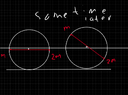
This is how my mind is visualising the motion. According to this diagram the center of mass is indeed in circular motion with respect to the center
 

Attachments

  • Screenshot_20250218-103037.png
    Screenshot_20250218-103037.png
    16.9 KB · Views: 79
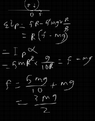
Here is my attempt for finding the frictional force. I have assumed that the center of mass is in circular motion with respect to the geometric center of the ring.
 

Attachments

  • Screenshot_20250218-104740.png
    Screenshot_20250218-104740.png
    19.2 KB · Views: 82
palaphys said:
Thank God. Why can't I take other point as geometric center of the ring?
Read the second paragraph in post #94. The center of the ring is NOT the &*%@# axis of rotation !!!!
palaphys said:
I have assumed that the center of mass is in circular motion with respect to the geometric center of the ring.
Bad assumption.

The figure below shows the trajectory of a point on the ring (blue line), the trajectory of the CM (red line) and the trajectory of the center of the ring (dashed black line) assuming that the ring is rolling at constant velocity. This is not the case here because the ring will oscillate back and forth after it is released.

Cycloid.jpg

I am signing off too.
 
Reply
  • Like
Likes   Reactions: SammyS
I know that the center of mass is not rotating about the center, I just said it was in circular motion with respect to it.
kuruman said:
Read the second paragraph in post #94. The center of the ring is NOT the &*%@# axis of rotation !!!!

Bad assumption.

The figure below shows the trajectory of a point on the ring (blue line), the trajectory of the CM (red line) and the trajectory of the center of the ring (dashed black line) assuming that the ring is rolling at constant velocity. This is not the case here because the ring will oscillate back and forth after it is released.

View attachment 357469
I am signing off too.
 
palaphys said:
I know that the center of mass is not rotating about the center, I just said it was in circular motion with respect to it.
Are you implying that my working is wrong once again? I completed the problem and am getting answers angular acceleration as g/10R ,frictional force as mg/2 and normal reaction as 49mg/10
 
Last edited:
Also @kuruman I have confirmed with my teacher, who says that from the frame of the center of the ring, initially the center of mass would appear to trace a circular path, so it has an angular acceleration alpha (r/5) at that instant
 
erobz said:
You are confusing kinetic friction with static friction. Kinetic friction is molecules sliding past each other, breaking structure permanently - converting mechanical energy to internal energy, and static friction is armwrestling with a wall...you might be warping it a bit, but it's springing back. Thats as far as I can see in plain terms.
@palaphys wrote that friction in general opposes a tendency to relative motion. Presumably that means the relative motion of the surfaces in contact, which is correct.
 
palaphys said:
Here is my attempt for finding the frictional force. I have assumed that the center of mass is in circular motion with respect to the geometric center of the ring.
Please don’t post working as images. It is contrary to forum rules for good reasons. Your writing is not completely clear, and it makes it hard for responders to refer to specific equations. If you must post working as images write very clearly and number the equations.
Also, you do not explain where your equations come from.

In your attachment to post #79, you seem to have an equation which has forces equal to ##\alpha R/5##. Is there an m missing?
In the attachment to post #101, what is ##\Sigma lp##? Or is it ##\Sigma \tau p##? Or ##\Sigma \tau_p##?

Wrt the answers, I do get something different.
 
haruspex said:
Please don’t post working as images. It is contrary to forum rules for good reasons. Your writing is not completely clear, and it makes it hard for responders to refer to specific equations. If you must post working as images write very clearly and number the equations.
Also, you do not explain where your equations come from.

In your attachment to post #79, you seem to have an equation which has forces equal to ##\alpha R/5##. Is there an m missing?
In the attachment to post #101, what is ##\Sigma lp##? Or is it ##\Sigma \tau p##? Or ##\Sigma \tau_p##?

Wrt the answers, I do get something different.
Yes indeed m is missing.
It is tau_p
 
Please
haruspex said:
Which means? It's hard to guess what your equations mean if you don’t define the variables.
Please ignore my poor handwriting. What I did was just taking the torques about the center due to friction and due to the weight from com and equated them to Ialpha
 
palaphys said:
... I humbly request someone to aid me in this problem and explain the mechanics here, thanks in advance. I'm only used to seeing rings roll where com coincides with geometric center.
Returning to your original post:
Have you had the same difficulty with the type of problems in which “rings roll where com coincides with geometric center”?
If not, have you have confusion regarding the direction and magnitude of the vector representing static friction between the ring and the surface?
 
palaphys said:
I don't understand this part please make it simple
Sorry, I will try.

Lnewqban said:
All points of the ring instantaneously rotate about the instantaneous ring-surface point of contact,
E7CDC747-7ECC-49E7-8929-4690F79E8CE1.jpeg

Lnewqban said:
which is constantly disappearing while another contact point, located just a little further, is constantly assuming the function of a new instantaneous pivot, around which all the points of the ring rotate again, and so on.
The center of the ring is forced to always keep the same r distance from the surface; therefore, it moves only parallel to it.
The many points of the periphery of the ring that sucesively work as a pivot are also forced to move along the surface.
Lnewqban said:
The succession of those points of contact moves horizontally at the same velocity of the geometrical center of the rolling ring, keeping always apart from each other the same vertical distance, which equals the radius of the ring.
Both instantaneous points, center of ring and pivot, have the same direction of movement, as well as same horizontal velocity and tangential acceleration.
 
Last edited:
haruspex said:
@palaphys wrote that friction in general opposes a tendency to relative motion. Presumably that means the relative motion of the surfaces in contact, which is correct.
I feel static friction is the interlocking of surfaces on a microscopic level in very non-obvious ways. Kinetic friction the rapid destruction of that interlock via shearing/deformation of the surfaces.

Maybe the definition covers it, but to me static and kinetic friction feel fundamentally different from each other and aren’t served well conceptually by a single definition. Just my opinion.

Friction is just the name we give for these complicated realities. Perhaps, it isn’t being covered adequately on a fundamental level because these definitions are attempting to be overly efficient. There needs some differentiation. They need to spend some more time on the topic in intro physics; Revisit the concepts as the problems evolve. This hang up is nothing new... I know firsthand.
 
Last edited:
palaphys said:
Also @kuruman I have confirmed with my teacher, who says that from the frame of the center of the ring, initially the center of mass would appear to trace a circular path, so it has an angular acceleration alpha (r/5) at that instant
Hang on to that thought because it is correct but is it useful? How is it going to help you find the linear acceleration relative to the ground and use it to find the force of static friction? Note that, relative to the center of the ring, the CM has tangential acceleration that points vertically straight down. That is useful for finding the vertical normal force, but not the force of friction that is horizontal.
 
Reply
  • Like
Likes   Reactions: erobz
kuruman said:
Hang on to that thought because it is correct but is it useful? How is it going to help you find the linear acceleration relative to the ground and use it to find the force of static friction? Note that, relative to the center of the ring, the CM has tangential acceleration that points vertically straight down. That is useful for finding the vertical normal force, but not the force of friction that is horizontal.
For force of friction I just took the torque about the center of the ring that's it

Also I SUDDENLY got another doubt...doesn't the bottom most point (here ICR) have an upward acceleration? Then why are we not considering the pseudo torque due to that..
 
I'm so close to finishing this, just gotta clarify that major thing whether the IAR is an inertial frame
 
I'm beginning to think that this problem is solvable only if the angular velocity just after rolling begins is small, otherwise this def isn't solvable.
 
kuruman said:
A torque is not a force and vice-versa.
I never said that I just said I used the center to find the frictional force, sorry for being unclear andsorry for annoying you for such a long time i promise if you answer my final question I posted above I will not ask anything else
 
palaphys said:
I never said that I just said I used the center to find the frictional force, sorry for being unclear andsorry for annoying you for such a long time i promise if you answer my final question I posted above I will not ask anything else
What question is this and in what post? Is it this
palaphys said:
I'm so close to finishing this, just gotta clarify that major thing whether the IAR is an inertial frame
If so, you need to clarify to me what the IAR frame is.

You are not annoying me.